Beijing, March 10,2026: As artificial intelligence (AI) rapidly moves from laboratories to solve problems in factories, hospitals and supply chains, Chinese policymakers have set their sights high, anticipating the rise of a “smart economy.”
At this year’s “two sessions” of China’s top legislature and top political advisory body, the government work report, submitted to the national legislature for deliberation last week, for the first time called for creating new forms of “smart economy.”
Analysts observe that China is conveying a broader message: AI is no longer merely a tool for improving efficiency, but has become a driver ushering in a new stage of economic development.
This wording in the key document marks a progression in policy thinking. In 2024, the government work report first introduced the “AI Plus” initiative, while the 2025 report advocated for its continued advancement. This year, it has moved further, framing AI as an engine of a broader economic transformation.
Zhou Li’an, a member of the 14th National Committee of the Chinese People’s Political Consultative Conference and a professor at Peking University’s Guanghua School of Management, said the phrase “smart economy” reflects a profound shift in how AI is positioned in policy thinking.
“The idea of a smart economy suggests that AI itself is increasingly becoming a foundational element of the economic system, shaping how resources are allocated, industries organized, and services delivered,” he noted.
In practical terms, this year’s report outlines how this transition might unfold. It calls for faster application of new-generation intelligent terminals and AI agents, large-scale commercial application of AI in key sectors and fields, and the cultivation of new forms and models of AI-native business.
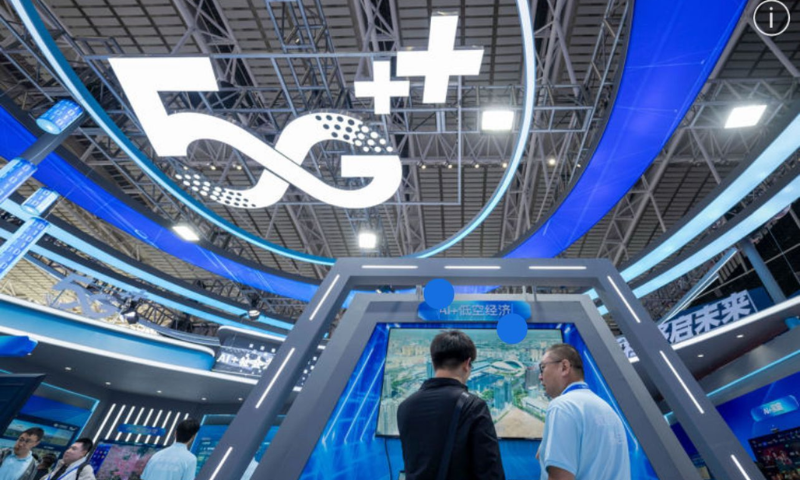
It also emphasizes strengthening open-source AI ecosystems, expanding public cloud services, improving national coordination of computing power, and building hyper-scale intelligent computing clusters. New infrastructure like satellite internet and upgraded 5G Plus Industrial Internet Initiative is also highlighted.
Taken together, these measures suggest that China’s AI strategy is entering a more comprehensive phase. Rather than focusing mainly on technological breakthroughs, policymakers are now underscoring the integration of AI with the real economy — from manufacturing and agriculture to public services and consumer markets.
This broader orientation is reinforced in the draft outline of the 15th Five-Year Plan (2026-2030), which calls for advances in areas such as multimodal systems, AI agents, embodied AI and swarm intelligence.
Behind these policies lies a clear economic logic. The “smart economy” can be seen as the next stage in the evolution of the digital economy. While digitalization centers on building networks, platforms and data flows, AI introduces systems capable of perception, decision-making and autonomous action.
To put it simply, if digital infrastructure is the “nervous system” of the modern economy, AI is its “brain.”
Turning AI into industrial value
This distinction also explains the emphasis on scale. Both the government work report and the draft outline of the five-year plan stress commercialization and large-scale deployment, signaling that AI is expected to move faster into the mainstream of economic activity.
China’s abundant data resources, comprehensive industrial system and vast application scenarios provide favorable conditions for the development of a “smart economy.”
Another defining feature of China’s strategy is the emphasis on intelligent terminals and AI agents. In recent years, much of the global AI discussion has focused on large models. China’s policy framework, however, places equal weight on the devices and systems through which AI is deployed in real-world applications.
For businesses, the true opportunity lies in vertical applications, especially in manufacturing.
Qian Gang, board chairman of CITIC Pacific Special Steel Group and a national political advisor, said the company has developed more than 100 AI vertical models to support intelligent manufacturing, helping turn one of its plants into the first “lighthouse factory” in the global special-steel industry. A “lighthouse factory” is a world-leading, future-oriented manufacturing site that exemplifies the use of cutting-edge technology for transformative business and societal benefits.
Similar experiments are unfolding across industries in China, the world’s second-largest economy. Experts say the country’s advantage lies in combining vast manufacturing capacity with expanding AI capabilities, turning technological advances into large-scale industrial value.
“AI is now transitioning from a decision-supporting ‘copilot’ to an autonomous, outcome-delivering ‘agent,’ as the industry moves from a period of explosive technological growth into one of value realization,” said Jia Shaoqian, chairman of Hisense Group and a deputy to the 14th National People’s Congress.
infrastructure for AI expansion
Infrastructure will play a decisive role in determining how quickly these applications spread. Training and operating advanced AI systems requires enormous computing resources and reliable energy supply. For that reason, the government work report emphasizes building hyper-scale intelligent computing clusters and improving coordination between computing power and electricity systems.
This approach reflects China’s efforts to better coordinate its digital and energy resources. While computing demand is growing rapidly in major economic centers, many inland regions possess abundant renewable energy. Aligning computing infrastructure with these energy resources can help reduce costs, improve efficiency, and support the sustainable expansion of the AI industry.
The report also highlights the development of satellite internet and the upgrading of industrial digital networks.
Ma Kui, a national lawmaker and general manager of China Mobile’s Sichuan provincial branch, said the country’s vast southwest could play an increasingly important role in its computing infrastructure expansion.
With abundant energy resources and growing demand, he noted, regions such as Sichuan and the neighboring Chongqing Municipality are well positioned to develop intelligent computing industries under China’s “East Data, West Computing” strategy.
“But to unlock the region’s full potential, it is imperative to expand large-scale applications and strengthen links with the real economy,” Ma said.
Governance and global cooperation
As China advances the development of a “smart economy,” policymakers are also placing greater emphasis on strengthening AI governance, a focus which is mentioned in both the government work report and the draft outline of the five-year plan.
With AI systems increasingly capable of handling complex tasks and supporting automated decision-making, the need to strengthen governance frameworks in areas such as data security, privacy protection and algorithm oversight is becoming more evident.
The report calls for improving AI governance, while the five-year plan highlights efforts to strengthen international dialogue and cooperation on AI, as well as accelerate the building of an open-source technology ecosystem and community with global reach. It also underscores expanding international cooperation in the digital and intelligent sectors, including deeper collaboration in e-commerce, mobile payments and smart-city development.
China’s core AI industry was valued at more than 1.2 trillion yuan (about 174 billion U.S. dollars) in 2025, and featured over 6,200 AI companies, Minister of Industry and Information Technology Li Lecheng said on the sidelines of the national legislative session. He stressed that AI should ultimately “serve people, benefit people and remain under human control,” and function as a shared global public good.
National legislator and tech expert Zhou Di said challenges such as AI technological barriers, cross-border data flows and ethical governance require greater international cooperation, so that the benefits of technological progress can reach more countries and help address challenges facing humanity as a whole.
Courtesy Xinhua