Islamabad, March 23, 2026: Pakistan Day was observed across the country on Monday with traditional zeal and patriotic fervour, though ceremonies remained simple in line with austerity measures announced by the government amid the ongoing global oil crisis.
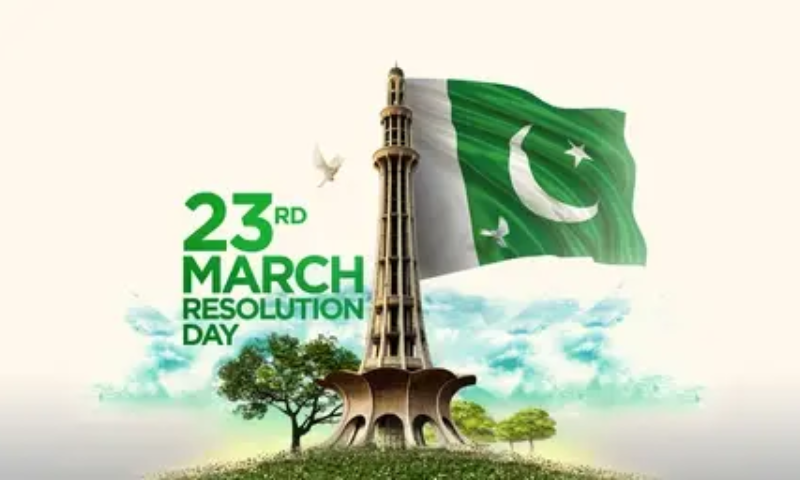
Observed annually on March 23, Pakistan Day commemorates the historic Lahore Resolution, passed in 1940 by the All-India Muslim League, which called for a separate homeland for Muslims of the subcontinent.
The federal government had recently introduced austerity measures to manage the economic impact of the ongoing US-Israel war on Iran, which has triggered a global oil crisis affecting several countries, including Pakistan.
The day began with gun salutes in the federal and provincial capitals, followed by flag-hoisting ceremonies held nationwide. In Lahore, a dignified change of guards ceremony took place at the mausoleum of Allama Iqbal, where a contingent of the Pakistan Air Force assumed ceremonial duties.
President Asif Ali Zardari and Prime Minister Shehbaz Sharif, in their separate messages, extended warm greetings to the nation.
President Zardari described Pakistan Day as a reminder of the importance of unity and solidarity in transforming national aspirations into reality. He noted that the 1940 resolution laid the foundation for a separate homeland and paid tribute to the sacrifices of the country’s founding leaders.
Highlighting national achievements, he said Pakistan has made significant progress despite early challenges, including strengthening institutions, achieving nuclear capability, and combating terrorism.
Referring to recent developments, the president said Pakistan responded decisively to aggression during Marka-e-Haq, adding that operations such as Operation Bunyan-um-Marsoos and Operation Ghazab-lil-Haq had yielded substantial results against security threats.
He reiterated that Pakistan would not allow any group, including Fitna al-Khawarij, to use foreign soil against it, vowing to eliminate terrorism and ensure national security.
The president also highlighted ongoing challenges, including the situation in Indian Illegally Occupied Jammu and Kashmir, calling it an unfinished agenda of partition and urging the international community to support the Kashmiri people’s right to self-determination.
He further called for global efforts to end atrocities against Palestinians and stressed the need for dialogue and diplomacy to resolve tensions in West Asia.
Prime Minister Shehbaz Sharif, in his message, said Pakistan has steered its economy towards stability despite challenges, pointing to declining inflation and improving investor confidence.
He described March 23 as a historic milestone that united Muslims of the subcontinent under the leadership of Quaid-i-Azam Muhammad Ali Jinnah, leading to the creation of Pakistan within seven years.
The prime minister praised the armed forces for their professionalism and sacrifices, stating that recent operations demonstrated the country’s “impregnable defence and unshakable resolve.”
He reaffirmed Pakistan’s commitment to regional and global peace, noting that lasting stability in South Asia depends on a just resolution of the Kashmir dispute. He also expressed solidarity with Palestinians and called for diplomatic efforts to ease tensions in the Middle East.
Separately, the military leadership, including Chief of Army Staff Asim Munir, Chief of Naval Staff Naveed Ashraf, and Chief of Air Staff Zaheer Ahmed Baber Sidhu, extended congratulations to the nation.
In a statement issued by the Inter-Services Public Relations, March 23, 1940, was described as a defining moment that shaped Pakistan’s destiny.
The statement reaffirmed the armed forces’ commitment to strengthening democratic institutions, ensuring national security, and safeguarding citizens’ well-being, while continuing efforts to eliminate terrorism and uphold Pakistan’s sovereignty.
The armed forces emphasized their resolve to defend the country’s borders, maintain internal security, and contribute to regional and global peace as a responsible member of the international community.