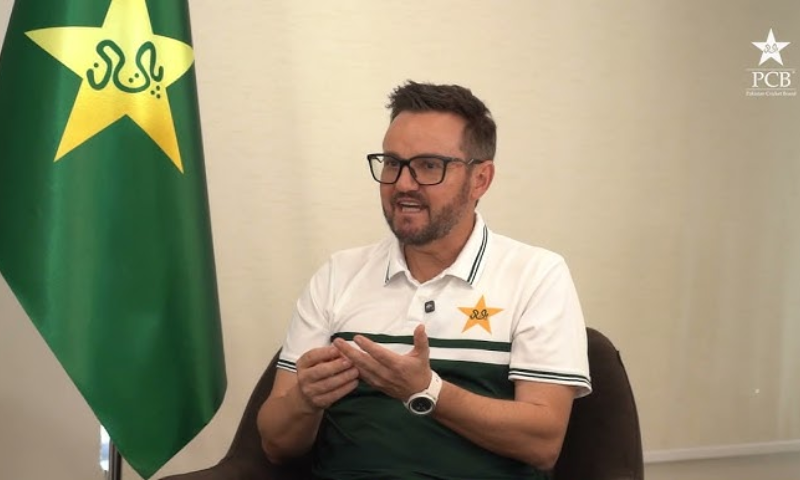
Lahore, May 23, 2026: Pakistan men’s cricket team white-ball head coach Mike Hesson has outlined the key areas the national side must improve in One Day Internationals (ODIs) ahead of the ICC Men’s Cricket World Cup 2027.
The tournament is scheduled to be co-hosted by South Africa, Zimbabwe, and Namibia.
Following Pakistan’s Super Eights exit from the ICC Men’s T20 World Cup 2026, which marked Hesson’s first major assignment with the team, the Green Shirts have shifted focus toward the 50-over format.
Pakistan have so far played only one ODI series this year — an away assignment against Bangladesh in March — and are now set to host Australia for a three-match ODI series from May 31 to June 4 as part of preparations for the World Cup.
Speaking during the Pakistan Cricket Board (PCB) Podcast, Hesson acknowledged Pakistan’s limited ODI schedule under the Future Tours Programme (FTP), with only an ODI tri-series involving England and Sri Lanka scheduled later this year after the Australia series.
Despite the sparse schedule, the former New Zealand coach said the team management had already identified several areas requiring improvement.
Hesson stressed the importance of taking wickets consistently during the powerplay overs, saying Pakistan needed bowlers capable of maintaining tight lines and disciplined bowling in all conditions.
“We’ve really struggled to take wickets in the powerplay in ODI cricket, and that’s something we’re going to have to address by finding bowlers who are consistent and able to do that job,” Hesson said.
He added that Pakistan’s bowling attack also needed to improve discipline during the middle overs, regardless of playing conditions.
On the batting side, Hesson praised Salman Ali Agha for his performances in the middle overs, noting that the all-rounder had averaged close to 50 in ODI cricket.
However, he said the batting unit overall needed to be more proactive during the middle phase of innings.
“We often leave too much to do at the end of the innings because we’re a little bit passive through the middle overs,” Hesson explained.
He added that Pakistan needed greater support around Salman Ali Agha and more intent in rotating strike and scoring during the middle overs to ease pressure on the finishers later in the innings.