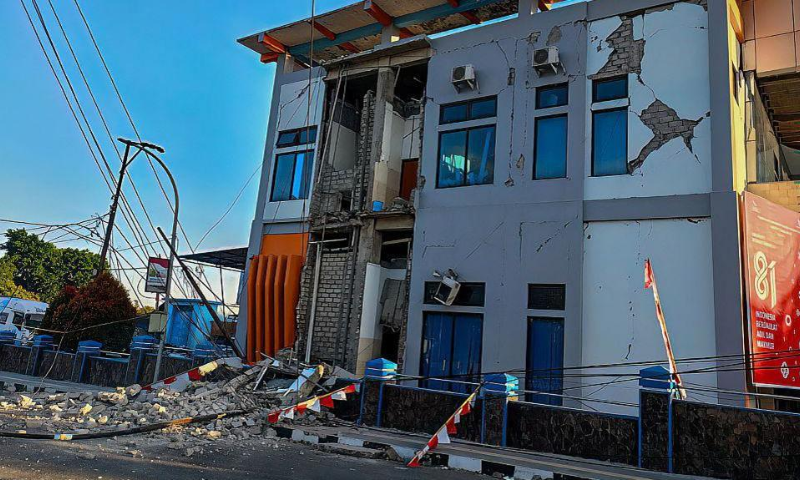
Jakarta, August 15, 2026: At least 38 people were killed and 13 others injured after a powerful 7.7-magnitude earthquake struck off Indonesia’s Flores Island on Saturday, as rescuers searched through collapsed buildings and debris for survivors.
Suharyanto, head of Indonesia’s National Disaster Mitigation Agency, said two of the injured were in serious condition and warned that more victims could be trapped under rubble.
“Victims are trapped in several buildings,” Suharyanto said at a news conference, adding that rescue teams would initially focus on reaching those believed to be buried under debris.
Two helicopters and an aircraft were being prepared to support rescue operations, while authorities continued assessing the extent of the damage.
The earthquake damaged dozens of houses and other buildings across the eastern Indonesian island and forced around 2,000 people to evacuate.
European Commission President Ursula von der Leyen offered assistance from the European Union’s Copernicus Earth observation programme to support search and rescue operations.
“Europe stands ready to deploy Copernicus, our eyes in the sky, to support search and rescue efforts. Indonesia, we stand with you,” she said in a post on X.
The shallow earthquake struck off the northern coast of Flores, according to Indonesian and US authorities.
Rescue official Fathur Rahman said efforts to locate people trapped beneath collapsed structures were being hampered by landslides that had blocked roads and complicated access to affected areas.
Residents near Nagekeo, close to the epicentre, rushed towards higher ground after the sea appeared to retreat, raising fears of a possible tsunami.
Although the tsunami warning was later lifted, authorities urged residents to stay away from damaged buildings because continuing aftershocks could cause further collapses.
Hundreds of people remained outdoors as a series of aftershocks continued to shake the island, with the strongest measured at magnitude 6.1.
Yulian Juita Ekalia, a university lecturer living in Ruteng, more than 100 kilometres from the epicentre, described the earthquake as the strongest she had ever experienced.
She said the tremor jolted her awake early in the morning and caused household items, including a television, dish racks and suitcases, to fall.
As residents fled their homes in panic, patients at a nearby hospital were treated under emergency tents.
Ekalia said she was particularly relieved that the earthquake occurred on a Saturday when there was no university activity, after seeing images showing extensive damage to her campus.
Another resident, 56-year-old Yohanes Babo, said people rushed out of their homes as the ground began shaking.
“People were panicking, running here and there,” he said, adding that residents were temporarily evacuating towards the hills.
Long queues of residents were seen leaving affected areas on foot, motorcycles and cars, with some travelling in the back of pickup trucks.
Indonesia experiences frequent earthquakes because it lies along the Pacific “Ring of Fire”, a vast zone of intense seismic and volcanic activity extending from Japan through Southeast Asia and across the Pacific.
Flores has experienced devastating earthquakes before. A magnitude 7.7 earthquake struck the island in 1992, triggering a tsunami that killed around 2,500 people.
The country was also at the centre of one of the world’s deadliest natural disasters when a magnitude 9.1 earthquake struck off Sumatra in 2004, generating a massive tsunami that killed around 220,000 people across the region, including approximately 170,000 in Indonesia.
Authorities were continuing rescue operations on Saturday as emergency teams worked to reach isolated communities, assess structural damage and search for people who may still be trapped beneath the rubble.