Islamabad, August 21, 2026: Pakistan’s opposition parties on Friday decided to approach the Supreme Court over what they described as the government’s failure to implement its order concerning the medical treatment of incarcerated Pakistan Tehreek-e-Insaf (PTI) founder Imran Khan, while reaffirming plans for a full-fledged protest and long march on September 27.
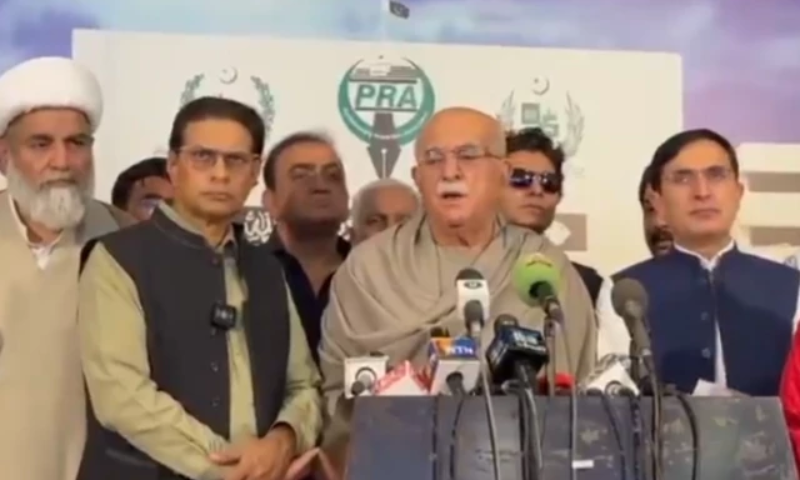
The decision was taken at a meeting of opposition parliamentary parties chaired by National Assembly Opposition Leader Mahmood Khan Achakzai at Khyber-Pakhtunkhwa House in Islamabad. Senate Opposition Leader Raja Nasir Abbas, PTI Chairman Barrister Gohar Ali Khan, former National Assembly speaker Asad Qaiser, Khyber-Pakhtunkhwa Chief Minister Sohail Afridi and PTI Secretary General Salman Akram Raja, among other opposition leaders, attended the meeting.
According to a statement issued after the meeting, participants expressed “deep concern” over Imran’s health and reiterated that no compromise would be made on his medical treatment.
The opposition leaders accused the government of staging a “drama” over the PTI founder’s health and maintained that failure to implement a Supreme Court order amounted to contempt of court.
The meeting decided that the opposition would approach the apex court on Saturday to seek implementation of its order concerning Imran’s medical treatment.
The participants also reaffirmed their decision to hold a “full-fledged” protest and long march on September 27 and agreed to invite all opposition parties to join the demonstration. They further decided to accelerate the public mobilisation campaign in Punjab and across the country.
The opposition leaders vowed to continue their joint struggle for the supremacy of the Constitution, democracy and the rule of law, while agreeing that future political and parliamentary decisions would be taken through mutual consultation.
The meeting also endorsed the Grand Opposition Alliance and agreed to make it more active. Participants welcomed the possible participation of Jamiat Ulema-i-Islam-Fazl chief Maulana Fazlur Rehman and other political parties, saying a broader alliance would strengthen the opposition’s voice in Parliament.
Achakzai warns against missing opportunity for dialogue
Speaking to the media alongside PTI leaders at Parliament House, Achakzai said the handling of Imran’s transfer had squandered an opportunity to reduce political tensions.
“There was hope, and we were thinking, ‘better late than never’,” he said, referring to the Supreme Court’s order directing Imran’s transfer to Shifa International Hospital.
Achakzai said wasting opportunities to ease the country’s political crisis was “tantamount to treason against this country”.
He described Imran as the leader of Pakistan’s “most popular party” and said the PTI founder had remained firm on his political principles despite being imprisoned.
The opposition leader said PTI had fully cooperated with the court’s decision and had publicly urged supporters not to gather outside the hospital, raise slogans or create disorder.
“If Imran Khan had remained in a hospital bed instead of a prison cell for a week and doctors had properly examined him, what would have happened?” he asked.
Achakzai said he had initially been encouraged after learning that Imran was being taken to hospital, believing that the former prime minister would remain there for treatment for at least a day or two. He said he was disappointed to learn the following morning that Imran had instead been examined at the Pakistan Institute of Medical Sciences (PIMS) and returned to Adiala jail.
He stressed that the opposition’s disagreement was not personal or directed against individual political or military figures.
“Our disagreement is only with those forces that do not accept the supremacy of the Constitution and an independent judiciary in Pakistan,” he said.
Achakzai said the opposition would respond through peaceful political activity and expressed confidence that the Tehreek-e-Tahafuz-e-Ayin-e-Pakistan (TTAP) and allied parties would remain in solidarity with PTI.
“The only way to save Pakistan is for the source of power to be Parliament alone, for the judiciary to be completely independent within its domain, and for there to be no restrictions on journalism,” he said.
PTI plans contempt petition
PTI Secretary General Salman Akram Raja said the party would also file a contempt of court petition on Saturday, accusing the government of refusing to accept and implement the Supreme Court’s order.
“The Supreme Court’s decision was not accepted,” Raja said, claiming that the medical board ordered by the court had not been constituted.
He said PTI had already announced plans to take to the streets and that its political and parliamentary committees were meeting to determine the party’s future course of action.
Raja also rejected the government’s explanation that security concerns outside Shifa International Hospital had prevented Imran from being taken there.
He claimed that the roads leading to the hospital had not been closed because of any rush and said Imran’s personal physician, Dr Faisal Sultan, had himself been taken to Shifa in a vehicle with tinted windows surrounded by police vehicles.
The government has maintained that Imran was taken to PIMS because of the security situation created by PTI workers on the route to and outside Shifa.
Gohar questions prospects for government talks
PTI Chairman Barrister Gohar Ali Khan also questioned how political negotiations could move forward following the government’s handling of Imran’s hospital transfer.
“What happened was very unfortunate. We did not expect this. There is someone who does not want any solution to the problems. We made a great effort,” Gohar told reporters outside Parliament.
He said the Supreme Court’s order was clear and required Imran to be shifted to a hospital, kept there and subjected to necessary medical tests.
“If there had been any ambiguity in it, a review could have been sought. There was no ambiguity in the SC’s order,” he said.
Gohar said PTI had been assured that the order would be implemented and that he had personally checked arrangements for the transfer.
He questioned what tests had been conducted on Imran, what the former prime minister had told doctors and why his family had not been properly informed about the arrangements.
“But the Supreme Court’s order has been violated,” Gohar said.
Responding to Prime Minister Shehbaz Sharif’s renewed offer of dialogue with the opposition, Gohar said PTI had consistently sought a political solution but criticised the government’s approach.
“You do not shake hands like this. Negotiations do not happen like this,” he said.
He questioned how democracy could function if the government could not provide political space to a major opposition party or implement an order of the Supreme Court.
Later, speaking in the National Assembly, Gohar warned that PTI could reconsider its participation in Parliament.
“Perhaps you do not want us to remain part of this system,” he said, adding that the party could decide within days whether it would continue participating in the assembly.
Imran taken to PIMS instead of Shifa
The controversy intensified after Information Minister Attaullah Tarar confirmed that Imran had been taken to PIMS rather than Shifa International Hospital for a medical examination during the night of August 20-21.
Tarar said the transfer was carried out under appropriate security arrangements and in accordance with the Supreme Court’s order. He said doctors from Shifa were also present during the examination.
According to the minister, Imran was taken to PIMS “in view of the security situation created by PTI workers on the route to and outside Shifa Hospital”.
The PTI has rejected the explanation, saying its supporters had been asked to stay away from the hospital and accusing the government of using security concerns as a justification for not implementing the court’s directions.
The dispute has added another layer to an already tense political environment, particularly as the government has recently renewed its offer of talks with the opposition.
The opposition’s latest decision to approach the Supreme Court, coupled with its plans for a September 27 protest and long march, could further complicate efforts to revive political dialogue between the government and PTI.
At the same time, the opposition’s move to broaden the Grand Opposition Alliance by bringing additional parties, including JUI-F, into its fold signals an effort to consolidate parliamentary and street opposition as political tensions remain high.