Islamabad, September 30, 2026: Information Minister Attaullah Tarar has rejected what he described as India’s attempts to weaponise water, asserting that the Indus Waters Treaty (IWT) cannot be unilaterally altered, rescinded, revoked or placed in abeyance.
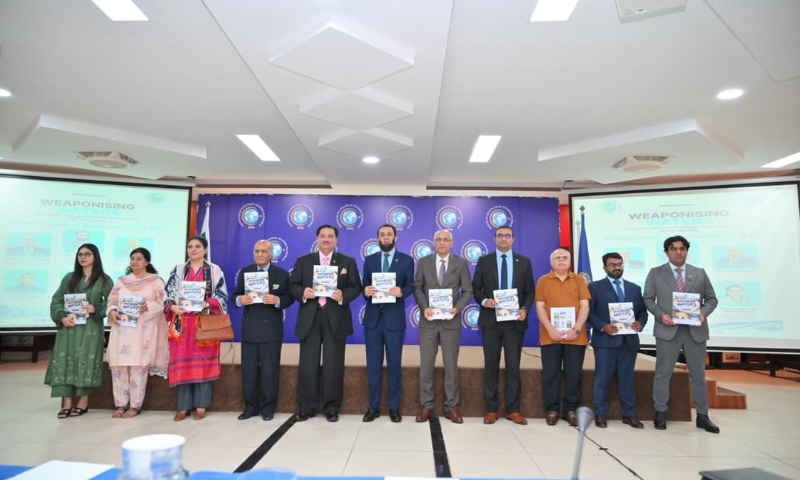
Addressing the launch of a special report, “Weaponising Waters: Historical, Legal, and Strategic Dimensions of IWT Suspension,” at the Institute of Strategic Studies Islamabad (ISSI), Tarar said Pakistan believed in peace but would not allow water to be used as a tool against the country.
Tarar said Pakistan’s legal position on the IWT had been strengthened by proceedings before the Court of Arbitration, which, according to Pakistan’s interpretation, supported the position that the treaty could not be changed through unilateral action. The Permanent Court of Arbitration on August 31 issued an award on the status of the IWT following India’s decision to place the treaty in abeyance, along with an order on interim measures concerning the Ratle Hydroelectric Plant.
The minister’s remarks come amid an ongoing dispute over the future of the 1960 water-sharing agreement. India announced in April 2025 that it was placing the treaty in abeyance following the Pahalgam attack, which killed 26 people and which New Delhi attributed to Pakistan. Islamabad rejected the allegation. The move was followed by heightened tensions and military hostilities between the two countries in May 2025.
Tarar said Pakistan had pursued the matter through diplomatic channels, engaging the international community and presenting its position before relevant international forums.
Recalling Prime Minister Shehbaz Sharif’s address to the 81st session of the United Nations General Assembly, Tarar said the premier had described the IWT as the “lifeblood” of the people and the region and warned that any attempt to usurp Pakistan’s water rights would be treated as an act of war.
The minister said Pakistan’s position on the treaty was clear and had received support from several countries, maintaining that the IWT remained an important instrument for regional peace and stability.
Tarar argued that any attempt to weaponise water or create controversy around the treaty was legally, diplomatically and morally unjustifiable.
He also urged the international community to consider the wider implications of allowing a state to unilaterally place a binding water-sharing treaty in abeyance despite the agreement’s established dispute-resolution mechanisms.
Such a precedent, he said, could undermine transboundary water governance and create concerns for other countries dependent on shared river systems and international water agreements.
The ISSI has separately described the IWT as one of the few durable frameworks between India and Pakistan and said India’s April 2025 decision to place it in abeyance had raised wider questions about international law, regional stability and transboundary water governance.
Tarar reiterated that Pakistan would continue its diplomatic and international engagement and defend its water rights and other vital national interests in accordance with international law.