
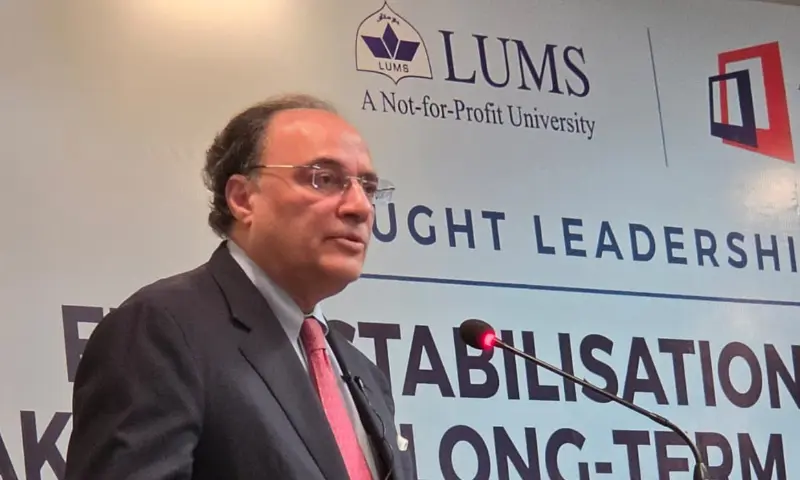
Lahore, October 24, 2026: Finance Minister Muhammad Aurangzeb has ruled out pursuing liquidity-fuelled, consumption-led economic growth, saying Pakistan must prioritise sustainable, export-led expansion and continue tariff reforms to enhance industrial competitiveness.
Addressing an event organised by the American Business Forum (ABF) at the Lahore University of Management Sciences (LUMS) on Saturday, the finance minister said Pakistan could not afford to repeat the cycle of import-dependent growth that had previously triggered balance-of-payments crises and forced the country to seek external assistance.
ABF President Osman Khalid Waheed, former State Bank of Pakistan governor Raza Baqir and Habib Group Vice Chairman Salman Burni also spoke at the event.
Aurangzeb said the government was committed to continuing tariff reforms, particularly to reduce the cost of raw materials and intermediate goods for exporters, despite concerns over the timing of the measures.
“We are very clear: no matter how much pressure there is, we are not going to go for liquidity-fuelled, consumption-led growth,” he said, stressing the need to avoid another cycle in which a temporary economic acceleration was followed by a balance-of-payments crisis.
He said the latest budget sought to steer the economy towards export-led growth through measures including the elimination of super taxes, reductions in tax slabs and financing for exporters at 4.5 per cent.
On tariff reforms, the minister said domestic industries had enjoyed protection for too long without sunset clauses, adding that the existing approach could not continue indefinitely.
“We are in year two of the tariff reform, and we are going to continue with that; there is no turning back,” he said.
Aurangzeb also emphasised that economic growth must translate into employment opportunities. Referring to Pakistan’s growth trajectory and that of a neighbouring country, he argued that growth of 7 to 8 per cent did not necessarily guarantee sufficient job creation.
He stressed that sectors driving economic expansion must also help address unemployment.
Reflecting on discussions at international forums in New York and London, as well as the annual meetings of the World Bank and the International Monetary Fund (IMF) in Bangkok, Aurangzeb said the global economy had remained resilient but faced an uncertain and concerning outlook.
He identified widening differences between oil-exporting and oil-importing economies, alongside the emergence of economies benefiting from artificial intelligence, as key themes in discussions on global growth.
Energy shocks and the El Niño weather phenomenon had also featured prominently, he said, warning that their effects were intensifying and contributing to food-security concerns in some parts of the world.
The minister highlighted high debt levels, limited fiscal space in some economies and the growing importance of digital infrastructure and workforce preparedness for artificial intelligence.
He said increasing trade fragmentation and geopolitical polarisation were creating opportunities for regional corridors and economic blocs, which could be particularly important for Pakistan.
Aurangzeb said Pakistan had made significant progress in reducing fiscal and external imbalances, with the combined twin deficits declining from 12.5 per cent of gross domestic product (GDP) to 2.6 per cent by the end of the last fiscal year.
He said the fiscal deficit had fallen to a 22-year low, while the country had recorded primary surpluses for three consecutive years. The current account deficit had narrowed to around 0.1 per cent of GDP, supported by remittances and information technology exports.
IT services exports had increased from less than $1 billion to $4.6 billion and were projected to reach $5.5 billion in the current fiscal year, he said.
Foreign exchange reserves had improved to more than three months of import cover, compared with just two weeks during the crisis.
Citing three credit-rating upgrades since April last year, Aurangzeb said a recent Panda bond issuance had attracted an order book twice its size, reflecting investor confidence beyond Pakistan’s current IMF programme, which is due to end in October next year.
The finance minister said Pakistan had managed immediate energy-supply challenges amid the continuing Middle East conflict, with supplies secured through November and arrangements for the winter season underway.
He said the government had moved away from blanket subsidies towards targeted support, citing the high cost of universal subsidies.
Assuming an average household size of four to five people, the targeted support programme had reached an estimated 40 million to 50 million people, he said, adding that energy and gas supplies remained areas requiring attention.
Aurangzeb said government borrowing had placed a disproportionate burden on the banking sector, but domestic debt-management operations had helped reduce debt-servicing costs to Rs6.9 trillion against the budgeted Rs8.2 trillion in the last fiscal year.
External debt payments had declined from $26.5 billion last year to $21.5 billion in the current fiscal year and were expected to fall further, he said. New external borrowing was largely intended to refinance existing obligations rather than increase the overall debt burden.
The minister also highlighted pension reforms, saying new entrants to the civil bureaucracy had shifted from defined-benefit arrangements to defined-contribution schemes, while discussions with the armed forces were ongoing.
Aurangzeb identified climate change and population growth as major challenges facing Pakistan and called for measures to reduce the country’s population growth rate of 2.55 per cent.
Citing Bangladesh, Indonesia and Iran, he said the three countries had reduced their population growth rates to below one per cent over a decade. He stressed the importance of women’s education, workforce participation and engagement with religious scholars in addressing the challenge.
The minister said restoring investor confidence required macroeconomic stability and the clearance of approximately $4 billion in outstanding dividend and profit repatriation obligations.
He also pointed to improving domestic investment, noting that Pakistan had recorded 11 initial public offerings (IPOs) last year, the highest number in 20 years, followed by five in the current year.
Aurangzeb said harmonising federal and provincial regulatory frameworks was essential to attract investment, as businesses often faced different requirements at the two levels of government.
He stressed that reforms in taxation, energy and financing were necessary to sustain economic growth, strengthen export competitiveness and generate employment.