
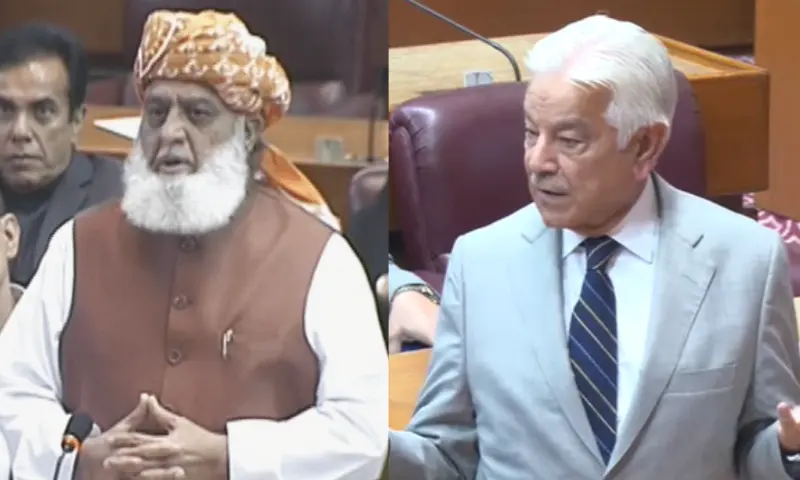
Islamabad, October 29,2026: Defence Minister Khawaja Asif on Thursday responded to Jamiat Ulema-i-Islam-Fazl (JUI-F) chief Maulana Fazlur Rehman’s criticism over his absence from a recent meeting in Tehran, saying the discussions did not concern Pakistan’s defence policy and fell outside the Defence Ministry’s mandate.
The meeting brought together Saudi Defence Minister Prince Khalid bin Salman, Pakistan’s Chief of Defence Forces and Chief of Army Staff Field Marshal Asim Munir, and Turkish intelligence chief Ibrahim Kalin. Iranian Foreign Minister Abbas Araghchi and Supreme National Security Council Secretary Mohsen Rezaei also participated.
The participants agreed to continue dialogue to strengthen cooperation among the four regional countries, particularly on regional peace and security.
On Wednesday, Fazlur Rehman raised the issue in the National Assembly, questioning why the defence minister was absent while a meeting concerning regional security was taking place in Tehran. He also questioned the presence of Interior Minister Mohsin Naqvi at the meeting and took a jibe at Asif, repeating the phrase “koi sharam hoti hai, koi haya hoti hai” (have some shame, show some modesty).
Responding in the House on Thursday, Asif said no defence pact was being negotiated in Tehran and that the discussions were not focused on Pakistan’s defence or related matters.
He said Field Marshal Munir had assumed a role for Pakistan following last year’s military conflict with India, focused on promoting peace and dialogue in the region.
Asif noted that Pakistan had signed two defence agreements — the Makkah defence pact and the Badr Memorandum of Understanding — and said he had been involved in both as defence minister. However, he maintained that the Tehran meeting did not fall within his ministry’s remit.
He said the chief of defence forces had travelled to Tehran as a “messenger of peace” to pave the way for dialogue. Iranian Foreign Ministry spokesperson Esmaeil Baghaei had previously said that Munir proposed holding the meeting during his visit to Tehran.
Asif also claimed that Pakistan’s diplomatic efforts had helped avert a possible confrontation and expressed hope that further dialogue could lead to progress on regional tensions involving Saudi Arabia and Yemen.
Advising Fazlur Rehman to adopt a more constructive approach, the defence minister described the JUI-F chief’s criticism as misplaced and urged political leaders to acknowledge Pakistan’s diplomatic role despite their political differences.
Asif questions Fazlur Rehman’s political record
The defence minister also criticised Fazlur Rehman’s political record, recalling his roles in successive governments and as opposition leader and chairman of the National Assembly’s Kashmir Committee.
Asif argued that someone who had held important political positions and represented Pakistan on international issues should maintain consistent principles. He accused the JUI-F chief of contradictions between his political conduct and public statements.
Referring to Fazlur Rehman’s offer to mediate with Kabul, Asif questioned the basis of the initiative and alleged that it was intended to strengthen the JUI-F chief’s political leverage.
He also accused Fazlur Rehman of targeting the government’s diplomatic efforts and said Pakistan’s role on the international stage deserved greater recognition.
Using a phrase commonly displayed on buses and trucks, Asif advised the JUI-F chief: “Mehnat kar hasad na kar” (work hard and do not envy).
The defence minister further alleged that Fazlur Rehman’s criticism was linked to political considerations, claiming that the JUI-F chief would have adopted a different position had his party received a share in governance in Khyber Pakhtunkhwa following the imposition of emergency and governor’s rule.
Describing Fazlur Rehman’s speech as an attempt at political “blackmail”, Asif cautioned against seeking power through compromises.
“Sitting in the opposition would be a more respectable approach, rather than sitting with people who will blackmail you,” he said.
Asif urged lawmakers to move beyond group-based politics and work within the framework of the Constitution and national security.
He called on parliamentarians to pursue a collective way forward rather than engage in personal and political confrontations.