
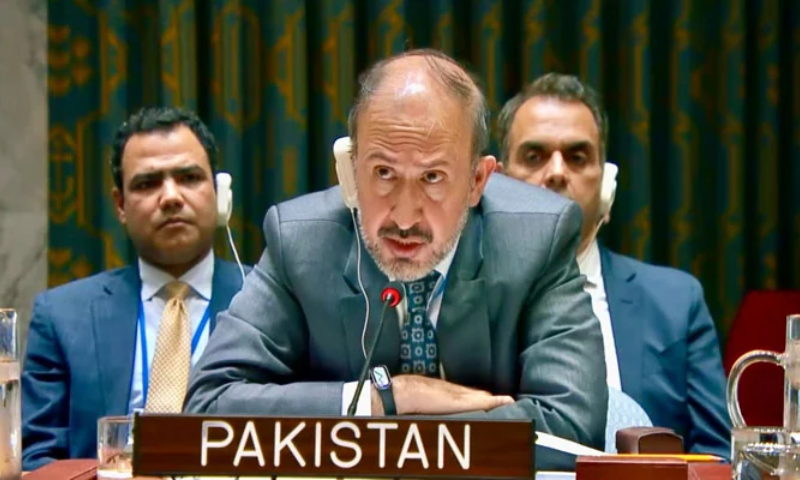
Islamabad, November 13,2026: Pakistan has strongly condemned Houthi attacks against Saudi Arabia, reaffirming its unwavering support for the kingdom’s sovereignty, territorial integrity, security and stability, while also reiterating its commitment to Yemen’s sovereignty, independence, unity and territorial integrity.
Addressing a session of the United Nations Security Council (UNSC), Pakistan’s Permanent Representative to the UN, Ambassador Syed Haider Shah, called for an immediate and unconditional cessation of Houthi attacks against Saudi Arabia.
The statement came following the adoption of a UNSC resolution renewing sanctions measures under Resolution 2140 (2014) and extending the mandate of the Panel of Experts supporting the 2140 Committee.
Ambassador Shah welcomed the resolution and underscored the importance of the committee’s work in promoting peace, security and stability in Yemen.
Expressing concern over the regional security situation, he strongly condemned the continued Houthi attacks against Saudi Arabia and conveyed Pakistan’s full solidarity with the leadership, government and people of the kingdom.
He also emphasised Saudi Arabia’s legitimate right to defend its territory and protect its citizens and residents in accordance with the UN Charter and international law.
The Pakistani envoy’s remarks came after the Houthis claimed on Thursday to have attacked a pumping station along Saudi Arabia’s East-West oil pipeline, an oil facility in the Red Sea city of Yanbu and an Aramco building in Riyadh.
The Saudi-led military coalition fighting the Houthis subsequently announced that it had intercepted and destroyed two drones launched by the group, one in the Riyadh region and the other in the kingdom’s oil-rich Eastern Province.
Ambassador Shah also appreciated the constructive role played by the United Kingdom, as the penholder, in negotiations leading to the adoption of the UNSC resolution.
He said Pakistan had voted in favour of the resolution, reaffirming its support for the work of the 2140 Committee and stressing that holding accountable individuals and entities threatening Yemen’s peace, security and stability was essential to creating conditions for lasting peace.
On the implementation of the sanctions regime, he emphasised the importance of maintaining the institutional framework established by the Security Council. He said the Panel of Experts must perform its responsibilities strictly within its mandate, with professionalism, impartiality and consistency, to ensure the credibility and effectiveness of its work.
Reaffirming Pakistan’s commitment to peace and stability in Yemen, Ambassador Shah stressed the need for UN-led efforts to advance an inclusive political process that is Yemeni-owned and Yemeni-led.
He reiterated Pakistan’s readiness to support initiatives aimed at restoring peace, security and stability in Yemen and alleviating the suffering of its people.
Pakistan and Saudi Arabia have also strengthened their defence cooperation in recent years, signing a bilateral defence agreement in September 2025.
In August 2026, Pakistan, Saudi Arabia and Turkiye signed the Makkah Joint Defence Agreement (MJDA), establishing a trilateral security arrangement. The agreement provides for an attack against any one of the three countries to be treated as an attack against all three, reflecting their stated commitment to collective defence and regional security.