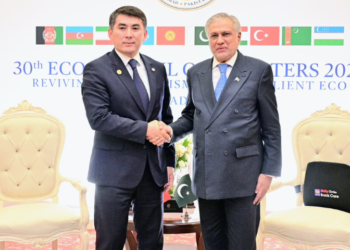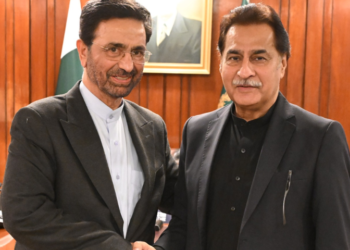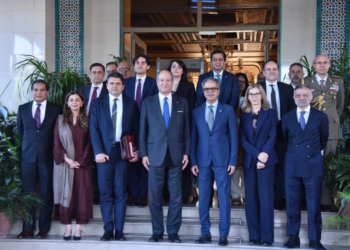

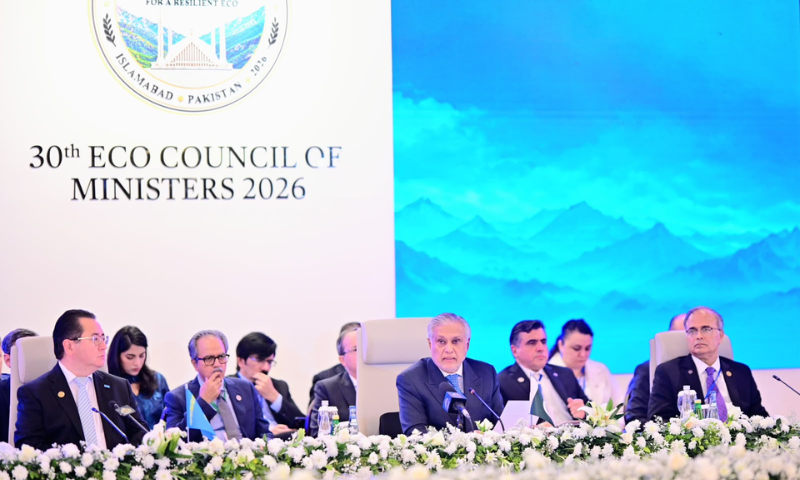
Islamabad, November 16,2026: Deputy Prime Minister and Foreign Minister Ishaq Dar on Monday called for stronger regional connectivity, economic integration and practical cooperation among member states of the Economic Cooperation Organization (ECO), stressing that action by the Afghan Taliban regime against terrorism and the establishment of a stable and secure environment were essential for sustained regional economic cooperation.
“Pakistan desires peaceful, prosperous and stable Afghanistan, fully integrated within the ECO framework,” Dar said while chairing the 30th meeting of the ECO Council of Ministers in Islamabad.
He said an Afghanistan at peace with itself and all its neighbours would not only benefit its own people but also contribute to peace and prosperity across the wider region.
Highlighting the importance of regional cooperation amid global uncertainty and rapid technological advancements, Dar urged ECO member states to strengthen connectivity and translate their geographical advantages into shared economic opportunities.
Reaffirming Pakistan’s commitment to the principles and objectives of the ECO Charter, he said the country, as a founding member, attached particular importance to regional cooperation based on sovereign equality, mutual respect, non-interference and mutual benefit.
He noted that the ECO region occupied a strategic position at the crossroads of South Asia, Central Asia and West Asia, bringing together major markets, abundant natural resources and a long history of trade.
Dar said Pakistan was committed to making its chairmanship productive and meaningful, adding that the country was proud to assume the ECO presidency for 2026-2027.
Iran calls for stronger trade, transport and energy cooperation
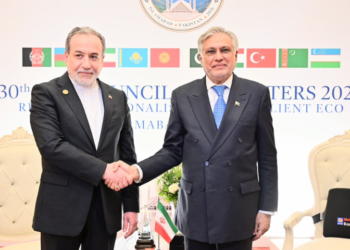
Iranian Foreign Minister Abbas Araghchi called for enhanced regional cooperation through the ECO, identifying trade, transport and energy as strategic priorities.
Addressing the meeting, Araghchi appreciated Dar’s leadership and thanked Pakistan for its hospitality. He also expressed gratitude to countries that had condemned what he described as US and Israeli aggression against Iran’s territorial integrity and expressed solidarity with the Iranian people.
He called for the ECO to become an effective platform for collective action, stronger cooperation and a shared regional strategy.
Welcoming the establishment of a technical negotiating committee to reform the ECO Trade Agreement, Araghchi urged member states to actively participate in negotiations to develop a new and effective trade framework.
On regional security, he reaffirmed Iran’s commitment to the United Nations Charter and international law, saying Tehran had remained committed to diplomatic engagement and peaceful dispute resolution over the past two years.
However, he accused the United States of pursuing aggression, threats, targeted killings, economic pressure and a blockade against Iran, describing these actions as violations of international law and the UN Charter.
The Iranian foreign minister urged regional countries to ensure that their territories, airspace and installations were not used for attacks against one another. He maintained that Iran’s defensive measures were directed only against the targets and military bases of those responsible for the aggression.
Calling for a collective regional strategy based on non-aggression and dialogue, Araghchi said a reliable and sustainable regional energy security system had become essential. He also invited ECO foreign ministers to attend the organisation’s 18th summit in Tehran.
Dar calls for implementation of ECO commitments
In his concluding remarks, Dar reaffirmed Pakistan’s commitment to strengthening regional economic cooperation, connectivity and intra-regional trade.
He said the adoption of the Strategic Goals of Economic Cooperation-2035, together with the Islamabad Communiqué, provided a common framework for advancing regional priorities and promoting practical cooperation among member states.
Dar said Pakistan, as ECO chair for 2026-2027, would work closely with member countries and the organisation’s institutions to advance mutually beneficial economic initiatives.
He announced that Pakistan would host the 19th ECO Summit in 2027 and expressed hope that all member states would participate at the highest level. He also looked forward to welcoming delegates to the 31st meeting of the ECO Council of Ministers next year.
Emphasising the need to move beyond declarations, he called for translating collective commitments into concrete action through clearly defined priorities, realistic timelines and effective follow-up mechanisms.
Senior officials finalise agenda and Islamabad Communiqué
Earlier, the ECO Senior Officials Meeting (SOM) was held under the chairmanship of Foreign Secretary Ambassador Asim Iftikhar Ahmad.
According to the Foreign Office, senior officials from ECO member states, representatives of the organisation’s secretariat and delegates from specialised agencies and regional institutions attended the meeting.
The officials reviewed preparations and the agenda for the 30th Council of Ministers meeting and finalised the draft Islamabad Communiqué for consideration by the ministers.
They also reviewed the activities of the ECO Secretariat during the year, including ongoing programmes, initiatives, outcomes of sectoral ministerial meetings and the work of subsidiary bodies and specialised institutions.
Administrative and financial matters were also discussed, along with proposals to improve the organisation’s effectiveness.
The SOM served as a preparatory forum for the ministerial meeting, enabling member states to review progress and build consensus on matters of mutual interest and proposed outcome documents.
Foreign ministers and senior officials arrive in Islamabad
Foreign ministers and senior representatives of ECO member states and regional organisations began arriving in Islamabad over the weekend to attend the high-level meeting.
Among the visiting dignitaries were Iranian Foreign Minister Abbas Araghchi, who was received at the airport by Additional Foreign Secretary Muhammad Tariq Wazir and other Foreign Office officials; Foreign Minister of Tajikistan Sirojiddin Muhriddin; and Uzbekistan Deputy Foreign Minister Bobur Masudovich Usmanov.
Other arrivals included Tahsin Ertugruloglu, Foreign Minister of the Turkish Republic of Northern Cyprus; Turkiye’s Deputy Foreign Minister and head of delegation Musa Kulaklikaya; and Shanghai Cooperation Organization Deputy Secretary General Ahmad Saidmurodzoda.
The visiting officials also included Organisation of Islamic Cooperation Secretary General Ismail Ould Cheikh Ahmed, Azerbaijan’s Deputy Foreign Minister Elnur Mammadov and Kazakhstan’s Deputy Foreign Minister Arman Issagaliyev.
Ahead of the meeting, Dar hosted a welcome dinner on Sunday for foreign ministers and heads of delegations from ECO member states.
Addressing the gathering, he highlighted the close bonds among ECO countries and reaffirmed Pakistan’s commitment to regional cooperation and shared aspirations for peace, progress and prosperity.
Dar meets ECO secretary general, OIC chief
On the sidelines of the meeting, Dar held talks with ECO Secretary General Dr Asad Majeed Khan, underscoring the importance of regional cooperation, connectivity and economic integration.
He outlined Pakistan’s priorities during its chairmanship under the theme “Reviving Regionalism for a Resilient ECO” and reiterated the country’s commitment to hosting the ECO Summit in 2027.
The secretary general appreciated Pakistan’s arrangements, hospitality and coordination for the 30th ECO Council of Ministers meeting. He also congratulated Pakistan on its upcoming chairmanship and preparations to host the 2027 summit.
Separately, Dar met OIC Secretary General Ismail Ould Cheikh Ahmed and discussed matters of mutual interest.
Welcoming the secretary general on his first visit to Islamabad since assuming office, Dar reaffirmed Pakistan’s commitment to strengthening the OIC as a unified and effective voice of the Muslim Ummah. He assured him of Pakistan’s continued support and cooperation in advancing the organisation’s objectives.
The OIC secretary general appreciated Pakistan’s diplomatic efforts during the Iran-US conflict to promote peace and regional stability. He also commended Islamabad’s active role in the OIC, including its contributions through the Commission on Science and Technology for Sustainable Development in the South (COMSTECH) to scientific and technological cooperation among member states.
The meeting concluded with a renewed emphasis on strengthening regional cooperation, improving connectivity and translating shared commitments into practical initiatives for economic integration and collective prosperity.