

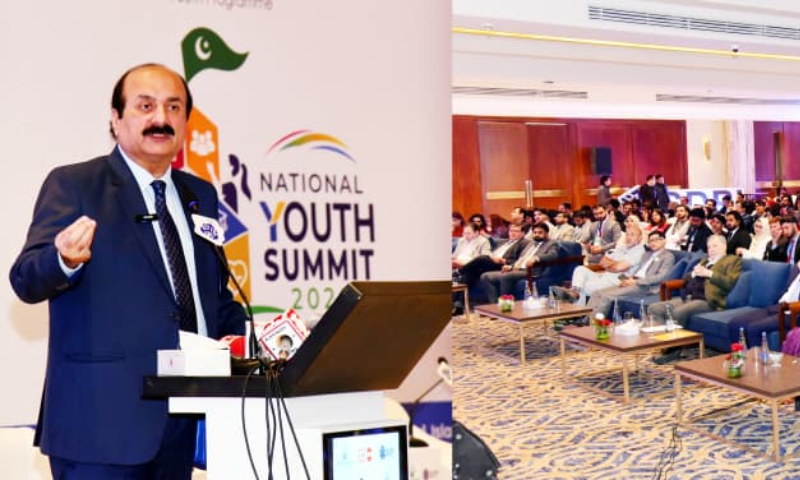
Islamabad, November 18,2026: Chairman of the Prime Minister’s Youth Programme (PMYP) Rana Mashhood Ahmad Khan has announced that the government will soon introduce Pakistan’s first National Adolescent and Youth Policy and E-Sports Policy following the rollout of the National Youth Employment Policy, Artificial Intelligence (AI) Policy and Chip and Semiconductor Policy.
Addressing the National Youth Summit 2026 on Wednesday, he said the government was working to make young people economically and technologically self-reliant. He noted that under the Rs292 billion Youth Loan Programme, soft loans of up to Rs25 million were being provided, while one million young people and 2,400 companies had registered with the Digital Youth Hub.
The summit was jointly organised by the Prime Minister’s Youth Programme, the United Nations Population Fund (UNFPA) and the Sustainable Development Policy Institute (SDPI).
Rana Mashhood said that, under Prime Minister Shehbaz Sharif’s vision, the federal cabinet had approved Pakistan’s first National Youth Employment Policy. Under the policy, a minimum 35 per cent annual quota in the labour force had been allocated for women, while at least 10 per cent of new companies registering annually would be youth-led enterprises.
He announced that the coming year had been declared the “Year of Skills”, adding that technical skills would be made mandatory for university students, following China’s educational model.
The PMYP chairman said Pakistan’s first uniform AI Policy had been developed in consultation with global technology companies, including Google, Alibaba and NVIDIA. He added that the Chip and Semiconductor Policy had also been introduced to strengthen the country’s technological capabilities and meet modern defence and industrial requirements.
He said the proposed National Adolescent and Youth Policy would cover three age groups: 10–15, 15–19 and 19–29 years. The government would also introduce the country’s first E-Sports Policy to tap into the rapidly expanding global gaming industry.
Highlighting educational initiatives, Rana Mashhood said the scope of the Laptop Scheme, Daanish Schools and Education Endowment Fund had been extended beyond Punjab to deserving students across the country on merit.
On sports development, he said Olympic champion Arshad Nadeem had also emerged through the Youth Festival. Through this year’s talent hunt programmes in football, hockey and track and field, the government aimed to prepare at least 10 athletes of Arshad Nadeem’s calibre for the next Olympic Games.
Commenting on the global economic situation, he said tensions between Iran and the United States had driven up petroleum prices worldwide. He also referred to the difficulties faced by consumers in India, claiming that nearly 70 people had died while waiting in petrol queues due to flawed policies.
In contrast, he said, the Pakistani government had taken timely measures and provided subsidies to protect the public from the impact of the global petroleum crisis.
Rana Mashhood further said that following Pakistan’s successes in Marka-e-Haq and Bunyan-um-Marsoos last year, the country’s international standing had improved, as reflected in the participation of foreign ministers from member states in the Economic Cooperation Organization (ECO) Summit in Islamabad.
Speaking at the summit, UNFPA Country Representative Dr Luay Shabaneh said Pakistan stood at a decisive crossroads in the era of artificial intelligence, urging young people to focus on solutions and future planning rather than despair.
He stressed that the country’s future could not be transformed without investing in women’s potential and ensuring gender equality. He also called on young people to hold decision-makers accountable and step forward to assume leadership responsibilities.
Chairman of the Board of Governors of SDPI Shafqat Kakakhel said nearly two-thirds of Pakistan’s population comprised people under the age of 30, making their inclusion essential for sustainable development.
He said the summit aimed to compile recommendations from young people on education, employment, mental health and good governance into a “Youth Demand Charter” for presentation to the country’s leadership.
He warned that the younger generation would bear the most enduring consequences of climate change, stressing the need to prioritise environmental challenges at every policy forum.