
Islamabad, November 26, 2026: Experts and academics have described Kyrgyzstan’s Vision 2030 as a people-centred development strategy, emphasizing that human development, economic transformation and regional connectivity will remain central to the country’s future progress.
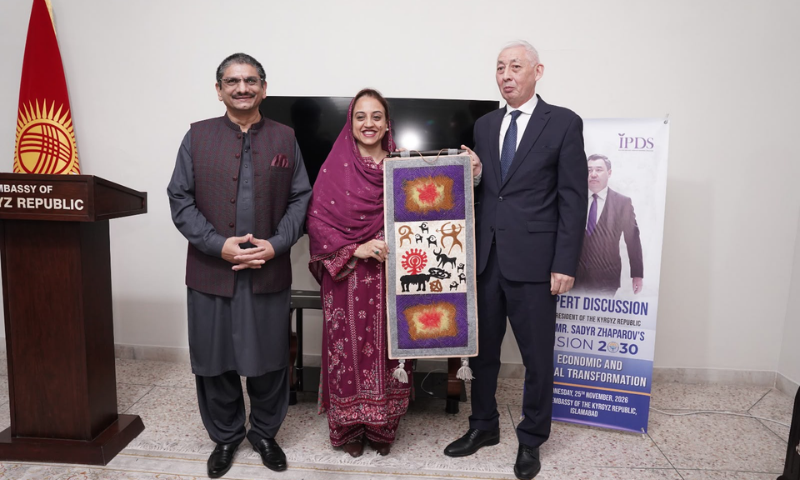
The views were expressed during an expert discussion titled “President of the Kyrgyz Republic Mr. Sadyr Zhaparov’s Vision 2030: Economic and Social Transformation,” jointly organised by the Embassy of the Kyrgyz Republic in Pakistan and the Institute of Peace and Diplomatic Studies (IPDS) at the Embassy of Kyrgyzstan in Islamabad on Wednesday.
The discussion focused on the National Development Programme of the Kyrgyz Republic until 2030, presented by President Sadyr Zhaparov on October 21, 2026. The five-year policy framework outlines the country’s key national priorities and provides a roadmap for economic and social transformation.
In his opening remarks, Chargé d’Affaires and Minister-Counsellor of the Embassy of Kyrgyzstan, Aibek Tilebaliev, highlighted the significant progress achieved by the country over the past five years. He identified the resolution of border issues with neighbouring Uzbekistan and Tajikistan as a major diplomatic breakthrough.
He also reaffirmed the historic and friendly relations between Pakistan and Kyrgyzstan, founded on longstanding political, economic and cultural ties.
Tilebaliev highlighted the extensive administrative reforms introduced under President Sadyr Zhaparov during the past five years, noting that these reforms had contributed to substantial economic progress, including a threefold increase in GDP between 2021 and 2024.
Dr. Farhat Asif, Founder and President of the Institute of Peace and Diplomatic Studies (IPDS), moderated the discussion and described the gathering as an important platform for understanding Kyrgyzstan’s development priorities and future direction.
She observed that economic transformation was at the heart of Vision 2030, while connectivity was being viewed as a broader instrument of national development rather than an isolated objective. She emphasised that human development had been recognised as a fundamental pillar of the country’s progress, with the financial system serving as an important enabler.
Speaking on trade and financial cooperation, President of the Kyrgyzstan Trade House in Pakistan, Dr. Shahid Hassan, highlighted Kyrgyzstan’s notable progress in establishing and expanding small-scale industries over recent years. He said this development reflected the country’s growing emphasis on a people-oriented economic model.
Discussing the programme’s socio-economic priorities, Professor Dr. Muhammad Munir, Dean of the Faculty of Social Sciences and Humanities at Muslim Youth University, said that after focusing on institution-building in previous years, Bishkek was now placing greater emphasis on developing human capital.
Referring to the healthcare sector, he explained that Vision 2030 viewed investment in health as an investment in human capital rather than merely a government expenditure.
On transport logistics and tourism, Managing Director of Best Trans (Pvt.) Ltd., Ramiz Ali Rabbani, underscored the importance of stronger Pakistan-Kyrgyzstan economic cooperation. He said a Free Trade Agreement (FTA) between the two countries could generate significant benefits for both sides.
He added that such an agreement would also help reduce transportation and trade costs for Kyrgyz companies seeking to use Pakistani seaports for cargo shipments, further strengthening regional connectivity.
In her concluding remarks, Dr. Farhat Asif reiterated the central message emerging from the discussion, saying that people and human development remained at the core of President Sadyr Zhaparov’s Vision 2030.
She noted that the programme offered a comprehensive approach to national development by linking economic growth, institutional reforms, financial sector development, healthcare, industrial expansion and regional connectivity.
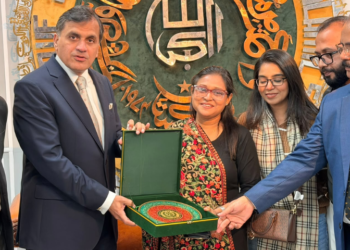
At the conclusion of the event, Chargé d’Affaires Aibek Tilebaliev presented souvenirs to the participating experts. The gifts featured traditional Kyrgyz craftsmanship in the form of decorative wall hangings, reflecting the country’s rich cultural heritage.