Kuala Lumpur, October 7, 2025: Pakistan and Malaysia have jointly called for an immediate, unconditional, and permanent ceasefire in Gaza, an end to the blockade, and the protection of civilians, while urging unhindered humanitarian access for those affected by the ongoing conflict.
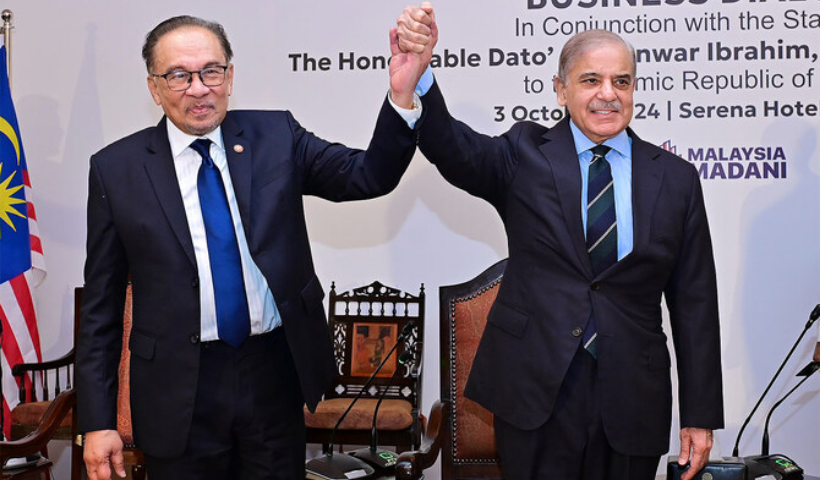
The appeal came in a joint statement issued at the conclusion of Prime Minister Shehbaz Sharif’s three-day official visit to Malaysia, from October 5–7, 2025. The statement underscored both countries’ “unwavering solidarity with the Palestinian people” and endorsed international efforts toward the recognition of a sovereign Palestinian state.
Prime Minister Shehbaz Sharif and his Malaysian counterpart held wide-ranging talks on October 6, covering bilateral ties, economic cooperation, and pressing regional and global issues — particularly the worsening humanitarian situation in Gaza and Rakhine State, Myanmar.
Both leaders strongly condemned the ongoing genocide in Gaza, reaffirming support for the Palestinian people’s right to self-determination and the establishment of an independent, contiguous, and sovereign state of Palestine based on pre-June 1967 borders, with Al-Quds Al-Sharif as its capital.
The two sides also agreed to reconvene the Joint Commission Meeting at the level of foreign ministers and reaffirmed their commitment to strengthening bilateral relations in trade, investment, defence, and technological innovation.
Both countries pledged to boost economic ties through the Malaysia–Pakistan Closer Economic Partnership Agreement (MPCEPA), focusing on market access, business facilitation, and balanced trade.
Malaysia expressed its intent to expand palm oil exports to Pakistan while ensuring sustainability and environmentally responsible production practices. The two leaders also identified halal industry development and sustainable agriculture as key areas for future collaboration, including joint research and innovation.
The leaders expressed satisfaction over the robust defence partnership under the Joint Committee on Defence Cooperation (JCDC) established in 1997. They agreed to deepen collaboration in defence science, technology, and industry, emphasizing knowledge-sharing and technology transfer to strengthen mutual capabilities.
Recognising the importance of people-to-people ties, both sides committed to enhancing aviation connectivity, increasing air traffic rights, and expanding direct flight routes between the two countries.
They also welcomed greater cooperation in education, technical and vocational training, and institutional partnerships.
In view of Malaysia’s upcoming “Visit Malaysia 2026” and “Malaysia Year of Medical Tourism 2026” campaigns, the leaders agreed to expand tourism promotion and cultural exchanges, encouraging greater travel between the two nations.
Pakistan and Malaysia agreed to collaborate in healthcare, pharmaceuticals, and medical devices, alongside exploring joint initiatives in renewable energy, energy transition, and climate resilience.
They reaffirmed their shared interest in clean energy research, knowledge-sharing, and green investments, stressing the importance of sustainable development in both economies.
The leaders reaffirmed their commitment to closer cooperation in science, technology, and innovation (STI), including areas such as artificial intelligence and digital transformation.
They also vowed to intensify efforts in cybersecurity, counterterrorism, and combating transnational organised crime, agreeing to continue exchanging information and expertise to address emerging security challenges.
The two countries reaffirmed their partnership within international organisations such as the United Nations (UN), Organisation of Islamic Cooperation (OIC), and Developing-8 (D-8), emphasizing unity and solidarity within the Muslim world.
They also reiterated their joint commitment to a peaceful and stable Afghanistan, calling for continued engagement with the interim Afghan authorities to combat terrorism and prevent the use of Afghan soil for hostile activities.
Both leaders condemned Islamophobia and xenophobia, urging the global community to counter hate speech and discrimination on religious grounds. They welcomed the adoption of UN General Assembly resolutions 76/254 and 78/264, establishing the International Day to Combat Islamophobia, and expressed support for UN Special Envoy Miguel Ángel Moratinos Cuyaubé in advancing global efforts against religious intolerance.
Prime Minister Shehbaz Sharif reaffirmed Pakistan’s strong support for Malaysia’s ASEAN Chairmanship, expressing confidence in Malaysia’s leadership to advance regional peace, integration, and prosperity.
Both sides concluded that their partnership is rooted in shared values, mutual respect, and a common vision for peace, development, and unity within the Islamic world.