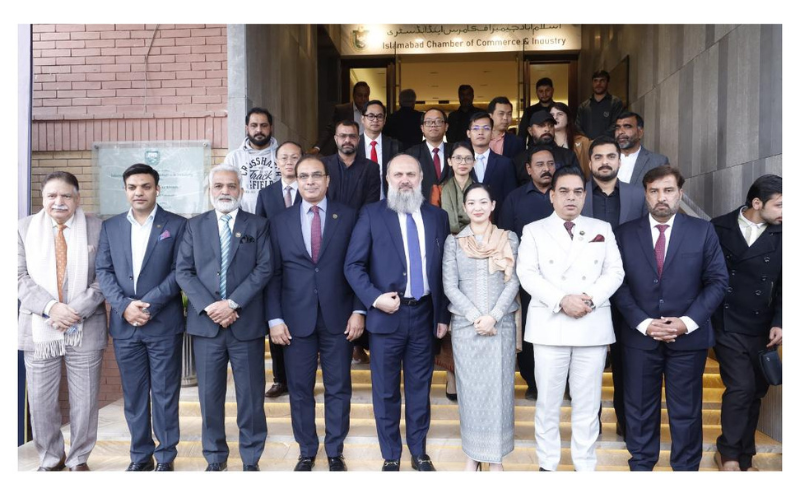
Islamabad, February 10, 2026: Federal Minister for Commerce Jam Kamal Khan highlighted Pakistan’s evolving export landscape, pointing to steady growth in pharmaceuticals, strong performance in information and communication technology (ICT), and increasing value addition in the food sector. He noted that Pakistan, once limited in value-added food exports, is now making significant progress across the entire food value chain.
The minister was speaking at a networking lunch hosted by the Islamabad Chamber of Commerce and Industry (ICCI) in honor of Cambodian Minister of Commerce Ms. Cham Nimul and her delegation.
Jam Kamal Khan also cited emerging export categories—including engineering goods, home and electrical appliances, water bikes, tractors, cosmetics, and perfumes—as evidence of Pakistan’s expanding industrial base and export maturity. He added that the country’s favorable climate, skilled workforce, robust life sciences sector, capable financial institutions, English-language proficiency, and predictable judicial framework provide a strong foundation for sustainable economic growth.
Referring to the macroeconomic outlook, the minister said Pakistan has transitioned from economic turmoil toward stability and is now positioned for growth. While acknowledging challenges such as taxation, production costs, and ease of doing business, he expressed confidence that reforms under Prime Minister Shehbaz Sharif would support sustained economic expansion.
Cambodian Commerce Minister Cham Nimul stressed the importance of stronger business-to-business engagement and welcomed greater participation of Pakistani firms in Cambodia and the wider ASEAN region. She revealed that 166 Pakistani companies are already registered in Cambodia and that efforts are underway to establish a Preferential Trade Agreement (PTA) to facilitate faster market access, streamline procedures, and promote investment—particularly in healthcare.
Inviting Pakistani entrepreneurs to explore opportunities, she highlighted Cambodia’s Special Economic Zones, which offer incentives such as tax holidays, duty exemptions, and simplified administrative processes. She also expressed interest in Pakistan’s footwear, surgical instruments, and pharmaceutical sectors, citing their global quality standards.
In his welcome remarks, ICCI President Sardar Tahir Mehmood said substantial untapped potential exists to expand bilateral trade and investment, adding that closer business interaction could foster supply-chain integration and long-term partnerships. Business leaders and government officials attending the event echoed optimism that the engagement would serve as a catalyst for stronger Pakistan–Cambodia economic ties.