Jerusalem/West Bank, April 25, 2026: Palestinians in parts of the occupied West Bank and central Gaza began voting on Saturday in long-delayed municipal elections, marking the first ballot since the devastating Israeli military campaign in Gaza and reflecting widespread political frustration and institutional fatigue.
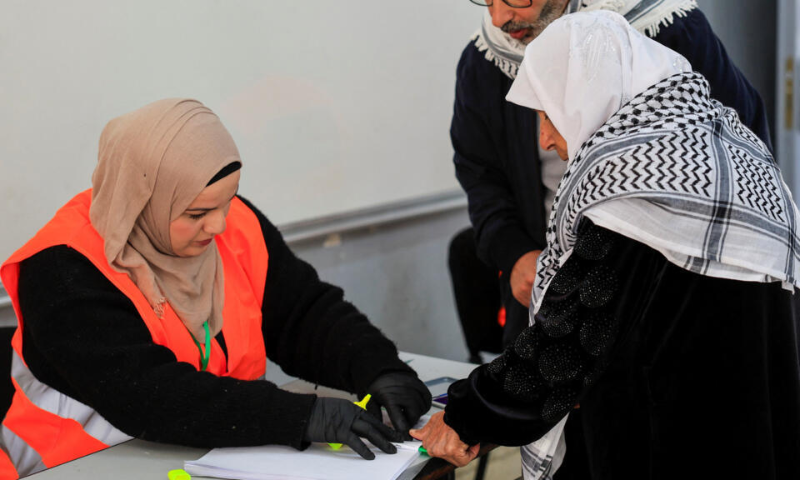
According to the Ramallah-based Central Elections Commission, nearly 1.5 million registered voters in the Israeli-occupied West Bank and around 70,000 residents in Gaza’s Deir el-Balah area are eligible to participate in the polls. Voting began at 7am (9am PKT), with polling stations opening in cities including Al-Bireh and Deir el-Balah.
Election officials, observed by AFP journalists, oversaw the process as voters cast ballots under tight security and strained infrastructure conditions.
The elections feature a narrow political field, with most candidate lists either aligned with President Mahmoud Abbas’s Fatah movement or composed of independents. No lists are affiliated with Hamas, which governs large parts of the Gaza Strip and remains absent from the vote.
In many West Bank municipalities, Fatah-backed candidates are competing against independent lists that include figures linked to smaller factions such as the Popular Front for the Liberation of Palestine.
“We must see change every four years through elections… We can’t change the situation but we hope to replace people… people who might be better and help develop the community,” said Khalid Eid, a voter in Al-Bireh.
Municipal councils in the Palestinian territories are responsible mainly for basic services such as water supply, sanitation, and local infrastructure, and do not hold legislative authority. However, with no national elections held since 2006, they remain one of the few functioning democratic mechanisms under the Palestinian Authority.
The vote comes amid long-standing criticism of the Palestinian Authority over governance challenges, corruption allegations, and declining public trust. International donors have increasingly linked financial support to governance reforms, particularly at the local level.
United Nations official Ramiz Alakbarov praised the electoral process, calling it a “credible process” and describing the vote as an important opportunity for democratic participation “during an exceptionally challenging period.”
However, voter sentiment in many areas remains deeply sceptical. In Tulkarem, where parts of the city have been under Israeli military control for over a year, businessman Mahmud Bader said the elections are unlikely to bring meaningful change.
“The [Israeli] occupation is the one that rules Tulkarem. It would only be an image shown to the international media — as if we have elections, a state or independence,” he said.
In Gaza’s Deir el-Balah, one of the few areas less affected by mass displacement, polling has been described as largely symbolic but significant in sentiment. The Palestinian Authority is treating the vote as a “test case” for future electoral feasibility, according to analysts.
“The elections are an experiment to assess success or failure,” said Jamal al-Fadi, a political scientist at Al-Azhar University in Cairo.
To manage the vote in Gaza, election authorities deployed staff from civil society groups and hired private security to safeguard polling centres, officials said.
The vote is taking place in the aftermath of more than two years of conflict that began in October 2023, which has left large parts of Gaza in ruins and caused tens of thousands of deaths, alongside widespread destruction of infrastructure and public services.
Despite the hardship, some voters expressed cautious hope. “We are an educated people with strong determination, and we deserve to have our own state,” said 24-year-old Mohammed al-Hasayna after voting in Deir el-Balah. “We want the world to help us overcome the catastrophe of war. Enough wars — it is time to work towards rebuilding Gaza.”