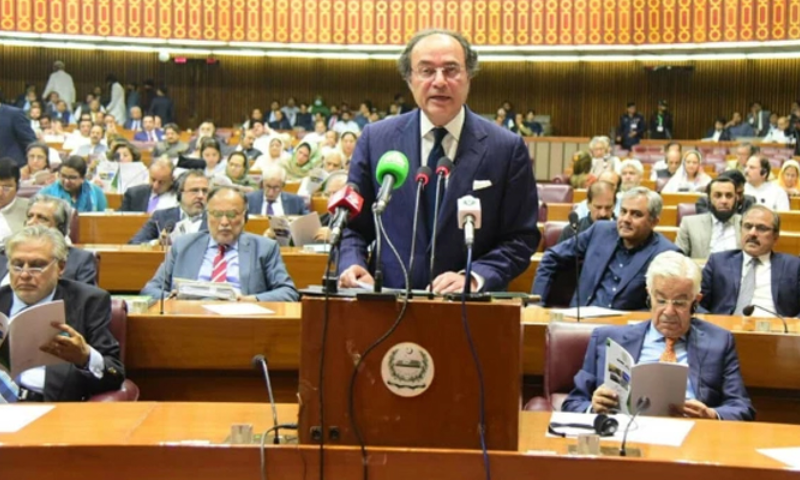
ISLAMABAD, June 12, 2026: Finance Minister Muhammad Aurangzeb on Friday presented Pakistan’s Rs18.8 trillion federal budget for fiscal year 2026-27 in the National Assembly, outlining the government’s economic roadmap while promising tax relief for salaried individuals, increased development spending, and continued fiscal consolidation amid regional geopolitical uncertainty and domestic political tensions.
The budget session, presided over by National Assembly Speaker Ayaz Sadiq, began nearly two hours behind schedule and was marked by noisy protests from opposition lawmakers, placard-waving demonstrations by PPP members over Sindh’s water shortage, and heated exchanges between treasury and opposition benches.
Aurangzeb described the budget as being presented at a time when Pakistan’s international standing had improved significantly, attributing the country’s growing diplomatic influence to its military capabilities, regional peace efforts, and economic stabilization measures.
“This budget is being presented at a time when Pakistan has achieved the status of a country whose voice is heard and whose friendship is desired around the world,” the finance minister said.
Budget outlay and economic targets
The federal government has proposed a total budget outlay of approximately Rs18.8 trillion, with the largest allocation of Rs8.05 trillion earmarked for debt servicing. Defence spending has been allocated Rs3 trillion, while Rs1 trillion has been set aside for the federal Public Sector Development Programme (PSDP).
For FY2026-27, the government has set:
- GDP growth target at 4 percent
- Average inflation target at 8.2 percent
- Fiscal deficit target at 3.6 percent of GDP
- Primary surplus target at 2 percent of GDP
The government estimates total tax revenues at Rs15.264 trillion, representing a 17.6 percent increase over the outgoing fiscal year’s collection of Rs12.983 trillion.
Aurangzeb announced that provinces would contribute Rs8.848 trillion through a newly agreed mechanism designed to meet national strategic requirements without affecting provincial constitutional rights under the 7th National Finance Commission Award.
Under the arrangement, Rs13.25 trillion from federal tax revenues will be distributed between the federation and provinces, while grants under Article 160 of the Constitution will help finance national priorities.
Economic recovery and fiscal improvements
Highlighting the government’s economic achievements over the past two years, Aurangzeb said Pakistan’s economy had reached a size of $452 billion, while per capita income increased from $1,751 to $1,901.
He noted that:
- GDP growth in FY2025-26 reached 3.7 percent.
- Large-scale manufacturing expanded by 6.1 percent.
- Services sector grew by 4.1 percent.
- Foreign exchange reserves rose to $17 billion from $4 billion three years ago.
- Remittances reached $38 billion during the first 11 months of the current fiscal year and are expected to exceed $41 billion by year-end.
The finance minister also highlighted improvements in fiscal management, stating that the tax-to-GDP ratio had risen from 8.5 percent to 10.3 percent over the past three years, while the fiscal deficit declined from 7.8 percent of GDP in June 2023 to an estimated 4 percent this year.
Pakistan has also shifted from a primary deficit of 0.7 percent of GDP to a primary surplus of 1.6 percent, reflecting what the government described as successful stabilization measures.
Relief for salaried class
A key feature of the budget is tax relief for salaried individuals. The government has proposed reducing income tax rates across four salary brackets:
- Income between Rs2.2 million and Rs3.2 million: tax reduced from 23% to 20%.
- Income between Rs3.2 million and Rs4.1 million: tax reduced from 30% to 25%.
- Income between Rs4.1 million and Rs5.6 million: tax reduced from 35% to 29%.
- Income between Rs5.6 million and Rs7 million: tax reduced from 35% to 32%.
In addition, the government proposed abolishing the super tax ranging from 1 to 7.5 percent on business incomes between Rs150 million and Rs500 million. For incomes exceeding Rs500 million, the super tax rate would be reduced from 10 percent to 8 percent.
However, existing surcharges on banks, oil and gas exploration companies, and fertilizer firms will remain unchanged.
Development spending and social sector allocations
The National Economic Council has approved a national development programme worth Rs3.675 trillion for FY2026-27.
The package includes:
- Rs1 trillion for the federal PSDP.
- Rs2.224 trillion for provincial development programmes.
- Rs451 billion for investments by state-owned enterprises.
The government announced that more than 60 percent of federal development spending would focus on transport, communications, water resources, and energy projects.
Under urban development initiatives, Rs54.6 billion has been allocated for sustainable housing and urban services, including plans to construct 150,000 affordable climate-resilient housing units and prepare digital master plans for 10 major cities.
In the social sector:
- Rs25.1 billion has been allocated for health projects.
- Rs46 billion has been allocated for higher education, up from Rs34.9 billion last year.
- Rs3.6 billion has been allocated for science and technology initiatives.
- Energy Reforms and Debt Management
Aurangzeb said the government had achieved significant progress in restructuring Pakistan’s energy sector despite ongoing instability in the Middle East.
According to the finance minister:
- The government saved more than Rs143 billion in electricity subsidies during FY2025-26.
- Circular debt accumulation in the power sector was brought to net zero.
- Long-term LNG agreements with Qatar and Italy were renegotiated, reducing 35 LNG cargoes for 2026 and generating estimated foreign exchange savings of $1.2 billion.
- Domestic gas production increased by approximately 100 million cubic feet per day.
He also highlighted debt management achievements, claiming the government reduced its debt burden by Rs4.9 trillion through early repayments and refinancing expensive debt.
The average maturity of domestic debt increased from 2.8 years in 2024 to 3.8 years in May 2026, reducing refinancing risks.
Corporate growth and privatisation push
Aurangzeb said Pakistan’s corporate sector continued to benefit from economic stabilization.
Corporate profits during January-March 2026 rose by 22 percent compared with the same period last year, while 11 initial public offerings (IPOs) were launched during the year — the highest number in two decades.
The Securities and Exchange Commission of Pakistan registered 39,000 new companies during the year, while more than 250 firms commenced operations in government-backed technology zones, employing over 25,000 technology professionals.
The minister also highlighted the successful privatisation of Pakistan International Airlines (PIA), which was sold for Rs185 billion in December 2025.
Following the PIA transaction, the government plans to privatise additional entities over the next five years, including electricity distribution companies, power generation firms, banks, insurance companies and airports.
Foreign policy, defence and regional tensions
A significant portion of Aurangzeb’s speech focused on Pakistan’s growing diplomatic and defence profile.
He credited Pakistan’s military response during the 2025 conflict with India for enhancing the country’s international standing and attracting global interest in Pakistan’s defence technology.
The finance minister also highlighted Pakistan’s role in facilitating peace efforts between the United States and Iran, saying Islamabad was working toward restoring stability in the region and safeguarding oil transit through the Strait of Hormuz.
He emphasized Pakistan’s strategic partnership with China and referenced a defence cooperation agreement signed with Saudi Arabia last year.
Addressing concerns over global energy markets, Aurangzeb said the US-Israel conflict involving Iran had pushed international oil prices higher. However, he said the government absorbed much of the increase and provided Rs128 billion in subsidies to protect consumers from the full impact.
Political tensions overshadow budget session
Despite the government’s focus on economic achievements, political tensions remained visible throughout the budget session.
Pakistan Peoples Party (PPP) lawmakers staged a protest over Sindh’s water shortage, carrying placards demanding the province receive its fair share of water resources.
PPP leader Shazia Marri said the party would maintain only “token participation” in the budget proceedings, accusing the ruling PML-N of failing to respect PPP’s political mandate.
“PPP has always cooperated in matters of national interest, but our political space must also be respected,” she said.
Although earlier reports suggested PPP Chairman Bilawal Bhutto-Zardari would not attend the session, he later participated in parliamentary meetings at Parliament House after consultations with Deputy Prime Minister Ishaq Dar and Law Minister Azam Nazeer Tarar.
Meanwhile, opposition lawmakers, particularly from PTI, disrupted proceedings with slogans and placards, while a brief scuffle also occurred between treasury and opposition members.
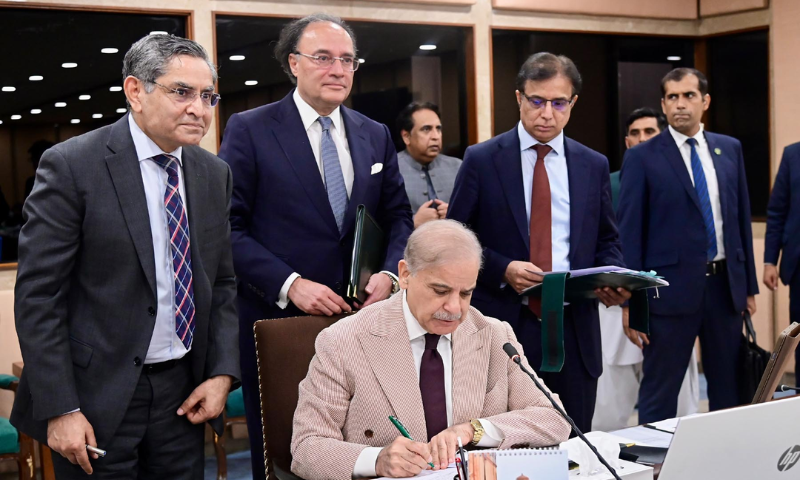
Earlier in the day, the federal cabinet formally approved the budget, while Prime Minister Shehbaz Sharif held consultations with coalition partner MQM-P, describing it as an important ally in the government’s economic and public welfare agenda.
The budget proposals will now be debated in Parliament before final approval and implementation from July 1, 2026.