New Delhi, July 25, 2026: India’s Education Minister Dharmendra Pradhan resigned on Saturday following weeks of nationwide protests over examination paper leaks, marking a significant political setback for Prime Minister Narendra Modi’s government after mounting public pressure led by student groups.
Pradhan announced his resignation in a two-page statement posted on X, saying he had submitted his resignation to Prime Minister Narendra Modi in the national interest amid escalating protests across the country.
“Considering the situation that has developed across the country… and to ensure that not even a single Indian student’s future gets entangled in legal complications, I have sent my resignation to the honourable prime minister,” Pradhan wrote.
The resignation came hours before a scheduled third round of talks between government representatives and leaders of the youth-led Cockroach Janta Party (CJP) movement, which has spearheaded demonstrations demanding accountability over alleged leaks in the National Eligibility cum Entrance Test (NEET-UG).
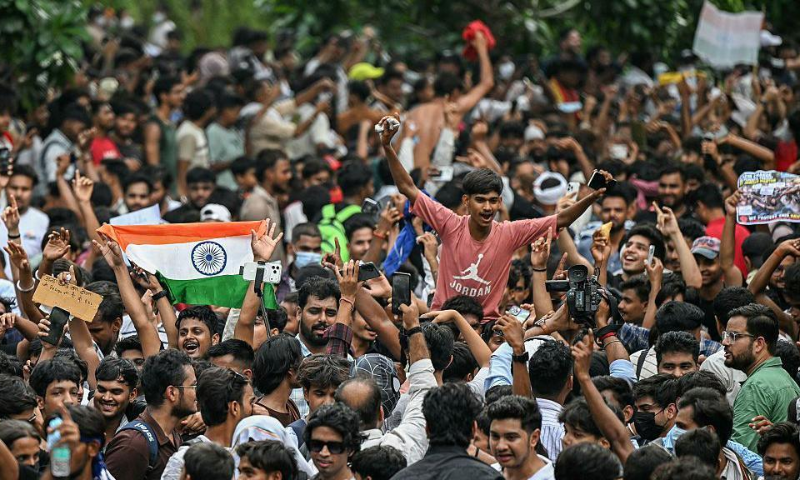
The protests, regarded as India’s largest youth-led demonstrations in recent years, intensified after police used batons and tear gas earlier this week to disperse demonstrators marching towards Parliament in New Delhi. Police again fired tear gas on Saturday to disperse protesters gathered near Jantar Mantar.
Following Pradhan’s resignation, thousands of protesters celebrated at the demonstration site, chanting patriotic slogans, singing the national anthem and distributing sweets.
CJP founder Abhijeet Dipke hailed the resignation as a victory for democracy but urged supporters not to personalise the movement.
“Do not make me a hero because of Dharmendra Pradhan’s resignation. The country has been ruined by making one person a hero,” he told cheering supporters.
After a third round of negotiations, the CJP announced it was ending its nationwide protests, saying the government had accepted all of its key demands.
According to the movement, the government agreed to provide the maximum possible compensation to families of students who allegedly died by suicide following the NEET paper leak controversy, withdraw all legal cases against protesters and consider the CJP’s five-point examination reform charter through further consultations.
The protests, which began in June, reflected broader public frustration over unemployment, corruption, examination irregularities and government accountability.
In his resignation letter, Pradhan said he had accepted responsibility for the controversy from the outset and noted that the federal government had promptly ordered a Central Bureau of Investigation (CBI) probe after irregularities emerged in the May 3 NEET-UG examination. He said the government cancelled the examination, announced a fresh test and decided that future exams would be conducted through a computer-based testing system.
Pradhan also accused unnamed individuals of attempting to mislead students and politicise the issue, while reiterating his faith in democratic values and the aspirations of India’s youth.
Opposition leaders welcomed his resignation, with Leader of the Opposition Rahul Gandhi calling it “a huge step” and urging Prime Minister Modi to apologise to students while ensuring accountability for police action against protesters.
Congress leader Priyanka Gandhi Vadra described the development as “a victory of the youth of India,” while activist Sonam Wangchuk, who recently ended a 26-day hunger strike, called it “a victory of democracy” and praised young protesters for their peaceful movement.
Pradhan, 57, has served in Narendra Modi’s cabinet since 2014, holding portfolios including petroleum and natural gas, steel, skill development and education. He became India’s education minister in 2021.