
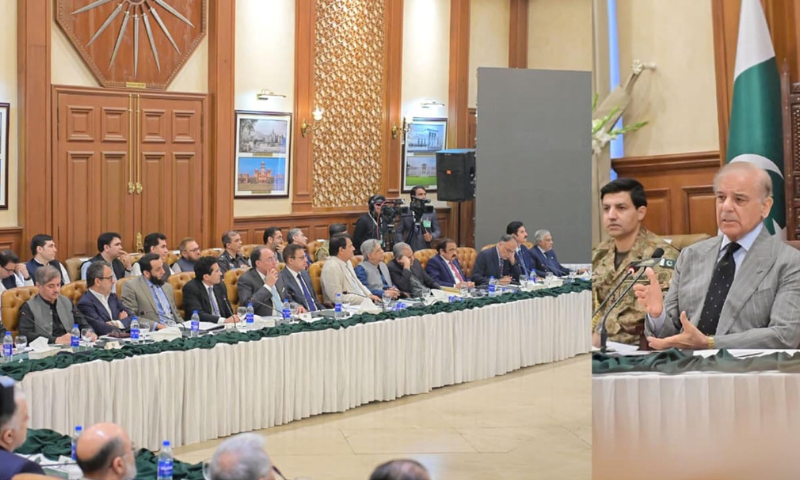
Peshawar, October 22,2026: Prime Minister Shehbaz Sharif on Thursday announced Rs160 billion in development funds for Khyber Pakhtunkhwa (KP), pledging that the federal government would make every possible effort to restore peace, accelerate development and improve public services in the province.
Chairing a meeting of the provincial apex committee in Peshawar, the prime minister said the Centre would provide all available resources to help KP overcome its security challenges and regain momentum in economic and social development.
The meeting was attended by Chief of Defence Forces and Chief of Army Staff Field Marshal Asim Munir, KP Governor Faisal Karim Kundi, federal ministers and newly appointed provincial advisers. It reviewed the overall security situation and measures to combat terrorism.
Shehbaz, who visited the province for the first time since the imposition of emergency and governor’s rule on October 11, said the federal government had been compelled to take the decision under difficult circumstances.
“I promise that we will leave no stone unturned in bringing back the happiness and era of progress to this province,” he said, adding that the Centre would ensure the practical realisation of the aspirations of the people of KP.
He expressed confidence that the federal government, the governor-led advisory council, the president and the military leadership would work together to help the province catch up with other parts of the country and potentially surpass them in development.
The prime minister criticised the handling of the security situation in KP over recent years, arguing that the sacrifices made by security personnel to establish peace had not been adequately protected.
He called for a comprehensive analysis of the circumstances that had allowed terrorism to resurface, describing the failure to safeguard national interests as a serious lapse.
Shehbaz said the provincial government had failed to address several critical security requirements, including filling around 5,000 police vacancies, completing Safe City projects, strengthening the Counter-Terrorism Department (CTD) and improving police training.
He recalled that all provinces had agreed under the 2010 National Finance Commission Award to provide additional resources to KP because of its frontline role in the fight against terrorism.
According to the prime minister, more than Rs800 billion had been provided or allocated to the province under the arrangement since 2010.
However, he said, the resurgence of terrorism had exposed serious shortcomings in equipment, operational capacity and trained personnel.
Shehbaz added that he had previously assured the provincial administrations led by former chief ministers Ali Amin Gandapur and Sohail Afridi of the Centre’s full support in combating terrorism, but expressed regret that the necessary measures had not been taken.
He said the federal government could not remain a silent spectator while terrorism threatened public safety and undermined economic stability.
The prime minister also referred to the breakdown of talks between the Centre and the provincial government on October 3, saying the federal government had been compelled to take what he described as a final step by imposing governor’s rule.
He credited cooperation between the political and military leadership for helping stabilise Pakistan’s economy over the past two and a half years, stressing that peace in KP was essential for sustaining national economic progress.
Shehbaz also raised concerns about alleged financial irregularities in provincial projects, citing Rs100 billion in alleged corruption in the Cities Improvement Project’s clean drinking water component and Rs37 billion in the Kohistan District Accounts Office scandal.
He said accountability and effective governance were essential to ensure that public funds reached the people and delivered tangible results.
Rs160bn development package, wheat supplies announced
Later, addressing a meeting of the Area Representative and Development Council (ARDC), the prime minister announced Rs160 billion for development projects in KP.
The council represents 12 districts facing serious security challenges: Dera Ismail Khan, Tank, Lakki Marwat, Bannu, Bajaur, Mohmand, Khyber, Kurram, Orakzai, North Waziristan, South Waziristan Upper and South Waziristan Lower.
It comprises 48 tribal elders and prominent personalities from these districts to ensure local representation in development and governance decisions.
Shehbaz also announced that the federal government would provide the province with as much wheat as required from the stocks of the Pakistan Agricultural Storage and Services Corporation (PASSCO) to address shortages.
He directed that the wheat should not be hoarded and that consumers should receive it at the same price at which the Centre supplied it.
The prime minister assured the council that the federal government would provide the resources and operational support needed to combat terrorism. He said directives had been issued to strengthen the CTD and complete Safe City projects.
He also pledged to resolve obstacles affecting federal development projects in the province, while the governor-led administration would address issues relating to provincial projects.
Appreciating the tribal elders for their support for Pakistan, Shehbaz said the ARDC had a significant responsibility in ensuring peace and development in the region.
He endorsed the council chairman’s assessment that development work remained negligible, corruption was widespread and terrorism had reached alarming levels.
The prime minister assured the representatives that steps would be taken to prevent corruption and ensure that funds intended for development and public welfare reached their intended beneficiaries.
KP governor relaxes police vehicle procurement ban
Separately, Governor Faisal Karim Kundi approved a relaxation of the ban on vehicle procurement for the provincial police to improve their operational capacity amid the prevailing security challenges.
In a post on X, Kundi said the police were at the forefront of protecting the lives and security of the people and needed adequate vehicles and resources to respond effectively to threats.
He clarified that the relaxation would remain within the approved scope and be financed from funds already allocated under the police procurement plan, without imposing an additional burden on the provincial exchequer.
The KP government had imposed the vehicle procurement ban in July, with exceptions for essential vehicles and equipment, including ambulances, fire trucks, rescue vehicles, motorcycles and certain transport and specialised vehicles.
The order had allowed the chief minister to grant exemptions on a case-by-case basis where essential requirements arose.
Merged districts declared a development priority
Addressing the apex committee, Governor Kundi described the restoration of peace and stability in KP as a collective national priority.
He said the peaceful transition following the imposition of emergency and governor’s rule reflected the public’s desire for stability, while paying tribute to residents who had exercised restraint during the political turmoil.
The governor also honoured the sacrifices of personnel of the police, Pakistan Army, Frontier Corps and Federal Constabulary in the fight against terrorism.
He said the foremost priority of the KP Advisory Council was to restore peace, eliminate terrorism and ensure that those facilitating and financing militant activities were brought to justice.
Kundi identified the development of the merged tribal districts as a special priority, stressing that their residents had endured significant hardships during the conflict and deserved improved education, healthcare and economic opportunities.
He said the federal government’s cooperation was crucial to achieving lasting stability and ensuring that the people of KP did not have to choose between peace and development.
The governor added that the advisory council would continue working to integrate the merged districts into the country’s broader development framework, emphasising that public trust would remain the key measure of success in the fight against terrorism.
The federal government imposed emergency and governor’s rule in KP on October 11, citing what it described as the PTI-led provincial government’s disengagement from counterterrorism efforts. Parliament subsequently endorsed the decisions amid opposition protests.
The move followed a breakdown in negotiations between the Centre and the provincial government, with counterterrorism policy emerging as a major point of disagreement.
The PTI maintained that it was being excluded from security decisions affecting the province and called for a review of the existing counterterrorism strategy. The federal government, meanwhile, criticised the provincial administration’s performance and its approach to engagement with the Afghan Taliban.
The Centre subsequently authorised the deployment of Pakistan Army troops and assets in KP in aid of civil power.
The federal government has maintained that restoring security, strengthening law enforcement and accelerating development are central objectives of the governor-led administration.