Paris, June 17, 2026: US President Donald Trump on Wednesday warned that the recently announced memorandum of understanding (MoU) between the United States and Iran is not a final agreement, saying Washington could resume military action if Tehran fails to comply with its commitments.
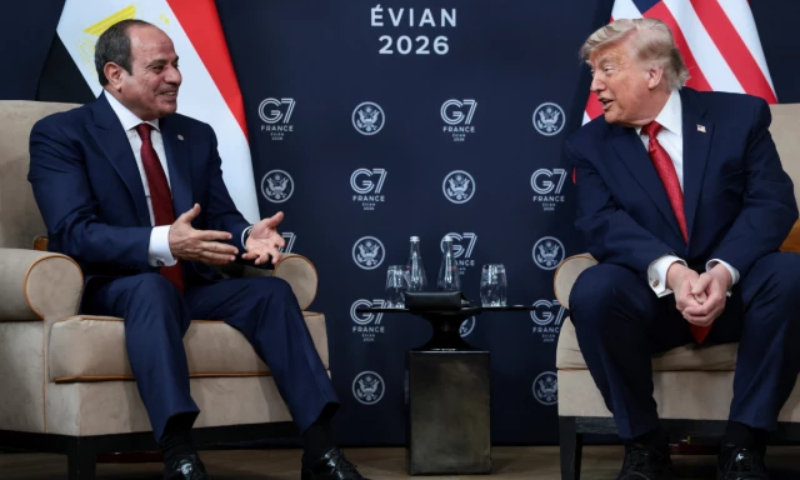
Speaking alongside Egyptian President Abdel Fattah el-Sisi at the G7 summit in France, Trump described the agreement as a preliminary framework and reiterated his hardline stance toward Iran.
“It’s a memorandum of understanding. And if I don’t like it, we’ll go back to shooting at them, dropping bombs on their head,” Trump told reporters. “If they don’t behave, we’ll go right back.”
Despite the warning, Trump expressed confidence that the agreement would prevent Iran from acquiring nuclear weapons.
“There is a 99.99 percent chance that Iran will never have a nuclear weapon,” he said, describing the framework accord as “very strong.”
The US president also said the Strait of Hormuz was expected to be fully reopened within the next few days, a move widely viewed as critical for global energy markets and maritime trade.
Trump dismissed media reports suggesting the agreement includes a $300 billion reconstruction and development fund for Iran.
“We’re not putting up 10 cents,” he said. “We are not investing, and we do not have a fund.”
He added that while Gulf countries were free to invest in Iran if they chose to do so, he did not expect such investments to materialize until confidence in Iran’s future conduct improved.
NATO Secretary General Mark Rutte welcomed the agreement, describing the planned reopening of the Strait of Hormuz as a “massive step forward” for international stability and global energy security.
“The restoration of free passage through the Strait of Hormuz will be a massive step forward,” Rutte told reporters in Brussels, adding that several allies were prepared to support maritime security efforts in the region.
The Strait of Hormuz, through which nearly one-fifth of global oil and gas supplies pass, has faced major disruptions since the outbreak of hostilities earlier this year.
Iranian officials said the MoU includes provisions requiring an end to military operations across all fronts, including Lebanon.
Iranian Deputy Foreign Minister Majid Takht-Ravanchi said the agreement contains a mechanism to address potential violations, including any future Israeli military actions in Lebanon.
Foreign Minister Abbas Araghchi stated that continued Israeli attacks or occupation of Lebanese territory would constitute a breach of the agreement, arguing that ending the conflict in Lebanon is inseparable from broader regional de-escalation.
However, reports indicate that Israeli forces continue to conduct military operations in southern Lebanon, while Israeli officials have signaled their intention to maintain a military presence in parts of the area despite the emerging US-Iran understanding.
The agreement has already affected global energy markets. The International Energy Agency (IEA) said the reopening of Hormuz could gradually restore Middle Eastern oil exports and eventually lead to a significant global oil surplus by 2027.
According to the agency, energy flows through the region have already begun recovering, while oil prices have fallen sharply amid expectations of improved supply conditions.
The IEA noted that if the agreement holds and Iranian exports resume fully, global oil supplies could outpace demand significantly over the coming years.
Leaders of the Group of Seven (G7) nations welcomed the US-Iran understanding and called for an immediate and robust ceasefire in Lebanon.
Meeting in France, G7 leaders said they were prepared to support implementation of the accord and enhance cooperation on maritime security following the reopening of the Strait of Hormuz.
The leaders reiterated their position that Iran must never acquire nuclear weapons while emphasizing the need for continued diplomacy to address broader regional security concerns.
The memorandum of understanding, which extends an existing ceasefire arrangement and establishes a framework for further negotiations, is expected to be formally signed in Bürgenstock, Switzerland, on Friday.
Negotiators from both sides are expected to spend the next 60 days working toward a comprehensive agreement covering nuclear issues, sanctions relief, regional security concerns and long-term economic arrangements.
While the framework has been welcomed by several international actors, significant challenges remain, including unresolved disputes over Iran’s nuclear program, sanctions, Israeli military operations in Lebanon and the broader security architecture of the Middle East.