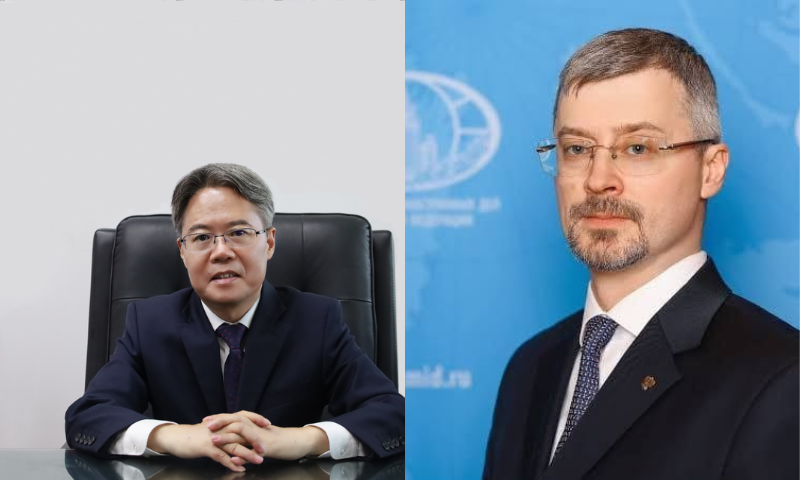
By H:E Jiangzaidong and H:E Albert P. Khorev
July 16 marks the 25th anniversary of the signing of the Treaty of Good-Neighborliness and Friendly Cooperation between China and Russia – a landmark document that laid a solid foundation for the comprehensive strategic partnership of coordination for the new era between our two countries.
The Treaty formalised the historical tradition of good-neighbourliness and friendship between China and Russia, consolidated the existing ties in conformity with the interests of our peoples, and opened a new chapter in bilateral relations. Built upon the principles of equality, mutual respect, good faith, and win-win cooperation, it has stood the test of time. What began as a commitment to strengthen neighbourly relations has evolved into a comprehensive strategic partnership of coordination for the new era, setting a prime example of a new type of major-country relationship, and serving as a vital constant amid century-defining changes sweeping across the world.
This year is rich in symbolic dates. We also commemorate the 30th anniversary of the 1996 Joint Declaration proclaiming the development of “relations of equal and trusting partnership aimed at strategic cooperation in the 21st century.” These foundational documents reflected our peoples’ conscious choice and continue to define the trajectory of bilateral relations.
Political mutual trust remains the hallmark of China-Russia relations. It is enshrined as the fundamental principle of the 2001 Treaty and continues to guide our cooperation across all domains. Head-of-state guidance is the greatest advantage of and fundamental guarantee for the high-level development of China-Russia relations. Regular reciprocal visits by the heads of state are complemented by frequent meetings between the two governments, close coordination between foreign ministries, and a broad variety of specialised mechanisms.
On May 19-20 this year, during President Vladimir Putin’s state visit to China, he and President Xi Jinping held substantive talks covering the full spectrum of cooperation and addressing major global issues. International security and economic ties were in the spotlight of the discussions that culminated in signing a substantial package of 40 agreements – from transport, trade, customs, and industry to nuclear energy, innovation, culture, sport, youth policy and education. The two countries expressed their intention to align national development goals even more closely. A particularly important milestone was the adoption of the joint statement on further strengthening comprehensive strategic coordination and deepening good‑neighborliness and friendly cooperation.
Last year, commemorative activities in Beijing and Moscow marking the 80th anniversary of victory in World War II once again demonstrated our shared commitment to preserving historical truth and memory and reminded the community of nations of the immense value of peace and sovereignty.
Building on this common historical legacy, our strategic partnership plays an important stabilising role on the global stage. It is based on shared interests and similar approaches to key international and regional issues rather than on bloc confrontation. Synchronized Chinese and Russian approaches are especially relevant at a time when the global system is undergoing a profound transformation.
China and Russia consistently advocate for a harmonious process of shaping an equal and orderly multipolar world and international relations of a new type, including a more just and rational system of global governance. It is heartening to note that Pakistan ascribes to a similar view. At the UN, China, Russia and Pakistan can often be seen jointly upholding the principles of international law, fairness and sovereign equality of states. As members of the United Nations Security Council, our three countries share principled approaches to the most pressing issues on its agenda.
China and Russia often work in tandem at other multilateral fora, including the BRICS, the Shanghai Cooperation Organization, G20 and APEC. Established on the foundation of the spirit of trust and good-neighbourliness embodied in the 2001 Treaty, the SCO has evolved into one of the most influential multilateral organisations across Eurasia. China and Russia consistently work together within the SCO to bolster regional security, combat terrorism, separatism and extremism, deepen economic and humanitarian cooperation, and promote dialogue among diverse civilisations and political systems. In an era of growing geopolitical fragmentation, the SCO represents a model of equal partnership free from bloc mentality.
China and Russia act in concert to uphold solidarity and equal cooperation across our shared Eurasian continent, promote peaceful conflict resolution, and strengthen mechanisms of regional stability. The two countries will step up coordination on Afghan affairs at both the bilateral level and under multilateral frameworks, and support Afghanistan in achieving long-term stability and security at an early date. The two sides attach great importance to and endorse the positive and constructive role played by regional platforms in advancing a political settlement of the Afghan issue, including the Moscow Format Consultations on Afghanistan, the Foreign Ministers’ Meeting of Afghanistan’s Neighbouring Countries, the China-Russia-Pakistan-Iran Quadrilateral Mechanism, and the SCO, and stand ready to assist Pakistan and Afghanistan to resolve their current differences as soon as possible through political and diplomatic means.
China and Russia are actively advancing the alignment of the Belt and Road Initiative with the development of the Eurasian Economic Union, while promoting its parallel and coordinated development with the Greater Eurasian Partnership. The two countries support the development of transport, trade and energy corridors establishing strong linkages across the Eurasian space, including between South Asia and its neighboring sub-regions. With its strategic location, Pakistan has the potential to become an essential node in the Eurasian connectivity network. Hence, it is natural that both China and Russia attach particular importance to this aspect of their relations with Pakistan.
Bilaterally, the China-Russia partnership possesses a strong economic dimension that directly contributes to the prosperity of our peoples. Mutual trade has exceeded $200 billion for three consecutive years and continues to grow steadily, with settlements conducted almost entirely in Chinese yuan and Russian rubles.
Energy cooperation has taken on a truly strategic character and serves as one of the key drivers of our practical ties. At the same time, both countries are actively developing new growth factors in innovation, industry, and cutting-edge technologies.
The strength of China-Russia relations lies not only in interstate cooperation, but also in the strong cultural and humanitarian bonds between our peoples. The successful China-Russia Years of Culture (2024–2025) brought our societies even closer together. More than 400 events, including exhibitions, concerts, and theatre companies’ tours, further enhanced our nations’ affinity. In May 2026, the 10th China-Russia Summer Youth Games were held in Kaliningrad, with over 300 athletes competing in 12 sports nurtured the already robust people-to-people contacts.
2026–2027 were declared the China-Russia Years of Education by Presidents Xi Jinping and Vladimir Putin. The initiative is bound to accelerate dynamic development in this vital area. Today, there are more than 72,000 Chinese students in Russia, while over 28,000 Russians are pursuing their studies in China. New ambitious projects are underway, including joint research platforms, university campuses and innovation centres. By combining scientific, technological and intellectual potential, our countries are investing in the future, as research capabilities are instrumental to long-term strategic development.
Over the past quarter century, China and Russia have come a long way and are now looking confidently to the future. Guided by the principles enshrined in the Treaty of Good-Neighbourliness and Friendly Cooperation, we stand ready to deepen political trust, expand mutually beneficial cooperation, strengthen coordination on international affairs, and promote common development for the benefit of our peoples and the wider international community. Our two countries’ regional and global initiatives are intended to create shared prosperity for all, and Pakistan will undoubtedly continue to play an important role in relevant projects.