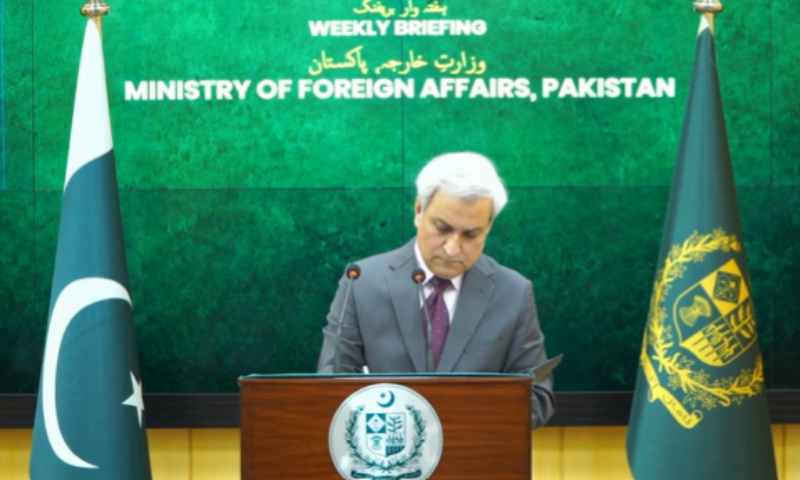
Islamabad, July 23, 2026: Pakistan on Thursday expressed disappointment over the European Union’s latest assessment of its compliance under the Generalised Scheme of Preferences Plus (GSP+), rejected allegations made in a recent Amnesty International report regarding military strikes in Afghanistan, and announced that Deputy Prime Minister and Foreign Minister Senator Mohammad Ishaq Dar will attend the Shanghai Cooperation Organisation (SCO) Council of Foreign Ministers meeting in Kyrgyzstan.
Speaking at the weekly media briefing, Foreign Office spokesperson Tahir Andrabi said Pakistan appreciated the European Commission’s acknowledgement of the country’s legislative progress and continued compliance with the 27 international conventions required under the GSP+ framework. However, he said the overall assessment failed to present a balanced picture of Pakistan’s performance.
The European Commission’s report, issued last week as part of its global assessment of the GSP scheme for the 2023-2025 period, stated that Pakistan had regressed in several areas while positive progress remained limited.
Responding to the report, Andrabi said it understated the breadth of reforms undertaken since Pakistan joined the GSP+ programme in 2014 and placed disproportionate emphasis on slower progress in a limited number of areas.
He reiterated that GSP+ remained central to Pakistan’s economic relationship with the European Union, supporting exports, employment, women’s economic participation, poverty reduction and broader economic development.
Describing the arrangement as mutually beneficial, the spokesperson said Pakistan would continue to engage constructively with the European Commission and other EU institutions while remaining committed to the effective implementation of the international conventions underpinning the GSP+ framework.
He added that Pakistan’s partnership with the European Union extended well beyond trade preferences to include cooperation in development, migration, counterterrorism, regional stability, climate resilience and connectivity.
Pakistan rejects Amnesty International report
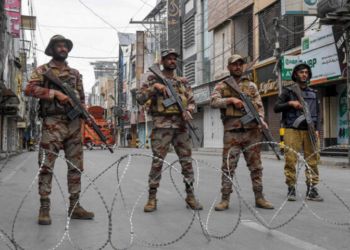
During the briefing, Andrabi also categorically rejected allegations contained in an Amnesty International report released on July 21, which claimed that Pakistani strikes in Kabul on March 16 had targeted a rehabilitation facility and resulted in civilian casualties.
“We completely reject the allegations made by Amnesty International,” he said, describing it as unfortunate that such serious claims had been made without credible evidence.
The spokesperson maintained that Pakistan’s military action was carried out strictly in exercise of its inherent right to self-defence under international law, was undertaken only as a last resort, and exclusively targeted terrorists and their logistical support bases in Afghanistan.
He said Pakistan’s response remained proportionate to the level of threat and strictly adhered to the principles of distinction, precaution and proportionality, adding that the scale of the operation reflected restraint despite the severity and frequency of terrorist attacks against Pakistan.
According to Andrabi, Pakistan rejects any suggestion that its actions deliberately targeted civilians.
He urged Amnesty International and the broader international community to focus instead on what he described as the Afghan Taliban’s continued patronage of terrorist organisations operating from Afghan territory.
The spokesperson called on the Taliban authorities to fulfil their obligations under relevant United Nations Security Council resolutions and the Doha Agreement by preventing Afghan soil from being used for terrorist activities against other countries.
He reiterated that Pakistan reserved the right to take all necessary measures to safeguard its sovereignty, territorial integrity and the safety of its citizens, stressing that no responsible state could remain passive while its civilians and security personnel continued to face cross-border terrorist attacks.
Andrabi further alleged that the Taliban administration continued to provide a permissive environment for terrorist groups, including the Tehreek-i-Taliban Pakistan (TTP), the Baloch Liberation Army (BLA) and their affiliates, enabling them to recruit, finance and launch attacks against Pakistan.
Dar to attend SCO foreign ministers’ meeting
The Foreign Office also announced that Deputy Prime Minister and Foreign Minister Senator Mohammad Ishaq Dar will travel to Kyrgyzstan on a two-day visit to participate in the Shanghai Cooperation Organisation (SCO) Council of Foreign Ministers meeting.
Andrabi said Dar would lead Pakistan’s delegation at the ministerial meeting and was expected to call on Kyrgyz President Sadyr Zhaparov while holding several bilateral meetings with his counterparts on the sidelines of the conference.
The Foreign Office said the Council of Foreign Ministers is the SCO’s third-highest decision-making forum and discusses key regional and international issues, including the organisation’s foreign policy and security agenda. Pakistan, China, Russia, India and Iran are among the ten member states of the Eurasian bloc.