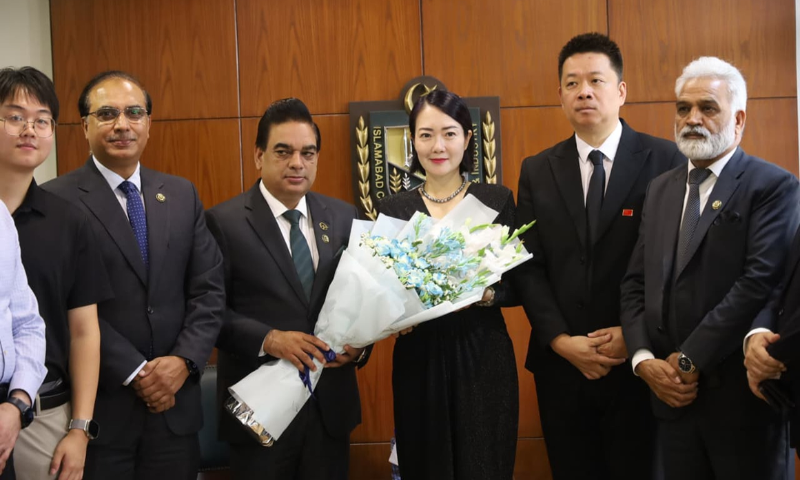
Islamabad, August 7, 2026: President of the Islamabad Chamber of Commerce and Industry (ICCI), Sardar Tahir Mehmood, has called for taking Pakistan-China economic cooperation beyond its traditional framework by focusing on innovation, advanced manufacturing, digital transformation and high-value investments, saying the next phase of the all-weather strategic partnership should be driven by knowledge, technology and industrial excellence.
He made these remarks while addressing a high-level Chinese business delegation led by Mr. Li Ang, Deputy Secretary General of the Commercial Culture Association of China (CCAC) and the China Association for the Promotion of Western Development (CAPWD), during a meeting at the ICCI Chamber House.
The delegation also included Ms. Wu Rachel, Deputy Secretary General of CCAC and Chief Executive Officer of BSFL Culture, Education and Technology Group, along with ten leading Chinese entrepreneurs representing sectors such as electric vehicles, artificial intelligence, renewable energy, green technologies, industrial modernization, the digital economy, smart logistics, modern agriculture and technology-driven joint ventures.
Welcoming the delegation, Sardar Tahir Mehmood said Pakistan and China share an iron-clad friendship that has stood the test of time and continues to serve as a model of strategic cooperation. He noted that while the China-Pakistan Economic Corridor (CPEC) has laid a strong foundation for bilateral economic collaboration, the future requires greater emphasis on emerging sectors including electric vehicles, artificial intelligence, renewable energy, green technologies, industrial modernization, the digital economy, smart logistics, modern agriculture and technology-based joint ventures.
He said Pakistan offers an attractive investment destination due to its strategic geographical location, young workforce, expanding consumer market and significant industrial potential. He emphasized that the country’s evolving economic landscape presents substantial opportunities for Chinese enterprises seeking regional expansion and long-term partnerships.
Speaking on the occasion, Mr. Li Ang appreciated the warm hospitality extended by ICCI and reaffirmed the Chinese business community’s confidence in Pakistan’s economic future. He said the delegation’s visit reflected China’s continued commitment to expanding commercial cooperation with Pakistan and expressed optimism that direct engagement between entrepreneurs from both countries would generate new investment opportunities, technology partnerships and mutually beneficial business ventures.
Ms. Wu Rachel highlighted the importance of strengthening people-to-people contacts, educational collaboration, cultural exchanges and technological cooperation to build long-term economic relations. She said closer interaction between Pakistani and Chinese enterprises would create sustainable opportunities for innovation, entrepreneurship and inclusive economic growth.
During the interactive session, business leaders from both countries discussed measures to expand bilateral trade, strengthen industrial collaboration, promote technology transfer, attract investment and develop effective mechanisms for facilitating joint ventures. Participants also explored new opportunities for cooperation in high-growth sectors capable of generating long-term economic benefits for both countries.
ICCI Senior Vice President Tahir Ayub said the chamber remains committed to building stronger institutional partnerships with leading Chinese organizations and providing an effective platform for meaningful business collaboration that contributes to sustainable economic development in Pakistan and China.
Earlier, ICCI senior member and coordinator of the Chinese delegation, Waqas Ahmed, delivered a detailed presentation highlighting the trade, investment and industrial potential of Pakistan and China while identifying promising areas for future cooperation.
The meeting was also attended by ICCI Vice President Mohammad Irfan Chaudhry, Executive Members Zulqurnain Abbasi, Waseem Chaudhry and Imran Minhas, former Senior Vice President Fahad Waheed, and a large number of business leaders representing various sectors of the economy.