
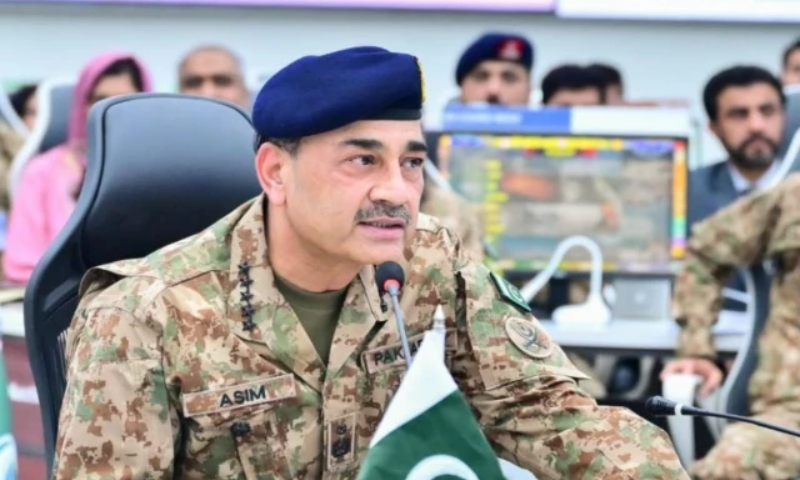
Islamabad/Tehran/Washington, August 23, 2026: Chief of Defence Forces (CDF) and Chief of Army Staff Field Marshal Asim Munir will visit Tehran on Monday as Pakistan intensifies diplomatic efforts to promote peace and stability in West Asia amid mounting tensions between Iran and the United States.
Iranian Foreign Ministry Spokesperson Esmaeil Baghaei announced the visit on Sunday, saying it was aimed at strengthening bilateral cooperation and building on Pakistan’s efforts to promote peace and security in the region. He said Field Marshal Munir would hold talks with senior Iranian officials during his visit.
Two Pakistani government sources also confirmed the visit, with one saying Islamabad and Tehran remained in direct contact. According to another Pakistani official, the discussions are expected to cover recent developments in the conflict, including US President Donald Trump’s threat of imposing tougher sanctions on Iran.
The talks are also expected to address peace efforts under an Islamabad memorandum of understanding, Trump’s latest warning, developments following the Pakistan-Turkey-Saudi Arabia agreement and the situation involving Yemen’s Houthis, the Pakistani source said.
The announcement of the Tehran visit followed a telephone conversation between Field Marshal Munir and Iranian Foreign Minister Abbas Araghchi earlier on Sunday. According to the Iranian government, the two discussed regional developments and ways to strengthen peace, stability and security in West Asia.
Pakistan has increasingly positioned itself as a mediator in efforts to ease tensions between Tehran and Washington. Field Marshal Munir has already visited Tehran several times this year as part of Islamabad’s diplomatic engagement. He travelled to Iran in April and again in May, when he was accompanied by Interior Minister Mohsin Naqvi. In July, he joined Prime Minister Shehbaz Sharif in Tehran to attend the funeral rites of Iran’s late Supreme Leader Ayatollah Seyyed Ali Khamenei.
Iran rejects US pressure
The planned visit comes as Iranian officials continue to reject what they describe as US military and economic pressure.
Iranian Foreign Minister Abbas Araghchi said on Sunday that Washington had no alternative to dialogue with Tehran based on respect, justice and dignity. He also described the US economic campaign as a repetition of what he called long-standing American bullying.
Araghchi further accused Washington of returning to what he described as old policies of military threats and claims of attacks, arguing that such measures demonstrated desperation rather than a new strategy.
Iranian President Masoud Pezeshkian, meanwhile, said on Sunday that his country was facing a “full-scale economic, military and security war”. He said his government was working to overcome the economic difficulties facing the country while maintaining what he described as Iran’s resilience and national unity.
Pezeshkian said Tehran would not make concessions and stressed that the country needed to move beyond what he called a “no war, no peace” situation. He argued that prolonged uncertainty over a possible resumption of hostilities was damaging Iran’s economy and making it difficult to attract investment.
At the same time, the Iranian president has called for a diplomatic solution, saying an end to the conflict would be preferable while Iran retained its strength and dignity.
Tehran issues warning over Strait of Hormuz
The situation has also raised concerns over the Strait of Hormuz, one of the world’s most important oil shipping routes.
Iran’s Supreme National Security Council Secretary Mohsen Rezaee warned neighbouring countries against joining what Tehran calls the US economic war. He said Iran would regard countries cooperating with Washington as hostile and threatened to target their interests if they participated in the campaign.
Rezaee also said Iran would not allow oil exports through the Persian Gulf if the economic blockade continued and maintained that the Strait of Hormuz would remain closed until Washington changed its behaviour and fulfilled its commitments.
The disruption has already sharply reduced maritime traffic through the strait. According to ship-tracking data cited in the source material, only four commodity ships travelled through the waterway on Thursday, with no large crude carriers or liquefied natural gas tankers among them. Iran, however, granted special permission for a number of Iraqi oil tankers to pass through following requests from Baghdad.
The US Energy Secretary Chris Wright said the US military had helped facilitate the movement of an average of eight million barrels of oil a day through the strait, compared with more than 20 million barrels a day before the war.
Iran highlights damage to nuclear facilities
Separately, the head of the Atomic Energy Organisation of Iran, Mohammad Eslami, said the country’s nuclear fuel production plant in Isfahan was among the first targets of US and Israeli military assaults.
Eslami said the facility produced fuel required by the Tehran Research Reactor, which is used for research and the production of radiopharmaceuticals. He added that a radiopharmaceutical production facility was also hit in the air raids.
He also said an oxygen-18 production line at the Khondab complex had been bombed. The material, he explained, is used for PET scans and was being produced domestically to support medical services in Tehran.
Diplomatic efforts continue
Alongside Pakistan’s engagement, Iran has continued diplomatic contacts with other regional countries.
Iranian Foreign Minister Abbas Araghchi and Egyptian Foreign Minister Badr Abdelatty discussed the latest developments in West Asia, including the situation in the Persian Gulf and Red Sea, during a telephone conversation on Saturday. The two sides also discussed diplomatic efforts aimed at de-escalating regional tensions and restoring peace and stability.
Iranian parliamentary speaker Mohammad Baqer Qalibaf has also said Tehran had received messages from neighbouring countries regarding possible new regional security arrangements and economic cooperation. He called for an independent, regional security order, arguing that such an arrangement could provide greater peace and stability.
Meanwhile, Iran has condemned plans by Washington to impose additional sanctions. Foreign Ministry spokesperson Esmaeil Baghaei described the proposed measures as an attempt to extend US economic jurisdiction over independent states and rejected secondary sanctions as having a basis in international law.
Execution and regional tensions
Against the backdrop of the wider conflict, Iran also executed a man accused of supporting hostile groups during anti-government protests. The judiciary identified him as Majid Adineh and said he had been convicted of offences including operational activities in favour of hostile groups, arson and conspiracy against national security.
Regional tensions have meanwhile spread beyond Iran. Kuwait condemned an Israeli drone strike on a civilian vehicle in a village southwest of Damascus that reportedly injured several civilians. Israel defended the operation, saying it had targeted what it described as terrorists in response to an immediate threat to its forces.
The latest developments have placed Pakistan’s diplomatic role under increasing international scrutiny. Field Marshal Asim Munir’s upcoming Tehran visit is expected to provide Islamabad with another opportunity to engage directly with Iranian leadership and support efforts aimed at preventing further escalation.
With Washington threatening tougher economic measures, Tehran warning of consequences for countries that cooperate with the US, and traffic through the Strait of Hormuz severely disrupted, Pakistan’s renewed engagement with Iran comes at a particularly sensitive moment for regional peace, energy security and international diplomacy.