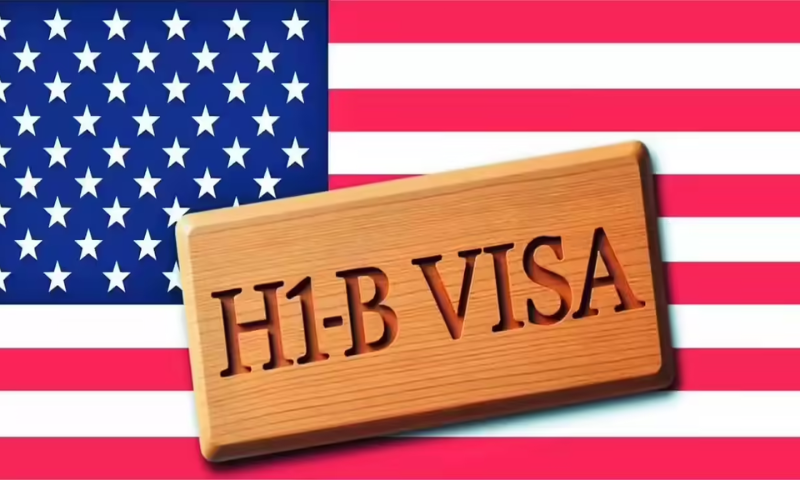
Washington, August 24, 2026: The administration of US President Donald Trump on Monday proposed a regulation to make permanent an unprecedented $103,265 fee on new H-1B visas for highly skilled foreign workers, reviving a policy that was introduced last year but has been blocked by US courts.
The proposed regulation, issued by the Department of Homeland Security (DHS), seeks to codify the fee initially imposed by Trump through a presidential proclamation in 2025. The measure has sharply increased the potential cost of H-1B visas, which are widely used by technology companies, universities, research institutions and other employers to recruit specialised foreign workers.
The proposed rule was posted online in the Federal Register on Monday and is scheduled for formal publication on Tuesday, triggering a 30-day public comment period. The regulation could be finalised by the end of the year.
Trump’s 2025 proclamation imposing the fee is due to expire in September, one year after it was issued. However, it directed the DHS to establish regulations that would make the charge permanent.
The proposed regulation comes amid continuing legal challenges to the fee. A federal judge in June ruled that the charge was unlawful and blocked the administration from collecting it. A Boston-based appeals court is reviewing that decision, while another court is considering a separate challenge brought by a major business group after a Washington, DC, judge rejected its case.
The legal challenges argue that the president’s authority to restrict the entry of foreign nationals does not allow the administration to override legislation establishing the H-1B programme.
The plaintiffs also argue that DHS cannot impose fees or other revenue-generating charges without explicit authorisation from Congress.
The Trump administration, however, maintains that the $103,265 charge is not a conventional tax and that federal courts have limited authority to interfere with the president’s power to restrict entry into the United States.
The H-1B programme allows US employers to hire foreign workers in speciality occupations requiring specialised knowledge and training.
The programme provides for 65,000 visas annually, along with an additional 20,000 visas for foreign workers holding advanced degrees from US institutions. H-1B visas generally allow employment for an initial period of up to three years, with extensions potentially taking the total period to six years.
Before Trump’s fee was introduced, H-1B applications typically involved government charges ranging from around $2,000 to $5,000, depending on the circumstances of the application and employer.
The proposed $103,265 charge would therefore represent a dramatic increase in the cost of employing eligible foreign workers under the programme.
The fee has become part of a wider political and economic debate over the role of foreign workers in the US labour market.
Trump and other critics of the H-1B system argue that companies have used the programme to replace American workers with less expensive foreign labour.
Business groups and many companies, however, contend that the programme is essential for addressing shortages of qualified workers in specialised fields and enabling US businesses to recruit highly skilled global talent.
Court filings show that around 70 employers had paid the $100,000 fee on 85 H-1B applications as of late February.
The US Chamber of Commerce, the country’s largest business lobbying organisation, Democratic-led states and a coalition of unions and employers are among those challenging the fee in court.
The lawsuits could be amended to challenge the new DHS regulation once it is finalised.
Trump introduced the fee by invoking presidential authority under federal immigration law to restrict the entry of certain foreign nationals whose admission he argued would be detrimental to US interests.
The administration has defended the measure as part of its broader effort to reform the immigration system and discourage what it considers excessive reliance on foreign labour.
The policy has already coincided with a decline in demand for H-1B visas.
According to data from US Citizenship and Immigration Services, employers registered for around 344,000 H-1B visas last year, more than 25 percent lower than in 2024 and less than half the approximately 794,000 registrations recorded in 2023.
The administration has also introduced enhanced vetting of H-1B applicants and proposed changes to the visa selection system that would give greater preference to higher-skilled and higher-paid workers.
Earlier in August, DHS separately proposed fees of up to $4,500 for applications involving extensions of stay for H-1B workers or transfers of employees based abroad to the United States.