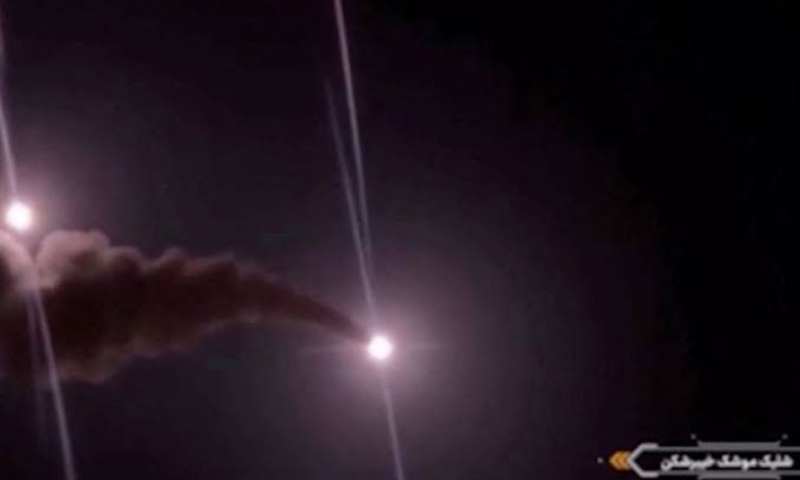
Tehran, August 31, 2026: Iran on Monday launched missile and drone attacks against US military-linked targets in Jordan and the United Arab Emirates, in retaliation for recent American strikes on Iranian territory, marking a fresh escalation in the six-month conflict.
Iran’s Islamic Revolutionary Guard Corps (IRGC) said it had targeted two US military bases in Jordan with ballistic missiles, claiming the strikes caused “heavy damage”.
Jordan’s military said it intercepted eight missiles but did not identify their origin.
Iranian state television also reported that the Iranian army had launched a drone attack against the Al Minhad Air Base in the UAE, claiming that US forces and helicopters were stationed there.
The UAE, however, rejected reports that the Al Minhad base had been targeted by missiles, describing the claims as “false”.
The UAE Ministry of Defence said its armed forces remained on a high state of readiness to respond to any threats while safeguarding the country’s sovereignty, security and stability.
In a separate statement, the UAE said its air force had engaged a drone over its territorial waters that had originated from Iran, but provided no further details about the incident or whether the drone was destroyed.
Iran said its attacks were in response to US strikes on Iranian rocket launchers on a small island in the Strait of Hormuz.
The US Central Command said its forces had taken “limited, precise action” against IRGC units involved in laying sea mines that Washington said posed an imminent threat to shipping through the strategic waterway.
The IRGC said the US strikes caused casualties among its personnel and described its subsequent attacks as retaliation for “US-Zionist aerial aggression”.
The exchange of fire came shortly after the conflict reached its six-month mark and as hostilities had appeared to be easing in recent weeks.
US military officials said Washington had recently completed clearing sea mines from international shipping routes in the Strait of Hormuz.
“US forces are monitoring the area closely and remain prepared to protect the free flow of commerce through this essential waterway,” US Central Command spokesperson Navy Captain Tim Hawkins said.
Iran has effectively restricted shipping through the Strait of Hormuz, a crucial global energy route through which around one-fifth of the world’s oil previously passed.
The latest escalation followed President Donald Trump’s warning that Iran’s key energy hub, Kharg Island, was being “blown to smithereens”.
Trump made the remark on social media after US forces struck two Iranian rocket launchers on another island in the Strait of Hormuz. The attacks were reportedly the first known direct US strikes on Iranian territory since late July.
Kharg Island is a critical component of Iran’s oil-export infrastructure and handled around 90 per cent of the country’s oil exports before the war began on February 28.
Any major attack on the island could severely disrupt Iran’s energy exports and intensify pressure on its already weakened economy.
The renewed military confrontation comes despite months of diplomatic efforts led by mediators including Pakistan and Qatar.
A ceasefire reached in April ended the most intense phase of the fighting, while the United States and Iran signed a memorandum of understanding in June aimed at paving the way towards a broader peace agreement.
However, negotiations have since stalled, with Washington increasingly focusing on what the Trump administration has described as “economic warfare” against Tehran.
A US naval counterblockade of Iranian ports has further squeezed Iran’s fuel supplies amid a domestic production shortfall.
The April ceasefire ended the most intense fighting, but sporadic attacks — particularly around the Strait of Hormuz — have continued to undermine prospects for a lasting settlement.
The latest US strike was preceded by an attack on Iran on July 29, which Washington said was conducted in response to an attempted surprise attack on US forces in the region. Earlier in July, US Central Command carried out strikes against Iran for 13 consecutive nights.
Iran has throughout the conflict retaliated against US military facilities and allied targets across the Gulf, with reported strikes affecting locations in Kuwait, Oman, Saudi Arabia and the UAE.
The continuing restrictions on the Strait of Hormuz have disrupted global energy and commodity markets, contributing to higher prices and shortages of fuel, fertiliser and other essential commodities.
Oil prices rose following the latest US strikes, with Brent crude moving back above $90 a barrel and West Texas Intermediate climbing above $85.
The conflict has also become increasingly controversial in the United States as the November midterm elections approach.
Senator Jack Reed, the senior Democrat on the Senate Armed Services Committee, criticised the administration’s handling of the conflict.
“Six months later, not a single objective has been achieved,” Reed said, arguing that the war had weakened the US position in the Middle East and internationally.
The latest exchange of strikes has further complicated diplomatic efforts to end the conflict, raising renewed concerns over the security of Gulf states and the uninterrupted flow of global energy supplies through the Strait of Hormuz.