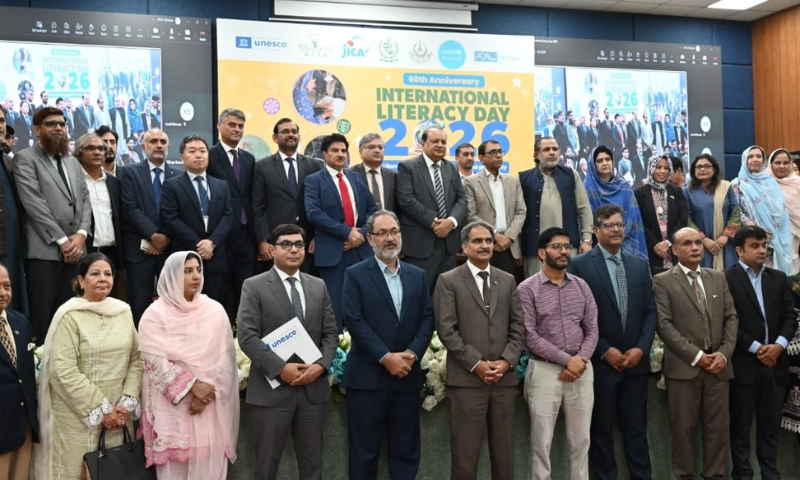
Islamabad, September 8,2026: Federal Minister for Education and Professional Training Khalid Maqbool Siddiqui stated that through formal, non-formal, and technical education, collective efforts will transform 150 million youth into a valuable national asset to meet both domestic and global skilled workforce demands. Addressing an event organized on International Literacy Day, he noted that Pakistan’s low literacy rate is a major challenge requiring innovative and effective strategies beyond traditional methods.
The Federal Minister suggested utilizing the country’s extensive network of mosques as short-duration educational centers between Ishraq and Dhuhr prayers. He highlighted that following the 18th Amendment, education is the responsibility of provincial and local governments, while the federal government continues its key role in policy formulation. Praising the efforts of JICA, NCHD, UNESCO, and UNICEF, Siddiqui emphasized that rural populations migrating to urban areas should be empowered through non-formal education rather than being viewed as a burden.
The minister stressed that despite 80 years of efforts to promote literacy in rural and underdeveloped areas, desired results have not been achieved, necessitating a unified national push involving educational institutions and civil society. He added that non-formal education systems can reintegrate out-of-school children and youth who face financial or geographical barriers.
Addressing the event, Takayuki Sugawara, Deputy Country Representative of JICA Pakistan, highlighted that JICA connects out-of-school children and adults with quality education and livelihoods through its AQAL project, the “Each One, Teach One” initiative, and Recognition of Prior Learning (RPL). Additionally, UNICEF Representative Pernille Ironside, UNESCO Representative Fuad Pashayev, Chairman NCHD Sadiq Iftikhar, and Vice Chancellor Allama Iqbal Open University Prof. Dr. Nasir Mahmood reaffirmed their commitment to delivering alternative, quality education to all.
Highlighting provincial progress, Balochistan Education Minister Raheela Durrani stated that the province’s literacy rate rose from 42% to 49%, while out-of-school children dropped from 58% to 45%. KP Advisor Mian Saad Uddin shared that KP holds a 51.09% literacy rate with 5.9 million students enrolled across 34,000+ schools. Azad Kashmir’s representative noted a allocation of PKR 52 million under Education Policy 2025 to enroll 260,000 out-of-school children, while Gilgit-Baltistan’s delegate reported an 86% literacy rate supported by 3,149 institutions.