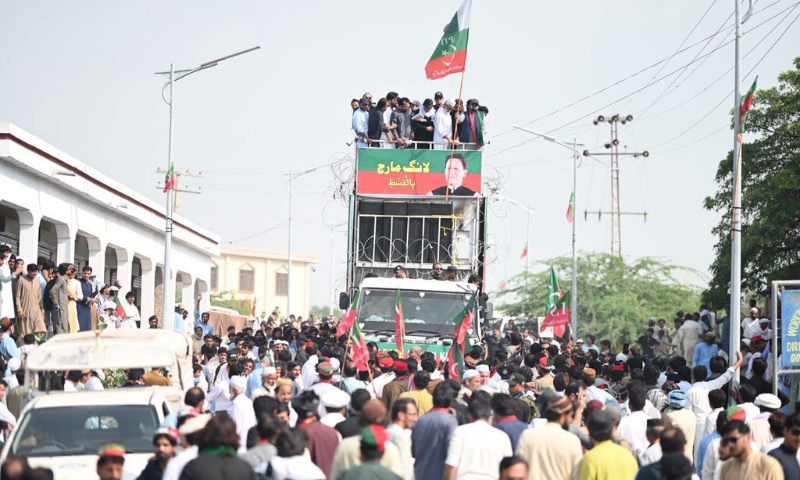
Karak/Kohat/Islamabad, October 5, 2026: Khyber Pakhtunkhwa Chief Minister Sohail Afridi on Monday resumed the Pakistan Tehreek-e-Insaf (PTI) protest march, addressing supporters in Karak before leading the convoy towards Kohat, as the opposition party pressed ahead with its campaign despite warnings from the federal government against any gathering in Islamabad.
The protest is primarily aimed at demanding the release of PTI founder and former prime minister Imran Khan, while the party has also raised objections to the federal government’s counterterrorism policy and demanded that its position be taken into account in decisions concerning security in Khyber Pakhtunkhwa.
Addressing supporters at Jail Chowk in Karak, Afridi again criticised the Centre’s counterterrorism policy, as well as past military operations and drone attacks.
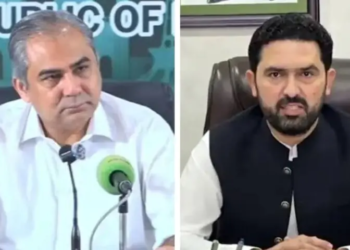
He also responded to Interior Minister Mohsin Naqvi’s remarks a day earlier in which the minister had described him as “immature”.
Referring to Punjab Chief Minister Maryam Nawaz’s statements about the terrorism threat to Punjab, Afridi said: “Suppose, I say that [my province] does not have a threat from India, but from the other three provinces, will you consider me mature?”
According to a post by Afridi, supporters in Karak were scheduled to join the convoy at noon, with departure planned for 12:30pm, although the convoy faced a delay.
The caravan is scheduled to spend Monday night in Kohat before resuming its journey towards Peshawar at noon on October 6. It will subsequently spend the night near Mattani.
The march had been launched from Lakki Marwat on Sunday afternoon after an earlier postponement, with Afridi’s convoy reaching Karak later that night.
The PTI decided to proceed with the march after weekend negotiations with the federal government failed to bridge differences between the two sides.
Talks end in deadlock
Two rounds of talks between the government and opposition on Friday and Saturday ended without an agreement, with access to Imran Khan and the federal government’s counterterrorism policy emerging as two major points of disagreement.
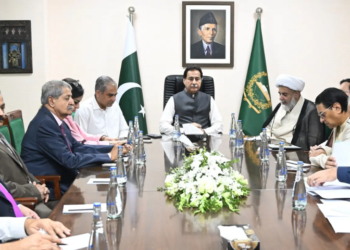
A joint delegation comprising representatives of the government and Pakistan Peoples Party (PPP) held talks with an opposition delegation comprising PTI and Tehreek-i-Tahafuz-i-Ayin-i-Pakistan (TTAP).
The government subsequently blamed Afridi for the failure of the negotiations. Naqvi said on Sunday that the KP chief minister had changed the proposed agreement.
Information Minister Attaullah Tarar separately accused the PTI representatives of maintaining what he described as “double standards and hypocrisy” during the talks.
The PTI, however, rejected the government’s version of events, saying it had entered the negotiations sincerely and was prepared to address the issues through dialogue.
PTI Secretary General Salman Akram Raja said on Monday that reconciliation between the government and PTI was not possible without including Imran Khan in the political dialogue.
Addressing a press conference at Khyber Pakhtunkhwa House in Islamabad, Raja said Imran had to be consulted on matters concerning the party.
“Only [Imran] has the capability to bridge the gulf that has developed between the state and the nation,” Raja said.
He said the party had sought immediate access to Imran, adding that the PTI had the right to obtain his opinion on the issues under discussion.
According to Raja, the government had agreed to restore meetings between Imran and his family members and lawyers from Tuesday but had declined to include access to the PTI founder as part of the proposed agreement.
Counterterrorism policy another sticking point
Raja said the federal government’s counterterrorism policy was another major reason for the failure of the negotiations.
He said the PTI had proposed a collective strategy to deal with terrorism in Khyber Pakhtunkhwa and had asked the government to consider recommendations made by a jirga convened by the KP Assembly.
The opposition delegation had also urged the government to take into account the views of tribal leaders, he said.
According to Raja, the PTI wanted the agreement to state that a collective decision would be taken on counterterrorism, but the government was unwilling to put such a commitment in writing.
“We were told that a unanimous strategy against terrorism would not be developed and it would not be included in the agreement,” Raja said.
Minister for Kashmir Affairs and Gilgit-Baltistan Amir Muqam, meanwhile, said on Monday that the government delegation had proposed that both sides should “be on the same page” regarding terrorism.
Restrictions and protests
Ahead of the march, authorities imposed restrictions under Section 144 in several areas of Khyber Pakhtunkhwa, including parts of Dera Ismail Khan, Upper and Lower South Waziristan, Tank and Hangu, for varying periods.
Former KP chief minister Ali Amin Gandapur, who had been leading PTI workers from Dera Ismail Khan towards Lakki Marwat, turned back from Yarik on Monday due to road blockades and the prevailing law and order situation.
Gandapur said Section 144 had been imposed in the area for three days and stressed that the party leadership had directed workers not to damage public property or engage in activities that could worsen the situation.
He said the decision to return should not be interpreted as a withdrawal from the protest movement, describing it instead as a temporary measure.
The protest campaign also faced restrictions in Karachi, where police personnel were deployed at several locations and roads were blocked.
The PTI claimed that more than 75 of its leaders and workers, including women, were detained from different parts of Karachi. The party further claimed that arrests in other parts of Sindh, including Sukkur, took the total number of detained PTI workers across the province to more than 100.
The federal government has warned that it will prevent gatherings in Islamabad, while the PTI has continued its march towards the federal capital despite the warnings.
The party has maintained that the protest will continue until its demands, particularly those relating to Imran Khan and its concerns over counterterrorism policy, are addressed.