
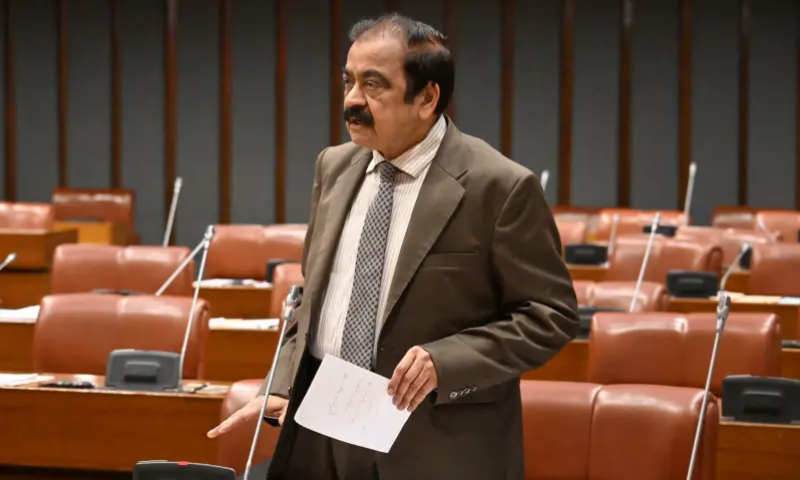
Islamabad, October 20,2026: Adviser to the Prime Minister on Political Affairs Rana Sanaullah on Tuesday said the federal government was ready to invite all political parties to build consensus on counterterrorism, urging the opposition to set aside other demands and stand united against terrorism.
Speaking in the Senate, the Pakistan Muslim League-Nawaz (PML-N) leader said Prime Minister Shehbaz Sharif was willing to bring political parties together to discuss ways to strengthen the national response to terrorism.
“Even now, if all parties can agree to sit down to discuss this issue, then Prime Minister Shehbaz Sharif is willing to invite them and find a way forward on counterterrorism or how operations can be supported by the entire nation,” Sanaullah said.
His remarks came amid heightened political tensions following the Centre’s imposition of emergency and governor’s rule in Khyber Pakhtunkhwa (KP) on October 11. The federal government cited the PTI-led provincial government’s alleged “deliberate disengagement” from counterterrorism efforts as the reason for the decision, which was subsequently endorsed by Parliament amid opposition protests.
Sanaullah criticised National Assembly Opposition Leader Mehmood Khan Achakzai, accusing him of refusing to recognise the National Assembly speaker’s authority despite his appointment as opposition leader and declining to meet the prime minister.
The PML-N senator also expressed sorrow over the martyrdom of an army officer a day earlier, highlighting the rising threat of terrorism and calling for a united political response.
He criticised the opposition for what he described as propaganda against the military leadership and said political rhetoric should not undermine national institutions at a time when the country was confronting serious security challenges.
Sanaullah also questioned the participation of the KP government in apex committee meetings, claiming that the provincial chief minister had attended only one such meeting in 11 months.
Recalling negotiations between the federal government and the Pakistan Tehreek-e-Insaf (PTI) earlier this month, he said both sides had agreed to establish a political committee comprising their representatives. However, he said the talks collapsed over the PTI’s alleged reluctance to fulfil its responsibilities and support federal counterterrorism efforts.
Chaudhry calls for national unity against terrorism
Federal Minister for Parliamentary Affairs Tariq Fazal Chaudhry also renewed the government’s invitation to opposition parties to develop a consensus against terrorism, saying the country’s peace and the future of its children depended on a united approach.
“I extended an invitation yesterday, and today I am once again inviting all opposition parties to come forward and build a consensus against terrorism,” he told the media.
“Why can we not develop a consensus, at least on this issue?” he asked, stressing that political differences should not be allowed to override the national interest.
Chaudhry said combating terrorism in KP was difficult without the provincial government’s full cooperation with federal institutions, the Pakistan Army and security agencies.
He alleged that the provincial government had refused to cooperate with the Centre on its Afghanistan policy, particularly efforts to prevent cross-border infiltration, describing this as the reason for imposing emergency in the province.
Criticising the PTI, the minister said the party was not prepared to condemn terrorism despite having governed KP.
He also pointed to networks allegedly linked to terrorist groups, smuggling operations and influential individuals accused of patronising them as factors contributing to persistent insecurity in the province.
However, Chaudhry said the provincial government was now extending full cooperation and expressed hope that the results would become visible soon. He added that counterterrorism operations would continue until the menace was eliminated.
Rejecting suggestions that the federal government’s move concerning KP was motivated by political power struggles, he said the objective was to restore peace.
“This is not a power game; it is a peace game,” he said.
The minister added that advisory councils comprising tribal elders had been established in 12 districts to empower local communities and facilitate intelligence-based operations in consultation with them.
Drawing a comparison with Balochistan, Chaudhry said the provincial administration, led by Chief Minister Sarfraz Bugti, was working alongside law enforcement agencies and federal institutions to combat terrorism. He said the Balochistan government had not refused to cooperate with the Centre, describing this as a key difference between the two provinces.
Political tensions deepen over KP security policy
Political tensions between the federal government and opposition parties had intensified in the days preceding the imposition of governor’s rule in KP. The PTI, which had been governing the province, had announced a protest march to Islamabad demanding the release of its jailed founder and former prime minister Imran Khan.
Negotiations between the government and the opposition in the week before the decision failed to produce an agreement, with counterterrorism policy emerging as one of the principal sticking points.
The PTI maintained that it was being excluded from security decisions concerning KP and called for a review of the counterterrorism policy. The federal government rejected the allegation of exclusion while criticising the provincial administration’s counterterrorism efforts and its position on dialogue with the Afghan Taliban.
The Centre subsequently authorised the deployment of Pakistan Army troops and assets in KP in aid of civil power.
Federal ministers have also alleged that the PTI-led provincial government maintained a “nexus” with terrorist groups, arguing that the province’s security situation warranted emergency measures.
The latest calls for political consensus underscore the continuing dispute over responsibility for counterterrorism in KP, even as the federal government urges political parties to set aside their differences and support efforts to restore peace.