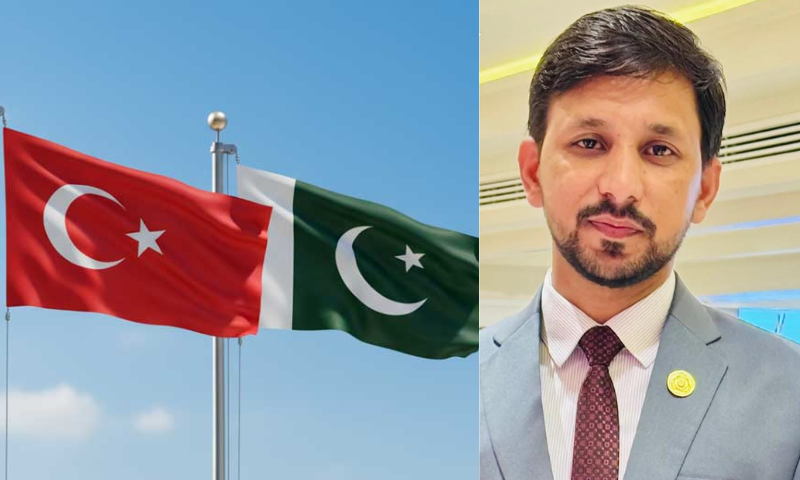
By Shabbir Hussain Ludharh
The Turks are a remarkable people. There was a time when their empire stretched across three continents and the halls of power in Europe reckoned with Ottoman strength. Then came an era when that same empire was described as the “sick man of Europe”. Its borders contracted, its provinces slipped away, and, after the First World War, the Turks’ own homeland faced foreign occupation and the threat of partition. A great era appeared to have reached its end. Yet the people of Anatolia still possessed one thing: the courage to rise again.
This decline unfolded over centuries. Difficulties in keeping institutions and the economy abreast of a changing world, internal weaknesses, intervention by European powers and successive wars steadily hollowed out the empire. The heirs of the Ottomans now faced the question of their very survival. It was in these circumstances that Gazi Mustafa Kemal Atatürk transformed scattered hopes into a national struggle. The War of Independence was fought, Ankara became the centre of national resistance, and, following the Treaty of Lausanne, the Republic was proclaimed on 29 October 1923. Atatürk was elected its first president.
On 29 October this year, the Republic marks 103 years since its founding. Behind this date lie the sacrifice of countless lives, a nation’s resolve and the desire to determine its own destiny. Atatürk faced the task of establishing state institutions, advancing education and laying the foundations of a new national life in a country emerging from war. Today’s Türkiye is the outcome of that reconstruction, the efforts of succeeding generations and the decisions taken in response to changing circumstances.
It was during that difficult period for the Turks that Allama Iqbal lit this lamp of hope
- Why grieve if a mountain of sorrow has fallen upon the Ottomans?
- For dawn is born from the blood of a hundred thousand stars.
The journey towards that dawn was not smooth. Türkiye also experienced military interventions, political strife, economic crises and terrorism. Even so, the development of the state, industry and education continued. There is an important lesson for us in this Turkish struggle. Sustaining national dignity requires keeping factories running, equipping young people with skills and enabling institutions to stand on their own feet. The world listens more closely to nations that possess the capacity to give weight to their words.
Today, Türkiye’s economy is an important source of that weight. According to the World Bank’s October 2026 report, its gross domestic product in 2025 was approximately US$1.6 trillion. Today, Türkiye stands among the world’s strong economies.
Türkiye is also making steady progress in tourism. According to the United Nations’ tourism agency, Türkiye was the world’s fourth-largest destination by international tourist arrivals in 2024, with tourism revenue of US$61.1 billion. Istanbul’s domes, Anatolia’s cultural heritage, the valleys of Cappadocia and the Mediterranean coast draw millions of people. The Turks have preserved their past while also making it a source of employment and income.
Behind this progress lies a world of universities and laboratories. In the QS World University Rankings 2027, Istanbul Technical University is tied at 279th, Middle East Technical University is ranked 305th, and Koç University is tied at 329th. Centres such as ODTÜ Teknokent connect universities with industry. TÜBİTAK’s Artificial Intelligence Institute is working to translate research into practical applications. This is the kind of work whose results emerge years later in the form of a new industry, an invention or a defence capability. Türkiye is a preferred destination for students from many countries around the world, including Pakistan.
Unmanned aerial programmes such as the Bayraktar TB2, AKINCI, TB3 and KIZILELMA have given the Turkish defence industry a prominent identity. Behind these names lies the sustained work of Turkish engineers, software specialists and research institutions. The project to build four MILGEM-class ships for the Pakistan Navy, together with technology transfer, connects this capability with bilateral cooperation. A lasting defence partnership takes shape when both sides strengthen each other’s industrial expertise and self-reliance. Today, Türkiye is one of the world’s major technology producers.
The Turks are now looking towards space as well. In January 2024, Alper Gezeravcı embarked on a mission to the International Space Station as the first Turkish astronaut, with 13 scientific experiments forming part of the mission. The domestically developed communications satellite Türksat 6A entered service in April 2025. In September 2026, TÜBİTAK announced the completion of the assembly and systems integration of its lunar spacecraft; its launch is targeted for the first half of 2027. The young people of a nation that once fought to save its own land are now preparing to reach the Moon.
Alongside this growing capability, Türkiye’s diplomatic confidence has also increased. That confidence is clearly visible in the activities of President Recep Tayyip Erdoğan and Foreign Minister Hakan Fidan. Hosting the 51st session of the Organisation of Islamic Cooperation’s Council of Foreign Ministers in Istanbul in June 2025, followed by the Makkah Joint Defence Agreement between Pakistan, Türkiye and Saudi Arabia in August 2026, further enhanced its role in the Muslim world. At a subsequent joint meeting, the three countries agreed to advance cooperation in the defence industry and joint technology development.
An important door has also opened in Türkiye’s domestic politics. In May 2025, the PKK announced that it would end its armed struggle and dissolve the organisation.
On Syria, Türkiye has remained one of the region’s important and influential actors. Alongside sheltering millions of Syrians, it has taken an active role in efforts concerning the new Syrian government, regional security and reconstruction. In supporting the ceasefire and integration agreement in January 2026, Ankara emphasised Syria’s unity, territorial integrity and inclusive governance. Syria’s wounds have yet to heal fully; the true value of Türkiye’s influence there will be determined by the safety of ordinary Syrians and the restoration of a stable state.
Contacts between Türkiye, Pakistan and Saudi Arabia also matter amid the wider tensions in the Middle East. The meeting in Tehran on 26 October 2026 between the Iranian leadership and Field Marshal Syed Asim Munir, Interior Minister Mohsin Naqvi, Saudi Defence Minister Prince Khalid bin Salman and Türkiye’s intelligence chief İbrahim Kalın was part of that effort. The region needs contacts that keep dialogue alive between the parties and help prevent the spread of war.
During the Russia–Ukraine war, working with the United Nations to open a route for grain shipments through the Black Sea was a notable example of Turkish diplomacy. Türkiye’s voice also continues to be heard in support of Palestinian rights. Now, from 9 to 20 November 2026, Antalya will host COP31, with Türkiye holding the presidency and Australia leading the negotiations. Across these different fields, Türkiye is creating both responsibilities and opportunities for itself.
For a Pakistani, this entire picture carries an emotional significance of its own. The affection expressed by the Muslims of the subcontinent during the Turkish War of Independence and the Khilafat Movement remains embedded in the foundations of this relationship. With the creation of Pakistan, the bond acquired a diplomatic form, and it grew stronger as the two countries helped each other through natural disasters and difficult times. President Erdoğan’s expression of solidarity with Pakistan during the Pakistan–India tensions of May 2025 was part of that same continuity.
Kashmir also holds a special place in this friendship. In his address to the United Nations General Assembly in September 2026, President Erdoğan reiterated the need to resolve disputes in South Asia, including Kashmir, through dialogue in accordance with the UN Charter and relevant resolutions. Travelling along Atatürk Avenue in Islamabad evokes the same historical connection. When a nation names a road in its capital after the founder of a friendly country, generations of attachment lie behind that gesture.
In Pakistan, the active diplomacy of Ambassador İrfan Neziroğlu and his team is visibly advancing this relationship through education, culture and people-to-people contacts. The Turkish Maarif Foundation, Yunus Emre’s cultural links and TİKA’s projects bring this friendship into people’s everyday lives. An educational opportunity for a student, training for a teacher or access to treatment for a family turns this relationship into a personal experience.
The upgrading of Teach For Pakistan’s training centre in Islamabad with TİKA’s support earlier this month is a good example. Inaugurated in the presence of Ambassador İrfan Neziroğlu and Minister of State for Federal Education Wajiha Qamar, the centre received modern teaching equipment, laptops and solar power facilities. More than 7,000 students are expected to benefit through the teachers trained under this project. TİKA’s Mother and Child Healthcare Centre in Raiwind was also established with the needs of a population of approximately 15,000 in mind.
In my view, it is through such work that the meaning of leading the ranks becomes clear. Advancing in knowledge, opening a path to dialogue in times of crisis and using one’s capabilities to benefit others lend legitimacy to leadership. Türkiye’s growing presence certainly recalls the historical reach and confidence of the Ottoman era. Today, the most meaningful expression of that confidence lies in assuming responsibility for knowledge, trade, cooperation and peace. Türkiye is now poised to assume leadership of the Muslim Ummah. Pakistan, Saudi Arabia and other countries will stand alongside it.
As we congratulate Türkiye on 103 years of the Republic, Pakistan should also learn from this experience. The next chapter of our friendship can be written through joint research, stronger industries and better opportunfor young people. Through their long journey, the Turks have reminded us once again that history continues after decline, provided a nation retains the courage to rise. The dawn of which Iqbal spoke is being illuminated by the Turks through their own hard work.
Long live Pakistan–Türkiye friendship.
The author is working as Public Relations Officer at the Standing Committee of OIC On scientific and Technological Cooperation (OIC-COMSTECH)