
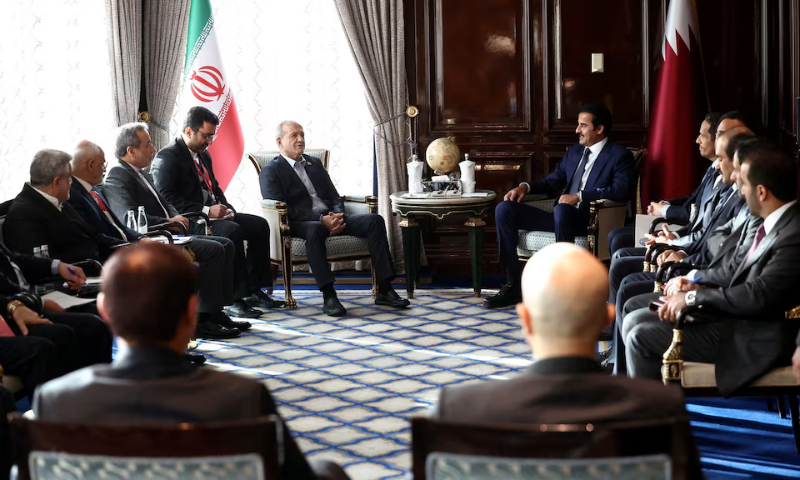
Tehran/Doha, October 28,2026: Qatar has presented Iran with a new draft proposal aimed at ending the eight-month war involving the United States and Israel, although Tehran has described the ideas as unacceptable and said they do not constitute a formal offer.
An official briefed on the negotiations said the proposal was delivered on Sunday and was under consideration by Tehran, with a response expected by the end of the week. Qatar and Pakistan have been leading diplomatic efforts to end the conflict, which has disrupted global shipping and oil supplies and expanded to Saudi Arabia and Yemen.
According to the official, the draft outlines a seven-day process involving daily confidence-building measures to address concerns raised by both Tehran and Washington. The process could begin early next week, with several countries serving as guarantors.
However, a senior Iranian official involved in the talks said Qatar had presented only “unacceptable ideas and not an offer”. The official added that Tehran’s position on the nuclear issue remained unchanged, with no flexibility on its stated policy.
Washington wants Iran’s nuclear programme included in negotiations from the outset. Tehran, meanwhile, insists that its conditions, including an end to the US blockade of Iranian ports and the lifting of sanctions on Iranian oil exports, must be addressed first. Iran rejects Western allegations that its nuclear programme is intended for military purposes.
The latest draft differs from a seven-day proposal Iran presented in late September, under which Foreign Minister Abbas Araghchi said the Strait of Hormuz could be reopened if certain conditions were met. US President Donald Trump rejected that proposal, prompting further Qatari mediation.
The conflict has also widened amid repeated attacks by Yemen’s Houthi forces against Saudi Arabia, a key US ally and the world’s largest crude oil exporter. Fighting intensified last month as the Houthis advanced against Saudi-backed forces towards the Bab el-Mandeb Strait, another critical global shipping route.
The official briefed on the negotiations said concerns had emerged ahead of Sunday’s meeting in Tehran that Israeli Prime Minister Benjamin Netanyahu could resume attacks on Iran during the week.
Jordan, Iran discuss sustainable ceasefire
Jordanian Foreign Minister Ayman Safadi and his Iranian counterpart Abbas Araghchi discussed efforts to secure a sustainable ceasefire between the United States and Iran during a telephone conversation late Tuesday, Jordan’s Foreign Ministry said on Wednesday.
The two ministers discussed ways to halt the escalation, reach a comprehensive settlement and establish a lasting ceasefire.
Safadi stressed the need for joint efforts to restore calm and achieve lasting regional security and stability. He also called for respect for international law, good-neighbourly relations, non-interference in other countries’ internal affairs and freedom of navigation through the Strait of Hormuz.
Oman urges Washington, Israel to return to negotiations
Omani Foreign Minister Badr Albusaidi called on the United States and Israel to leave Iran alone, urging a return to diplomacy and a peaceful resolution of regional conflicts.
In an interview with Iran’s IRNA news agency, Albusaidi said the destruction caused by war was not what people wanted and called for a “peaceful and just solution” to the Palestinian issue.
“I really hope they go back to the negotiating table and resolve what is pending,” he said.
Tehran criticises Trump’s remarks on Islamabad MoU
Iranian Foreign Ministry spokesperson Esmaeil Baghaei criticised US President Donald Trump’s reported remarks about the Islamabad Memorandum of Understanding (MoU), accusing Washington of undermining diplomatic commitments and disregarding international obligations.
In a post on X on Wednesday, Baghaei said Washington’s attitude towards diplomacy had once again exposed what he described as the “hollowness of their diplomatic commitments”.
He said Trump’s reported admission that he had never believed in the Islamabad MoU and considered it a waste of time reflected what Tehran viewed as a pattern of broken US commitments.
Baghaei also criticised European countries and other supporters of Washington, arguing that they had no justification for defending US actions or shielding it from accountability.
“Broken commitments cannot be excused, international law cannot be applied selectively, and no amount of political spin can absolve Washington of accountability,” he said.
Araghchi calls for regional cooperation without foreign intervention
Iranian Foreign Minister Abbas Araghchi stressed that regional cooperation without foreign military intervention was essential for lasting security, calling for joint efforts to counter Israeli aggression and terrorism, according to Press TV.
Separately, Iran’s Ambassador and Chargé d’Affaires to the United Nations, Gholamhossein Darzi, described sanctions as a form of economic terrorism and said blockades enforced through armed force constituted acts of aggression under international law.
Addressing the UN General Assembly during a discussion on the US embargo against Cuba, Darzi said sanctions and blockades had serious implications under international law.
Iran urges Qatar to uphold mediation principles
Iran’s Foreign Ministry urged Qatar to exercise greater caution in its public statements and adhere to the principles of mediation, citing Doha’s role in diplomatic efforts to end the war, IRNA reported on Wednesday.
Mahmoud Maleki, head of the Iranian Foreign Ministry’s Public Relations Department, responded to remarks by Ibrahim bin Sultan Al-Hashmi, director of the Media and Communication Department at Qatar’s Foreign Ministry, concerning the visit of senior Pakistani, Turkish and Saudi officials to Tehran.
On Tuesday, Al-Hashmi had said Iran needed to demonstrate its commitment to regional security by ending threats against neighbouring countries and reopening the Strait of Hormuz.
Maleki said the four-way meeting in Tehran itself demonstrated Iran’s goodwill and responsible approach towards shared regional interests.
He called on all regional countries, including Qatar, to show reciprocal goodwill and respect good-neighbourly relations. He also urged them not to allow their territory or facilities to be used for military attacks against Iran.
US war costs exceed $47 billion, Pentagon estimate shows
The US military has spent more than $47 billion on the war in Iran, according to a Pentagon estimate obtained by Reuters, marking an increase of more than 25% from the figure provided by Defence Secretary Pete Hegseth in July.
The Pentagon did not immediately respond to a request for comment. The latest estimate has not been made public.
The figures include operational expenses and projected replacement costs of more than $29 billion for munitions used during the conflict. More than $6 billion would be required to replace military equipment and platform losses, including aircraft and drones.
The rising costs come as Republicans face political pressure ahead of the November 3 elections that will determine control of Congress. Higher global energy prices linked to the conflict have weighed on support for Republican candidates and affected President Trump’s approval ratings, while his party holds narrow majorities in both chambers of Congress.
Trump launched the war jointly with Israel in February, initially predicting that the conflict would be brief. The US military initially relied on expensive precision missiles to weaken Iranian defences, intending to use less costly munitions later.
An April ceasefire, however, gave Iran time to recover underground storage facilities and restore access to some air defences, missiles and drones that had been inaccessible.
Trump subsequently imposed a naval blockade on Iran aimed at restricting its oil export revenue and has left open the possibility of renewed combat operations after the midterm elections. US officials, speaking anonymously, have said the Pentagon is preparing for a possible resumption of heavy fighting if ordered.
The latest estimate compares with Hegseth’s July assessment of $37.5 billion in war costs. Reuters reported that the figures cover a range of operational expenses, including flight operations and cyber support, but do not clearly account for the potentially substantial cost of repairing US bases damaged by Iranian missile and drone attacks.