Islamabad, November 7, 2026: The National Assembly’s Special Committee on Gender Mainstreaming has reaffirmed Parliament’s commitment to protecting the legal safeguards against workplace harassment, expressing concern that a recent Federal Constitutional Court (FCC) judgment could narrow the scope of protections provided under the law.
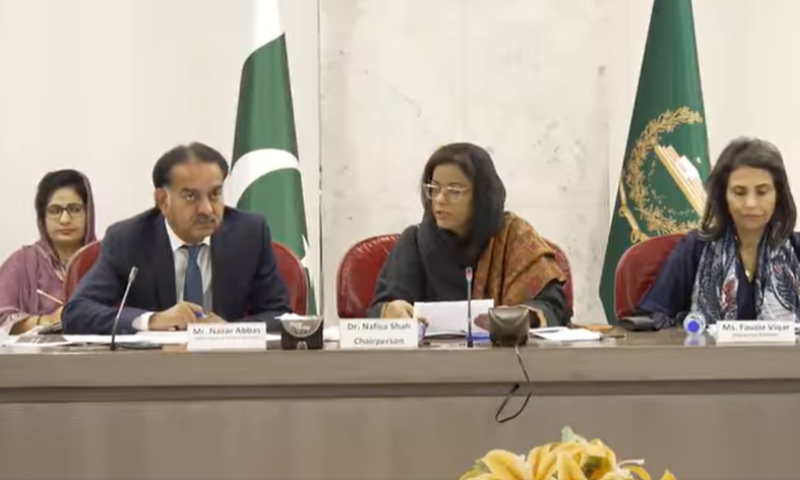
The committee, which met at Parliament House under the chairpersonship of Dr. Nafisa Shah, MNA, supported the Federal Government’s review petition against the judgment in Usman Shahid v. Nadia Sarwar and Connected Appeal (C.P.L.A. Nos. 1011 and 1113 of 2025), stressing the need to uphold Parliament’s legislative intent and ensure that protections against gender-based discrimination are not diluted.
During the meeting, Attorney General for Pakistan Mansoor Usman Awan briefed the committee on the legal grounds for the review petition. He observed that the court’s judgment appeared to have overlooked important legislative developments introduced through subsequent amendments to the law.
“Apparently, the court was either not properly assisted or the law had gone through changes that were not brought to its notice,” the Attorney General said.
He expressed the view that the government could request the court to reconsider the matter in light of the relevant legal provisions and earlier judicial interpretations.
FOSPAH Chairperson Fauzia Viqar also highlighted the implications of a restrictive interpretation of workplace harassment, explaining that a 2022 amendment had expressly incorporated gender-based discrimination into the statutory definition of harassment, whether or not it was sexual in nature.
“Requiring harassment to strictly show sexual intent is against not only the spirit but the letter of the amended law,” she said.
Committee Chairperson Dr. Nafisa Shah observed that the judgment appeared to depart significantly from Parliament’s legislative intent and the evolving jurisprudence of the Supreme Court of Pakistan.
The committee also expressed concern that the judgment could be inconsistent with principles established in Nadia Naz v. President of Pakistan (PLD 2023 SC 588) and subsequent rulings, which recognise workplace harassment as a matter involving power imbalances and gender-based domination, rather than limiting it solely to sexual conduct.
Members further questioned the requirement for independent third-party corroboration, observing that imposing such a standard could introduce criminal-law requirements into a civil remedial framework. They noted that workplace harassment frequently occurs in private or digital settings, where independent witnesses may not be available, potentially discouraging victims from reporting incidents and undermining constitutional protections relating to equality and dignity under Articles 25 and 14.
The committee recommended that the Federal Government and the Law Division vigorously pursue the review petition to safeguard Parliament’s legislative intent, including protections against non-sexual harassment under Section 2(h)(ii) of the relevant law and the applicable civil standards of proof.
The committee also reviewed the performance of the Federal Ombudsperson Secretariat for Protection against Harassment (FOSPAH), which reported that it had received 7,095 complaints since its establishment in 2010 and disposed of 6,944 cases, achieving a resolution rate of 98 per cent.
During 2025, FOSPAH received 1,290 complaints and resolved 1,288. These included 273 complaints involving federal entities, 703 from Punjab, 156 from Sindh and 123 from Khyber Pakhtunkhwa.
The committee appreciated the institution’s case-disposal performance but stressed the importance of strengthening safeguards against retaliation and ensuring protection for complainants and witnesses.
The committee also examined the gender-disaggregated performance of the Prime Minister’s Youth Programme (PMYP) under its four-pronged framework of Education, Employment, Engagement and Environment, appreciating progress in expanding opportunities for women across the country.
MNA Amna Batool, Youth Focal Person for the Prime Minister’s Youth Programme, said the programme had moved beyond setting basic gender quotas towards addressing the digital divide and empowering young women across all provinces.
She said female participation under the PM Youth Business and Agriculture Loan Scheme had reached 21 per cent, with Rs37 billion disbursed to 121,034 women, while women’s participation in skills training had increased to 46 per cent, exceeding the prescribed 33 per cent quota.
According to the briefing, between January 2023 and September 2026, Rs37 billion was disbursed to 121,034 female entrepreneurs under the loan scheme. Women’s share of loans reached 21 per cent in FY2025-26, while the non-performing loan rate among female borrowers stood at 0.7 per cent.
Under the NAVTTC Skills Development Programme, women’s participation reached 46 per cent in 2026, with 35,201 female trainees, surpassing the 33 per cent target. Another 500 women received specialised technical training under the “She Fixes” pilot initiative.
The committee was also informed that female students secured 58.5 per cent of merit-based laptops distributed under Phase IV, accounting for 55,728 recipients. Women represented 54 per cent of Digital Youth Hub users, with 310,300 female users, while 5,469 women accounted for 48 per cent of PEEF scholarship beneficiaries.
In sports, 67,054 female athletes participated in 10 different disciplines under the programme.
To further strengthen women’s economic participation, the committee recommended that the State Bank of Pakistan and commercial banks establish a minimum benchmark of 33 per cent female participation in youth and agricultural loan schemes.
It emphasised the need to recognise women’s creditworthiness and repayment performance while expanding their access to formal financing.
The committee also called for the active involvement of Rural Support Organisations, including the National Rural Support Programme (NRSP) and provincial organisations, in distributing Tier-I microfinance loans of up to Rs500,000 on an interest-free basis. The initiative aims to ensure that micro-credit reaches marginalised rural women at the grassroots level.
It further recommended comprehensive multilingual awareness campaigns and parliamentary orientation sessions for MNAs and MPAs to improve the visibility and outreach of the programme, particularly in remote districts.
The committee also constituted a four-member sub-committee under the chairpersonship of Senator Rubina Qaim Khani to examine women’s representation in Parliament and related institutions.
The sub-committee comprises MNA Shahida Rehmani, Senator Khalida Ateeb and MNA Munazza Hasan.
It will assess the challenges faced by women parliamentarians, review women’s inclusion and participation in parliamentary processes and leadership positions, and propose measures to promote gender equality, strengthen institutional support and improve women’s representation.
MNAs Shaista Pervaiz and Shahida Rehmani, Senators Rubina Qaim Khani and Khalida Ateeb, along with officials from the relevant departments, attended the meeting.