
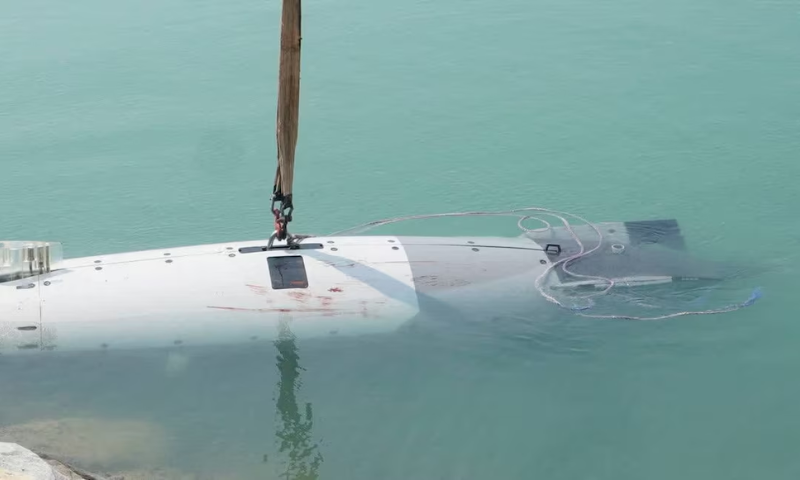
Tehran, November 16,2026: Iran’s Islamic Revolutionary Guard Corps (IRGC) Navy on Monday claimed it had seized control of a US military drone south of Qeshm Island in the Strait of Hormuz and brought it down intact amid escalating tensions in the strategic waterway.
In a statement, the IRGC Navy’s public relations office identified the aircraft as an MQM-170, saying it was intercepted during an electronic warfare operation in the morning.
The statement alleged that the drone was attempting to locate and identify Iranian air defence and electronic warfare systems when Iranian forces took control of its guidance system and forced it to land without damage.
The IRGC Navy said it was the fourth drone of this type captured by its electronic warfare and drone command and the eighth drone brought down intact by Iranian air defences in the Strait of Hormuz area.
It further claimed that Iranian forces had intercepted, destroyed or disabled other US drones, including MQ-9s, MQ-1s and Lucas attack drones. There was no immediate comment from the United States on the claims.
Separately, Iran’s army said an oil tanker caught fire on Monday after striking a naval mine in the eastern part of the Strait of Hormuz, warning vessels against entering what it described as restricted areas in the strategic waterway.
The British maritime agency, UK Maritime Trade Operations (UKMTO), also reported that a tanker had been struck by an unknown projectile while travelling outbound through the strait. The incident sparked a fire in the vessel’s engine room.
No casualties were reported, while the extent of the damage and any environmental impact remained unclear, according to UKMTO.
Iran’s navy said late on Sunday that another oil tanker had struck a naval mine east of the strait and caught fire. It described the vessel as having violated maritime restrictions and warned that ships entering restricted areas without coordinating with Iran’s armed forces risked hitting mines.
Earlier on Sunday, the IRGC claimed that two oil tankers had struck mines and caught fire while attempting to use an unauthorised route through the southern part of the strait.
It said one of the vessels, a supertanker carrying more than two million barrels of crude oil, had sunk in the southern Gulf. The IRGC did not identify the vessels or provide details about their crews.
Iran announced on July 12 that it had closed the Strait of Hormuz again following the resumption of US strikes on the country. Tehran has warned that vessels using routes other than those designated by Iran or attempting to transit without its permission could be targeted.
The Strait of Hormuz is a critical international shipping route for crude oil and liquefied natural gas, and disruptions to maritime traffic have heightened concerns over global energy supplies.
Addressing the 30th meeting of the Economic Cooperation Organization (ECO) Council of Ministers in Islamabad, Iranian Foreign Minister Abbas Araghchi blamed what he described as hostile US and Israeli policies for the prevailing insecurity in the Persian Gulf and developments in the Strait of Hormuz.
According to Iran’s official news agency IRNA, Araghchi said the situation stemmed from “hostile policies and joint acts of aggression by the United States and the Zionist regime against Iran”.
He said Iran’s defensive measures were directed exclusively at the targets and military bases of those it considered aggressors and should not be interpreted as actions against neighbouring countries or their people.
Araghchi also warned that the growing impact of US and Israeli actions on regional energy security made stronger energy cooperation an urgent strategic priority.
Meanwhile, the US Embassy in Bahrain urged American citizens on Sunday to exercise heightened vigilance amid escalating regional security threats and reported Iranian attacks.
In a security alert issued in Manama, the embassy advised citizens to remain alert to possible warnings, flight cancellations, airspace closures and travel disruptions. It also cited the risk of armed attacks by forces affiliated with Yemen’s Houthi group and possible targeting of US government personnel, facilities and businesses.
The embassy said routine citizen and visa services would continue, while advising travellers across the Middle East to monitor airline operations and prepare contingency plans.
The advisory followed an announcement by Bahrain’s Defence Force that its air defences had intercepted multiple Iranian aerial attacks. The force said its units remained at the highest level of readiness and were prepared to defend the kingdom.
Earlier on Sunday, the IRGC claimed it had targeted a US radar installation at Bahrain’s Al-Riffa Air Base with six drones amid continuing tensions between Washington and Tehran.