
Turbat, November 19,2026: Chief of Army Staff (COAS) and Chief of Defence Forces (CDF) Field Marshal Asim Munir has commended the Pakistan Army’s operational preparedness and professionalism amid challenging conditions, the Inter-Services Public Relations (ISPR) said on Thursday.
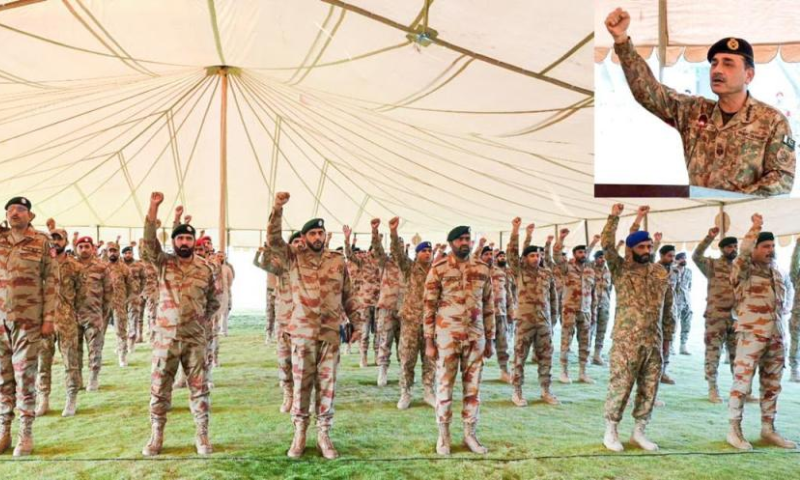
During his visit to Turbat, the army chief received a comprehensive briefing on the prevailing security situation, operational readiness and ongoing operations against what the military described as externally sponsored terrorism.
The Corps Commander Balochistan received Field Marshal Munir upon his arrival. He subsequently laid a floral wreath at the Shuhada Monument and offered Fateha for the martyrs.
Interacting with troops, the army chief praised their professionalism and unwavering resolve to defend the country.
He reaffirmed the Pakistan Army’s commitment to stand alongside the people of Balochistan in their efforts to achieve peace, prosperity and sustainable development.
Field Marshal Munir was also briefed on the progress of various ongoing socio-economic development initiatives aimed at improving the lives of people in the province.
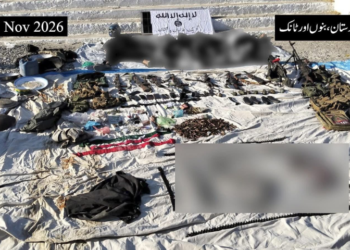
The visit comes days after two Pakistan Army personnel, including a major, were martyred and eight terrorists killed in an engagement in the Kolpur area of Balochistan.
According to the ISPR, terrorists backed by India targeted military vehicles on patrol using armed quadcopters on November 14. The attack resulted in the martyrdom of Major Omer Minhas Nasir and Havildar Muhammad Adnan Khan.
Pakistan has witnessed an increase in terrorist activities, particularly in Khyber Pakhtunkhwa and Balochistan, since 2021, when the Afghan Taliban returned to power in Afghanistan.
According to a report by the Centre for Research and Security Studies (CRSS), the two provinces remained the country’s main hotspots for violence during the second quarter of 2026, accounting for nearly 96 per cent of all violence-related fatalities recorded nationwide.
The report said more than 61 per cent of the fatalities, or 475 deaths, occurred in Khyber Pakhtunkhwa, while Balochistan accounted for 34 per cent, or 265 deaths.
Khyber Pakhtunkhwa also recorded the highest number of violent incidents, with 151 cases, representing 57 per cent of the national total. Balochistan reported 94 incidents, accounting for 35 per cent, highlighting the concentration of militant activity in the two provinces.