By Muhammad Mohsin Iqbal
The monsoon rains in Lahore have always held a special place in my heart, not merely as a season, but as a chapter of life rich in fragrance, emotion, and memory. With each drop that falls upon the ancient soil of this historic city, my mind returns to those cherished mornings spent with my beloved late father, Chaudhry Muhammad Iqbal, whose discipline and affection were the guiding stars of my childhood.
My father was a man of unyielding routine. Come rain or shine, cold winds or the crisp amber hues of autumn, he would set out for his morning walk in Bagh e Jinnah (formerly known as Lawrence Garden) right after Fajr prayers. It was a practice he followed with religious sincerity. Long before I reached the eighth grade, I had begun to accompany him, clutching a book in hand, partly to honour his discipline, and partially for the unspoken delight of being in his presence.
Our walk would begin with a graceful loop around Bagh e Jinnah, its winding paths shaded by majestic trees, their leaves trembling with morning dew. Once my father concluded his first round of the garden with brisk walk, I would continue alone, wandering toward the Mughal Garden. There, barefoot, I would tread softly on the wet grass, its chill both awakening and soothing. That green canvas, kissed by dawn, became my study room, my sanctuary, where I prepared for upcoming exams, surrounded by nature’s unmatched tranquility.
The Bagh e Jinnah boasts an almost encyclopedic collection of trees—each offering shade, fragrance, and inexplicable comfort. Breathing under their canopy, one could feel not just rejuvenated, but healed. There is indeed truth in the ancient belief that time spent amid trees cures ailments both of the body and the soul. Scattered among these botanical sentinels were fruit trees too—jamun trees in particular were both prominent and prized.
During the rainy season, jamuns would appear like amethyst treasures—gleaming in the early light, piled high in baskets across the garden. With the newfound medical understanding that jamuns aid in the control of diabetes, their demand soared. Walkers would buy them in handfuls, convinced they were plucked fresh from the trees above. The idea of eating fruit straight from nature’s lap lent a certain satisfaction that no packaged luxury could match.
However, one morning, my father—fondly called Haji Sahib by many—cast a knowing eye upon the jamun vendors and remarked, “They claim these are fresh from the garden, but how could such large quantities be plucked daily from just a limited tree?” His question lingered in my thoughts. The following morning, we reached earlier than usual and caught a vendor red-handed, unloading crates of jamuns purchased from the local market. The charm of the illusion was shattered, yet it brought us immense amusement. We chuckled together, amused by the psychological play that made the same fruit taste fresher when imagined to be picked from one’s own backyard.
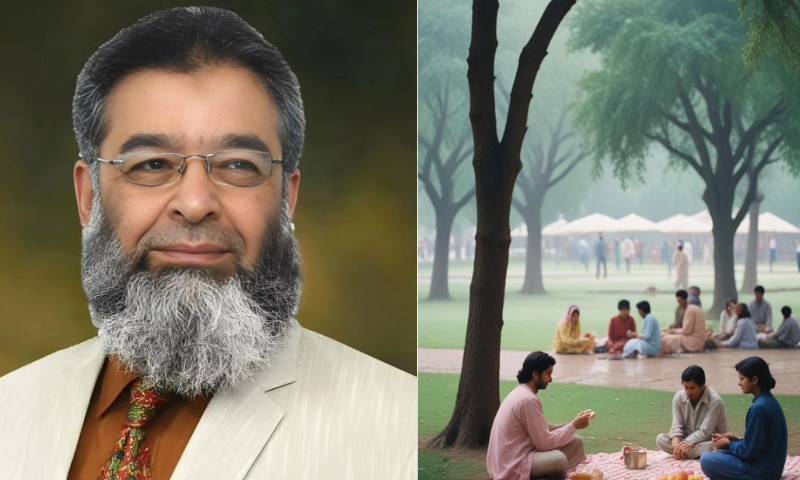
Those days were also defined by the delightful simplicity of seasonal food. On a rainy morning, the combination of Puri Halwa, Metha Pur’ra, Qeemay Waala Pura, with lassi was an example of itself. After having this breakfast, users slept for hours. Rainy days of monsoon in Lahore were incomplete without the aroma of freshly baked mincemeat rotis or Nans (Qeemay Walay Nan), the tang of curd chutney, the sweetness of mangoes, and the refreshing coolness of lassi. Sometimes, we would carry these treats to picnic spots such as Bagh Jinnah, Kamran’s Baradari, Jahangir’s Tomb, Shahi Qila, or the Badshahi Masjid, where friends and family would gather beneath overcast skies, sharing laughter, stories, and food under the rain-washed trees and domes.
And how can one forget the traditional childhood games that came alive during the rainy season? In narrow mohallas and wide-open courtyards, children played barefoot in the rain-soaked streets. Paper boats would float along the flowing rainy water, each child cheering their tiny vessel as it sailed past leaves and pebbles like a warrior of monsoon waters. Girls and Elder women, seated in woven charpoys beneath tin roofs, would sip cardamom-laced chai and reminisce about their own childhood rains, often while shelling peas or slicing raw mangoes to be pickled.
The rain would also bring with it a special rhythm to the city—street vendors calling out in high-pitched tones, selling roasted corn (Bhutta) smothered in salt and lemon; fried pakoras crackling in giant woks placed under makeshift tarpaulin shades; the spicy aroma of aloo samosas mingling with the petrichor rising from the earth. These were not merely snacks, but seasonal rituals—a feast for the senses that defined monsoon in Lahore.
We have become entangled in the tangles of life and have forgotten these sensory contents. The scent of damp earth, the taste of seasonal fruits, the feel of dew-laced grass under bare feet, and the sound of gentle rain mingling with morning birdsong—these experiences that once nourished our spirits are now buried beneath schedules and screens.
There was a purity to those moments, a sacredness to such companionships. Time, however, moves on with unrelenting grace. Many of those dear souls are no longer with us. The city has grown, perhaps even prospered in concrete and commerce, but the heart longs for what cannot be replaced—the people, the innocence, and the quiet depth of connection found in shared silence under a cloudy sky.
Some memories, like the scent of wet earth after the first summer rain, linger forever. They are not merely recollections—they are treasures, eternal and irreplaceable. In today’s world of haste and distraction, they offer a bridge to what was once whole and beautiful. And though the seasons may change and time may take away those we love, the rains of Lahore will always remind me of my father’s quiet footsteps, of the jamun-laced laughter, of barefoot mornings in gardens kissed by dew, and of a Lahore that once whispered love through its rain.