By Muhammad Mohsin Iqbal
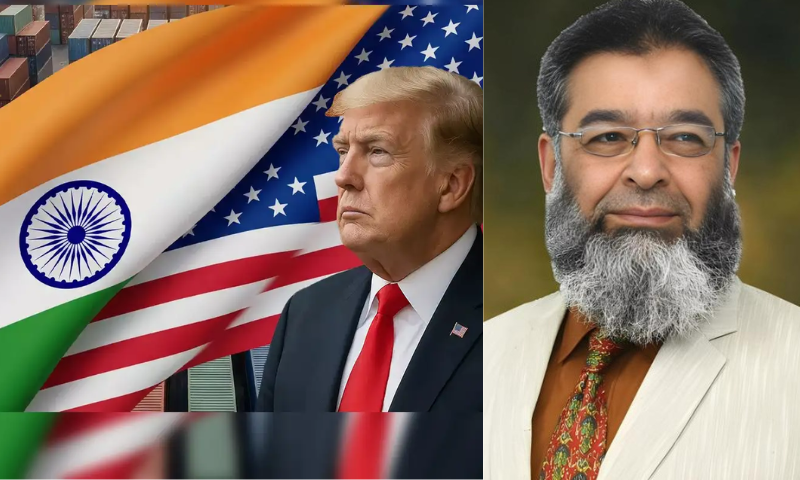
Since the early 2000s, the Indo-American relationship has largely been characterized by increasing strategic convergence, particularly in the domains of defense cooperation, trade, and shared concerns about the rise of China. However, during the presidency of Donald J. Trump (2017–2021), this relationship saw several unexpected dips, moments of diplomatic chill, and public expressions of dissatisfaction, especially from the American side. Contrary to the earlier fanfare about the natural alliance between the world’s largest democracies, the Trump administration’s posture toward India was often marked by cold pragmatism and visible discontent. This departure from the optimistic tones of the Obama era merits detailed examination.
President Trump, known for his transactional foreign policy, publicly voiced his frustration with India on multiple occasions. One of the earliest signs of this came on January 2, 2018, when Trump tweeted his tough on Pakistan, stating that the United States had “foolishly given Pakistan more than 33 billion dollars in aid over the last 15 years” and received “nothing but lies and deceit”. While this tweet was directed at Islamabad, it implicitly signaled a shift in Washington’s South Asia policy—one that placed pressure on regional allies, including India, to demonstrate their worth in tangible, deliverable terms.
Trump’s dissatisfaction with India became more explicit during trade negotiations. On June 5, 2019, the U.S. formally terminated India’s designation as a beneficiary developing country under the Generalized System of Preferences (GSP), affecting $5.6 billion in Indian exports. The U.S. Trade Representative’s office stated India had failed to provide “equitable and reasonable access to its markets”.
Despite Prime Minister Narendra Modi’s public bonhomie with Trump, especially at the “Howdy Modi” event in Houston on September 22, 2019, where Trump and Modi shared a stage before a crowd of over 50,000, the unresolved issues beneath the surface remained. Trump’s speech praised India’s democracy and economic rise, but in follow-up interviews and policy actions, trade friction continued without resolution.
On the defense front, while India signed key agreements such as Communications Compatibility and Security Agreement (COMCASA) in September 6, 2018 and Basic Exchange and Cooperation Agreement (BECA) in 27 October 2020, it irked Washington by proceeding with the purchase of the Russian S-400 missile system, valued at over $5 billion. Despite repeated warnings from U.S. officials, including then-Secretary of State Mike Pompeo during his June 2019 visit to New Delhi, India showed no signs of backing down. Pompeo warned that India risked sanctions under the Countering America’s Adversaries Through Sanctions Act (CAATSA) if it proceeded with the deal.
Further unease emerged over India’s reluctance to directly align with American strategic goals in Asia. Washington expected India to play a stronger role in the Indo-Pacific alliance. The Trump administration’s 2017 National Security Strategy named India as a key partner, yet U.S. strategists grew frustrated with India’s cautious approach. Despite participating in Quad meetings (Quadrilateral Security Dialogue) and the Malabar naval exercises, India hesitated to escalate tensions with China beyond controlled diplomatic means, especially during the Doklam standoff in 2017 and the Galwan Valley clash in June 2020.
An episode that particularly strained trust was President Trump’s claim on July 22, 2019, during a joint press conference with Pakistani Prime Minister Imran Khan at the White House, that Prime Minister Modi had asked him to mediate on Kashmir. Trump said, “I was with Prime Minister Modi two weeks ago, and he actually said, ‘Would you like to be a mediator or arbitrator?’”. The Indian Ministry of External Affairs immediately issued a denial, reiterating that “no such request was made,” and that Kashmir was strictly a bilateral issue.
Trump’s overtures toward Pakistan further complicated the Indo-U.S. relationship. After starting his presidency with a sharp rebuke of Islamabad, the tone shifted significantly by mid-2019, particularly as Pakistan facilitated U.S.-Taliban peace talks in Afghanistan. During Khan’s visit to Washington in July 2019, Trump publicly thanked Pakistan for its “tremendous help” and emphasized a “very good relationship” going forward. This contrasted with the expectation in New Delhi that Washington would align more firmly with India post-Uri and Pulwama episodes.
India’s continued engagement with Russia remained a consistent source of tension, even beyond Trump’s presidency. Following Russia’s invasion of Ukraine in February 2022, the Biden administration and its NATO allies swiftly imposed severe sanctions on Moscow and expected global partners—including India—to join the Western consensus. However, New Delhi maintained a balanced, non-aligned stance. India abstained from several UN resolutions condemning Russia and continued to engage with Moscow diplomatically and economically.
A key point of contention was India’s increased import of Russian crude oil at discounted rates. While the West moved to isolate Russia economically, India ramped up its purchases, citing national energy security and consumer price stability. By late 2022, Russia had become India’s largest oil supplier, surpassing Iraq and Saudi Arabia. This drew criticism from American and European officials, but India defended its position firmly. At a press briefing in Washington in April 2022, Indian External Affairs Minister Dr. S. Jaishankar, when questioned about oil purchases, replied, “If you’re looking at energy purchases from Russia, I would suggest your attention be focused on Europe… We do buy some energy, which is necessary for our energy security.”
Herein lies the deeper question; is the diplomatic chill merely about oil, or does it reflect Washington’s growing unease with India’s role in BRICS, its economic alignment with the Global South, and its potential to challenge the global supremacy of the U.S. dollar? India, along with China, Brazil, Russia, and South Africa, has been promoting alternative payment mechanisms in BRICS, including cross-border trade in national currencies and potential expansion of a non-dollar reserve structure. For the United States, which depends on the dollar’s role as the global reserve currency to maintain its economic leverage and sanction regime, this trend is strategically alarming. While India is not overtly antagonistic toward the West, its pursuit of financial multipolarity—symbolized by energy payments to Russia in rupees and participation in non-dollar settlements—directly challenges the architecture of U.S.-led economic dominance. From Washington’s view, such developments may explain not only its pressure on New Delhi but also its lukewarm attitude, even during periods of public cordiality.
This episode underscores a long-standing Indian doctrine; multi-alignment rather than alliance dependency. It also reveals the enduring misalignment in expectations between Washington and New Delhi. While the U.S. wants India to stand firmly in the Western camp—against both China and Russia—India views its own interests through a prism of regional balance, strategic autonomy, and economic necessity. American impatience, whether under Trump or Biden, could not alter this fundamental reality.
In retrospect, the Trump-Modi era presented a paradox; public displays of camaraderie concealed policy-level disconnects. The friendship was real, but conditional. Trump wanted India to “buy more, do more, align more.” But from the American perspective, India did not seem to be meeting American expectations.
Thus, the chill in Indo-American relations during Trump’s presidency—and even beyond—was not the result of any single rupture, but of unmet expectations, clashing diplomatic styles, and divergent national interests. If anything, it served to remind both nations that a strategic partnership requires more than smiles and slogans—it requires trust, respect for each other’s red lines, and above all, realistic expectations.