By Muhammad Mohsin Iqbal
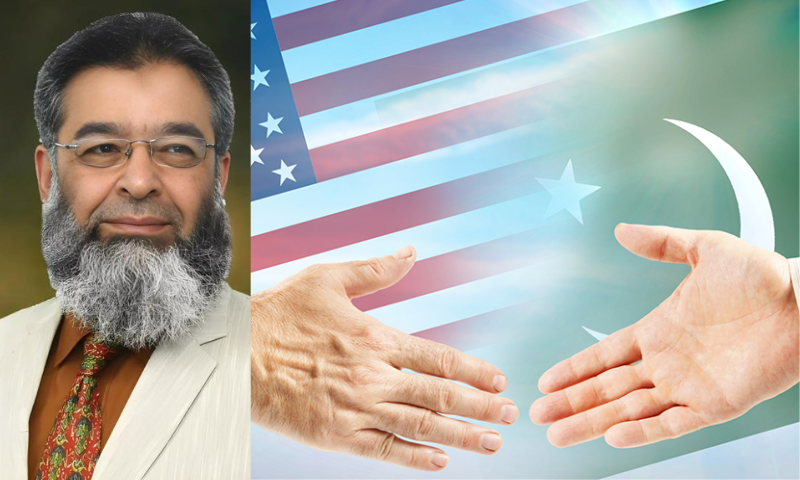
Pak-US relations have a long and complicated history, often resembling the unpredictable weather in the hill station of Murree. On a sunny day there, one might think the skies will stay clear, only to see clouds gather and rain start within minutes. In much the same way, trust in this relationship has never been constant—warmth and cooperation can suddenly turn into coldness and disengagement.
Noam Chomsky, the renowned American linguist and political thinker, once described U.S.-Pakistan relations in blunt terms, calling Pakistan a “tool” in Washington’s geopolitical chess game. Pakistan, in his view, has been useful when needed—against the Soviets, against Al-Qaeda—and then left on its own when Washington’s attention shifted elsewhere. His conclusion is clear; the United States does not have permanent friends—only permanent interests. U.S. support for military rulers such as Zia-ul-Haq and Pervez Musharraf, Chomsky insists, was never about promoting democracy but about securing bases, intelligence networks, and influence in the region.
In recent months, however, one development has been seen as a rare moment of alignment between Islamabad and Washington. The U.S. formally designated the Balochistan Liberation Army (BLA), responsible for spreading unrest in Balochistan, as a terrorist organization. This move, though long overdue in Pakistani eyes, was welcomed as a cool breeze, signaling a partial acknowledgment of Pakistan’s concerns. For years, Pakistan has highlighted the destructive role of groups like the BLA in sabotaging stability in Balochistan, targeting Chinese and local workers on CPEC projects, and undermining development in the province.
The significance of this decision cannot be understood without recognizing Balochistan’s immense wealth in natural resources. It is no exaggeration to say that Allah has blessed this province with treasures beneath its rugged mountains and desert plains. Balochistan is home to vast deposits of copper and gold—most famously at the Reko Diq site in Chagai District, which holds one of the world’s largest undeveloped copper-gold reserves. Saindak, another major mining site, has been producing copper, gold, and silver for decades. Beyond these precious metals, the province contains significant coal reserves in Dukki, Harnai, and Mach; large quantities of chromite in Muslim Bagh and Khuzdar; and marble of exceptional quality in Chagai and Loralai.
Oil and gas reserves, though less developed, are also present, with exploration projects underway in various districts. Natural gas fields such as Sui, while technically in Balochistan’s Dera Bugti, have long fueled industries and homes across Pakistan. In addition, Balochistan possesses rare earth elements, gypsum, limestone, and granite, resources that could fuel industrial growth for decades. The province’s location makes it even more strategic; its coastline along the Arabian Sea, particularly the deep-sea port of Gwadar, lies near vital shipping lanes and the mouth of the Persian Gulf. This is also the route through which pipelines could connect to oil and gas supplies in Iran and Central Asia.
For the United States, the geopolitical significance of Balochistan is intertwined with the China-Pakistan Economic Corridor (CPEC). Gwadar is a flagship CPEC project and a potential gateway for Chinese trade routes to the Middle East and Africa. Washington has often expressed concern about the security of this port and the broader Chinese presence in the region. The unrest in Balochistan, partly fueled by groups like the BLA, has raised questions about the viability of long-term projects. By supporting Pakistan’s efforts to dismantle such networks, the U.S. is not only aiding Chinese investment security but also ensuring that its own potential commercial interests in the region are preserved.
Interestingly, the current U.S. president’s approach to foreign relations seems less focused on military interventions and more on economic diplomacy. Unlike predecessors who preferred strategic entanglements, this administration appears more inclined toward fostering trade and infrastructure investments. This shift in priorities could have implications for South Asia. India, once a central pillar of U.S. Indo-Pacific strategy, may no longer be as indispensable in Washington’s economic calculus, especially given trade disputes, human rights concerns, and New Delhi’s balancing act between the West and Russia.
In this changing environment, opportunities may emerge for Pakistan—provided it acts with clarity and foresight. Our policymakers must recognize that while foreign support can be useful, no external power will prioritize Pakistan’s long-term welfare over its own interests. The history of our relations with Washington is testimony to this reality. Whether during the Soviet-Afghan War, when Pakistan was armed and funded to serve as a frontline state, or in the post-9/11 period, when our territory became a staging ground for counterterrorism operations, the pattern has been consistent; intense cooperation during shared crises, followed by neglect or even sanctions when those crises passed.
Now, with the U.S. labeling the BLA as a terrorist organization and signaling a willingness to engage in more constructive economic dialogue, Pakistan must decide how to channel this into lasting benefits. Securing Balochistan and unlocking its mineral wealth is not just an economic imperative but also a strategic necessity. Transparent policies, fair distribution of resource revenues, and local development are key to ensuring that the people of Balochistan see themselves as stakeholders rather than bystanders in the province’s progress. Only then can the province’s gold, copper, marble, coal, and energy reserves serve as a foundation for national prosperity rather than a source of conflict.
The metaphor of Murree’s weather still applies—Pak-U.S. relations may warm today and cool tomorrow—but by learning from history, Pakistan can prepare for those shifts. If we keep our own interests at the center, maintain a diversified network of international partnerships, and ensure that our internal stability is not hostage to external agendas, then even unpredictable weather can be managed. After all, clouds will come and go, but the strength of the ground beneath us—like the mineral-rich soil of Balochistan—must be our enduring foundation.