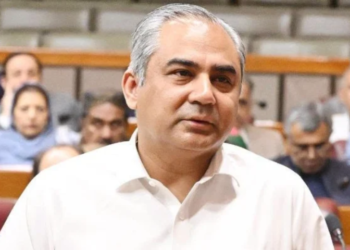
Islamabad, November 21, 2025: Chief Justice Aminuddin Khan, in his first public message as head of the newly created Federal Constitutional Court (FCC), hailed the establishment of the institution under the 27th Constitutional Amendment as a “landmark moment” in Pakistan’s constitutional development, underscoring its role in strengthening the rule of law.
His statement was published on the FCC’s newly launched official website on Friday.
Justice Aminuddin, appointed last week as the court’s first chief justice, said the FCC carries a mandate “of great significance: to interpret the Constitution with clarity, independence and fidelity; to safeguard the fundamental rights guaranteed to the people; and to ensure that the constitutional order remains a source of stability, justice and balance for all institutions of the state.”
He emphasised that the court’s decisions would have far-reaching consequences for the “lives, liberties and aspirations” of citizens and pledged that every case would be handled with “fairness and restraint, guided solely by the Constitution and the principles of justice.”
The chief justice noted that the launch of the FCC’s website marks an important step toward transparency. The platform will offer the public, the legal fraternity, and state institutions access to information on the court’s jurisdiction, procedures, and decisions.
“In an age where the effective delivery of justice is inseparable from the free flow of information, we hope this platform will serve as a meaningful bridge between the court and the people it exists to serve,” he said.
Justice Aminuddin expressed hope that the FCC would emerge as “a guardian of constitutionalism and an enduring symbol of justice for generations to come,” concluding his message with a pledge to discharge his duties “with wisdom, humility and unwavering commitment to the Constitution.”
Justice Aminuddin’s appointment followed the establishment of the FCC under the 27th Constitutional Amendment, which overhauled Pakistan’s judicial structure. The amendment dissolved the constitutional benches formed under last year’s 26th Amendment and transferred key constitutional powers of the Supreme Court to the newly formed FCC.
Key provisions include:
- Equal provincial representation in the FCC.
- Joint role of the president and prime minister in appointing judges.
- Transfer of constitutional cases from the Supreme Court to the FCC.
- Transfer of suo motu powers to the FCC, which may now initiate such proceedings on petitions.
- Retirement age of FCC judges set at 68, three years higher than that of Supreme Court judges.
Justice Aminuddin previously headed the now-dissolved constitutional bench created under the 26th Amendment. His legal career spans nearly four decades.
While Justice Yahya Afridi remains the country’s top judge until the completion of his three-year term, the amendments stipulate that the senior-most judge from among the Supreme Court and FCC will assume the top judicial office thereafter.
The reforms also include changes to bench-formation procedures under the Supreme Court Practice and Procedure (Amendment) Bill 2025. A three-member committee—comprising the chief justice of Pakistan, the most senior judge, and another nominated judge—will now decide bench compositions by majority vote.
These sweeping changes collectively mark one of the most significant restructurings of Pakistan’s judiciary in recent history.