Washington, March 19,2026: US Director of National Intelligence Tulsi Gabbard has identified Pakistan among countries posing potential strategic threats to the United States, citing concerns over evolving missile capabilities that could eventually place the American homeland within range.
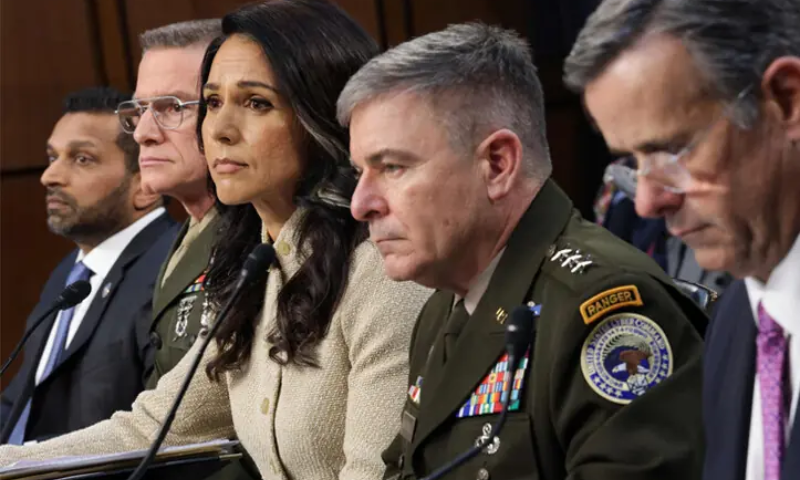
Presenting the 2026 Annual Threat Assessment before the Senate Intelligence Committee, Gabbard stated that countries including Russia, China, North Korea, Iran, and Pakistan are actively developing a range of advanced and traditional missile systems capable of carrying both nuclear and conventional payloads.
She warned that Pakistan’s long-range ballistic missile programme could potentially evolve to include intercontinental ballistic missiles (ICBMs) capable of reaching the United States. The US intelligence community also anticipates a significant rise in global missile threats, projecting that the number could exceed 16,000 by 2035, up from more than 3,000 currently.
Analysts, however, offered a more nuanced view. Washington-based scholar Shuja Nawaz described Pakistan’s inclusion in the list as consistent with previous US policy trends, noting that earlier administrations had imposed sanctions on certain Pakistani entities to curb technology acquisition.
He argued that most public assessments place the range of Pakistan’s Shaheen-III missile at under 2,800 kilometres and maintained that Islamabad’s nuclear doctrine is primarily focused on deterrence against India, rather than targeting regions beyond South Asia.
Another expert, Michael Kugelman, termed the reference “significant but not extraordinary,” noting that Pakistan was grouped with several other states rather than singled out. He added that while Islamabad may be uncomfortable with such comparisons, the broader US stance towards Pakistan has remained relatively measured.
South Asia security concerns
The threat assessment also highlighted South Asia as a region of “enduring security challenges,” particularly due to tensions between Pakistan and India. The report warned that relations between the two nuclear-armed neighbours continue to pose risks of escalation, especially in light of past conflicts.
It further noted that militant groups operating in the region remain a persistent concern, often exploiting political instability and ungoverned spaces to rebuild capabilities.
Tensions along the Pakistan-Afghanistan border were also flagged, with the report pointing to Islamabad’s concerns over the presence of anti-Pakistan militant groups in Afghanistan and intermittent cross-border clashes with Taliban forces.
Broader regional and global context
Beyond South Asia, Gabbard told lawmakers that the global security environment is becoming increasingly volatile, with both major and regional powers showing a greater willingness to use force—either directly or through proxies—to advance strategic interests.
On the Middle East, she said Iran’s government remains intact despite being weakened by ongoing conflict following the launch of “Operation Epic Fury” on February 28. However, Tehran and its allied groups retain the capacity to target US and allied interests in the region.
During the hearing, CIA Director John Ratcliffe emphasized that Iran has long posed a sustained threat to the United States. Meanwhile, Democratic Senator Michael Bennet raised concerns over the lack of clarity in Washington’s long-term strategy regarding Iran.
The hearing also revealed that President Donald Trump had been extensively briefed prior to US strikes on Iran, with intelligence warnings indicating potential retaliation, including possible disruption of the Strait of Hormuz—a key global energy route.
The annual assessment underscores growing global security risks, with missile proliferation, regional conflicts, and non-state actors expected to remain central challenges for US policymakers in the coming decade.