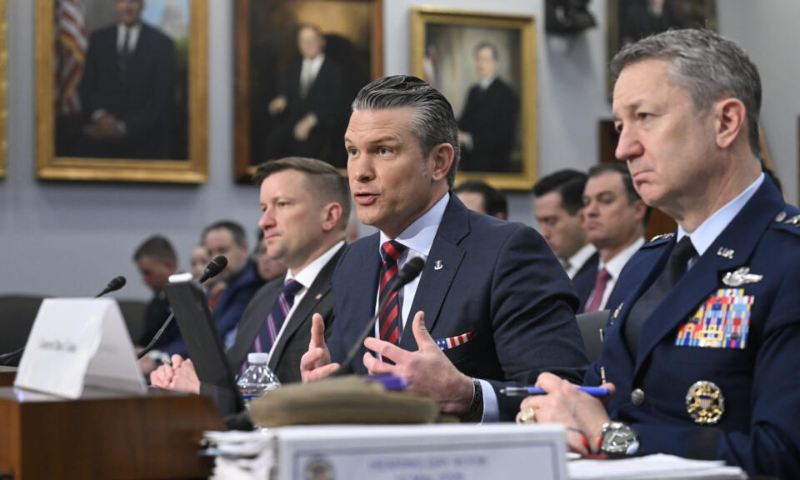
Washington/Tehran, May 12, 2026: The United States’ ongoing war in Iran has cost approximately $29 billion so far, a senior Pentagon official confirmed on Tuesday, marking an increase of $4 billion from an estimate reported just weeks earlier.
Jules Hurst, acting comptroller at the U.S. Department of Defense, told lawmakers that the revised figure reflects updated operational expenses, including equipment repair, replacement costs, and ongoing military deployments. The earlier estimate had placed the cost at $25 billion.
Hurst made the remarks alongside War Secretary Pete Hegseth and Chairman of the Joint Chiefs of Staff General Dan Caine, noting that cost assessments remain under continuous review by defense authorities.
The rising war expenditure comes amid intensifying political debate in the United States, where Democrats are seeking to link the conflict to cost-of-living pressures ahead of upcoming midterm elections. Public opinion polls indicate growing scrutiny of the administration’s handling of the war.
Meanwhile, tensions in the Gulf region have escalated further after senior officials from Iran’s Islamic Revolutionary Guard Corps (IRGC) said the strategic Strait of Hormuz has been redefined into a much broader “operational zone.”
According to IRGC deputy political director Mohammad Akbarzadeh, the waterway is no longer viewed as a narrow maritime corridor but as an expanded strategic area stretching from Jask to Siri Island. Iranian state-affiliated media also reported that the perceived operational zone has widened significantly in scope.
The Strait of Hormuz remains one of the world’s most critical energy chokepoints, with nearly one-fifth of global oil and liquefied natural gas supplies historically passing through it.
The United States military said it continues to enforce a naval blockade on Iran, with US Central Command (CENTCOM) reporting that 65 commercial vessels have been redirected and four disabled as part of ongoing operations.
CENTCOM also stated that the aircraft carrier USS Abraham Lincoln is conducting operations in the Arabian Sea, including enforcement measures aimed at restricting maritime movement linked to Iran. Since mid-April, Washington has reportedly blocked or redirected dozens of oil tankers, significantly disrupting Iranian exports.
Amid rising tensions, diplomatic efforts continue through multiple regional actors. Qatar and Turkey have expressed support for mediation initiatives led by Pakistan, aimed at de-escalating the conflict between Iran and the United States.
Qatari Prime Minister Sheikh Mohammed bin Abdulrahman Al Thani emphasized the need for renewed diplomacy, warning that restrictions in the Strait of Hormuz were affecting global maritime movement and regional stability. Turkish Foreign Minister Hakan Fidan also backed continued mediation efforts, calling for an end to hostilities.
The conflict has also intensified concerns over Iran’s nuclear programme. Iranian parliamentary spokesperson Ebrahim Rezaei said Tehran could consider enriching uranium up to 90% purity—levels considered weapons-grade—if attacked again.
The statement comes amid ongoing disagreements in negotiations, with Washington demanding limits on enrichment and relocation of highly enriched uranium stocks, while Tehran insists on retaining domestic nuclear capabilities.
The conflict has also affected regional energy infrastructure. Reports indicate damage to facilities in the United Arab Emirates, including gas production sites that remain below full capacity due to wartime disruptions.
At the same time, cybersecurity warnings have been issued in Israel following reports of alleged “intimidation messages,” while Gulf energy markets continue to experience volatility due to supply chain disruptions.