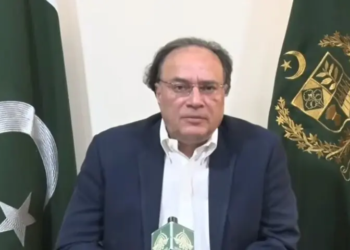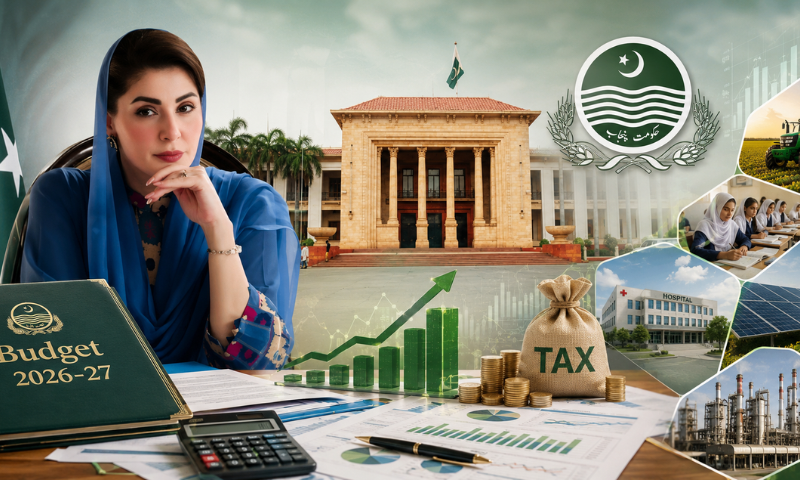
Lahore, June 16, 2026: Punjab Finance Minister Mian Mujtaba Shuja-ur-Rehman on Tuesday presented a Rs5.90 trillion provincial budget for the fiscal year 2026-27, describing it as a “people-friendly” and balanced budget focused on fiscal discipline, public welfare, development, and economic growth.
The budget, with a total outlay of Rs5,903.46 billion, represents a 10.7 percent increase compared to the previous fiscal year. The budget session, attended by Chief Minister Maryam Nawaz Sharif, provincial ministers, and lawmakers, witnessed noisy protests from opposition members, who gathered in front of the Speaker’s dais and disrupted proceedings.
7% salary hike, 3.5% increase in pensions
Presenting the budget in the Punjab Assembly, the finance minister announced a 7 percent increase in salaries for government employees, raising the provincial salary bill to Rs638.93 billion.
Pensioners will receive a 3.5 percent increase, with total pension expenditures projected at Rs500.12 billion.
Shuja said the measures were aimed at providing relief to public servants while continuing the government’s rightsizing policy to improve administrative efficiency.
The finance minister said current expenditures had been reduced by 3.1 percent to Rs1,962.93 billion through austerity measures and improved resource management.
He described the budget as a responsible financial plan that reduces unnecessary spending while safeguarding public welfare and essential services.
Revenue targets and federal transfers
Punjab expects to receive Rs4,390.94 billion from the federal government under the National Finance Commission (NFC) Award, reflecting an 8.1 percent increase over the previous year.
The province has also set an ambitious own-source revenue target of Rs1,209.86 billion for FY2026-27.
Major revenue projections include:
- Punjab Revenue Authority (PRA): Rs528.50 billion
- Board of Revenue: Rs86.19 billion
- Excise and Taxation Department: Rs124 billion
- Non-tax revenues: Rs461.17 billion
According to the finance minister, Punjab is expected to achieve 99 percent of its current fiscal year’s revenue target, collecting Rs820.16 billion out of the targeted Rs828 billion without imposing new taxes, making it the highest own-source revenue collection in the province’s history.
Foreign-funded loans and an estimated provincial surplus of Rs910 billion have also been incorporated into the budget framework to maintain fiscal discipline in line with federal and IMF requirements.
Rs1.99 trillion development plan
The provincial government unveiled an ambitious three-year development framework worth Rs1,995 billion aimed at accelerating economic growth, increasing exports, and generating employment opportunities.
The plan is expected to create millions of jobs and contribute an additional $6.8 billion in exports through targeted investments across key sectors.
Major allocations include:
- Industry: Rs1,188 billion
- Agriculture: Rs586 billion
- Livestock: Rs230 billion
- Tourism: Rs642 billion
- Aqua Farming: Rs190 billion
- Skills Development: Rs186 billion
- Technology Sector: Rs64 billion
- Health and Education Prioritised
The budget allocates more than 10 percent of total spending to the health sector to strengthen healthcare services and improve access to free medical facilities across Punjab.
For education, the government has proposed Rs750 billion, including Rs63.3 billion for development projects and Rs686.8 billion for operational expenditures, accounting for more than 15 percent of the total budget.
Major investment in water and local development
A total of Rs507 billion has been allocated for water supply, sanitation, urban development, and local government sectors.
Out of this amount, Rs187.1 billion will be spent on development projects aimed at expanding infrastructure and improving public services across urban and rural areas.
Under the Saaf Pani Programme, projects worth Rs45 billion are currently underway in 18 districts to provide safe drinking water. More than 5,600 water filtration plants will be installed across Punjab, while all facilities will be digitally geo-tagged to enhance transparency and monitoring.
The government has also launched a dedicated helpline, 1336, to address public complaints related to water services.
Meanwhile, Rs59 billion has been earmarked for the Model Village Programme, under which 48 villages in 10 divisions will be transformed into model settlements equipped with modern civic facilities and improved infrastructure.
Opposition Leader in the Punjab Assembly Moeen Riaz Qureshi rejected the budget, calling it a “web of words” that failed to address the real concerns of the people.
Addressing a press conference after the session, he described the budget as “anti-people” and “anti-farmer,” arguing that it did not adequately address challenges facing ordinary citizens and the agricultural sector.
Qureshi also criticised Chief Minister Maryam Nawaz for leaving the assembly session before the completion of budget proceedings and stressed that political stability was essential for sustainable economic progress.
CM Maryam terms budget a ‘budget of hope’
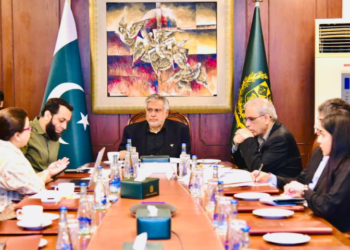
Earlier in the day, Chief Minister Maryam Nawaz formally approved the budget after the provincial cabinet endorsed the document during its 35th meeting.
Addressing cabinet members, she described the budget as a “budget of hope” prepared without imposing any new taxes and focused on public welfare, development, and prosperity.
The chief minister said the government had made every effort to provide maximum relief to citizens despite economic challenges and difficult global conditions.
She directed the Punjab Revenue Authority to take effective measures to enhance revenue generation and strengthen the province’s financial position while maintaining a citizen-centric approach.
Expressing confidence in her administration’s performance, Maryam said the budget reflected the aspirations of the people and reaffirmed her government’s commitment to serving Punjab with dedication and sincerity.