Islamabad, August 16, 2026: The federal government has expanded its efforts to eliminate hepatitis in Pakistan by designating Dr. Akbar Niazi Teaching Hospital (ANTH) as an official Hepatitis Screening Site, bringing testing and early detection closer to communities.
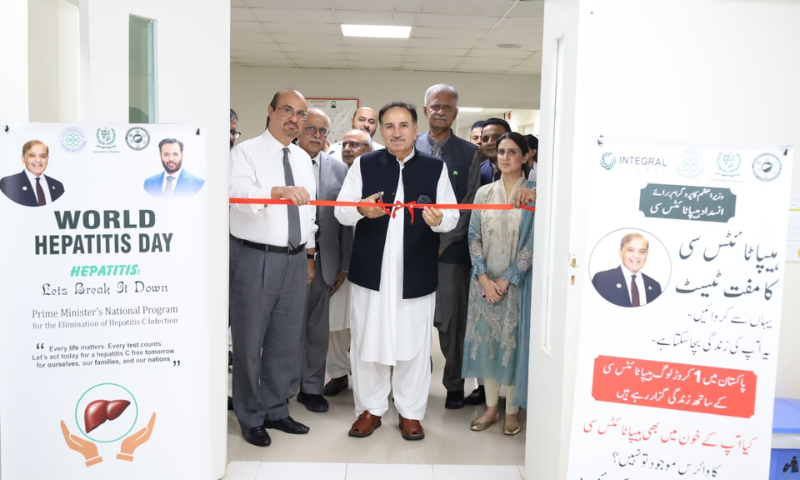
The screening site was inaugurated by Dr. Zia Ullah Khan Dawar, Project Director of the Prime Minister’s National Programme for the Elimination of Hepatitis in Pakistan, following ANTH’s designation as a focal point for the national hepatitis elimination programme on World Hepatitis Day 2026.
The initiative was taken under the Ministry of National Health Services, Regulations and Coordination, led by Federal Health Minister Syed Mustafa Kamal, and represents a public-private partnership aimed at expanding the reach of the government’s hepatitis screening and elimination efforts.
Speaking at the inauguration, Dr. Dawar said the government was committed to taking hepatitis screening to the doorstep of the people, stressing that wider testing was essential to the elimination effort.
He said early detection allows patients to receive timely treatment and helps prevent serious complications. The inclusion of ANTH in the national screening network, he added, would strengthen the programme by utilizing the hospital’s clinical expertise, healthcare infrastructure and large patient base.
The scale of Pakistan’s hepatitis challenge remains significant. According to the World Health Organization (WHO), an estimated nine million people in Pakistan were living with hepatitis C in 2024, representing the highest national burden reported globally. WHO has also reported that only around 25 to 30 per cent of people affected by hepatitis B and C know their status, leaving millions without timely diagnosis and treatment.
Yasir Khan Niazi, Group CEO of GAK HealthCare International and ANTH, said the scale of the crisis made screening a national imperative rather than merely a healthcare intervention.
“When millions are living with hepatitis and most do not know their status, screening becomes the bridge between national policy and an individual life. Our responsibility is to find people earlier, connect them to timely care and prevent avoidable suffering,” he said.
Niazi praised the federal government for prioritizing prevention, population-wide screening and early diagnosis, saying Pakistan already possessed the necessary knowledge, diagnostic capacity and effective treatments to address the disease.
“What matters now is reaching people in time. Every early diagnosis can protect a life, a family and our health system from a much greater future burden,” he said.
He said the partnership between the government and ANTH demonstrated the potential of coordinated public-private healthcare initiatives.
“The future of healthcare lies in ecosystems, not silos. When Government leadership is matched with the infrastructure, reach and clinical capacity of responsible private institutions, we can move faster and reach further. ANTH is proud to serve this national mission,” Niazi added.
The development follows a national seminar held in Islamabad on World Hepatitis Day 2026 by the Federal Ministry of Health in collaboration with ANTH, GAK HealthCare and other stakeholders.
Federal Health Minister Syed Mustafa Kamal inaugurated the seminar, which was attended by Federal Minister for Planning, Development and Special Initiatives Professor Ahsan Iqbal Chaudhry as chief guest, along with senior government officials, WHO representatives, healthcare leaders, policymakers, researchers and clinicians.
During the seminar, Dr. Dawar designated ANTH as a focal point for the national hepatitis elimination programme, citing its strategic location, advanced infrastructure, clinical capacity and extensive catchment area covering Islamabad, Rawalpindi Division, Murree, Galyat, Azad Jammu and Kashmir and adjoining areas of Punjab and Khyber Pakhtunkhwa.
With the screening facility now operational, ANTH will support the government’s efforts to expand hepatitis testing, facilitate earlier diagnosis and connect patients with timely care.
The initiative is expected to contribute to Pakistan’s broader goal of achieving a Hepatitis-Free Pakistan by 2030, while demonstrating how government leadership and private-sector healthcare capacity can be combined to address one of the country’s major public health challenges.