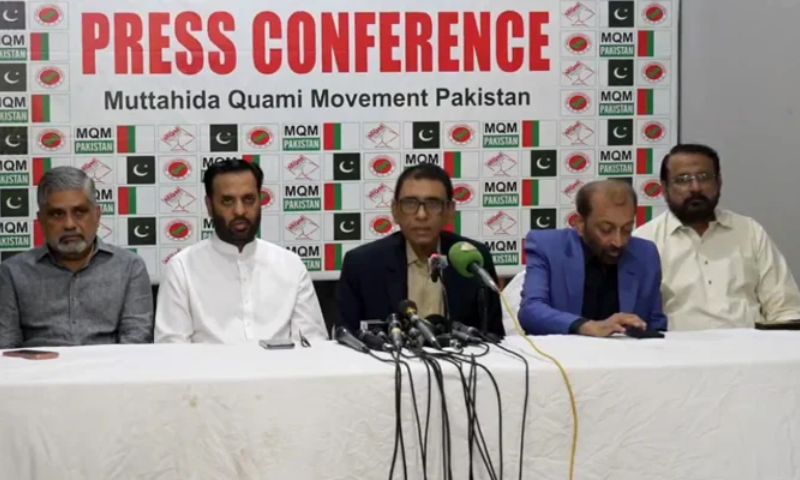
Karachi, August 16, 2026: Muttahida Qaumi Movement-Pakistan (MQM-P) Chairman Dr Khalid Maqbool Siddiqui has announced that his party will approach other political forces to initiate a “grand national dialogue” on the creation of new provinces and administrative units across Pakistan.
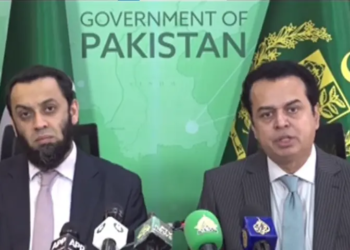
Speaking at a press conference in Karachi on Sunday, Siddiqui said the issue could no longer be ignored given the country’s growing population and administrative challenges.
He argued that Pakistan’s existing provincial structure had been shaped largely along linguistic lines and did not fully meet what he described as legal and administrative requirements.
“We have been saying for the past 40 years that Pakistan’s existing provinces were not created in accordance with all merits of law and were made on linguistic grounds,” Siddiqui said.
He welcomed support from political parties and groups for the MQM-P’s longstanding demand for additional provinces and said his party was prepared to engage all stakeholders regardless of their political differences.
“Regardless of your political demands, start a dialogue with each other,” he said, adding that the MQM-P would speak to various political parties about their proposals and reservations.
“We are initiating it,” Siddiqui said, stressing that the party would support voices calling for the creation of new provinces wherever such support existed.
MQM-P says demand is nationwide
Siddiqui clarified that the MQM-P was not demanding new administrative units exclusively in Sindh, but across the country. However, he maintained that the case for creating a new province in Sindh was particularly strong.
He also linked the debate to Article 140-A of the Constitution, introduced through the 18th Amendment in 2010, which requires provinces to devolve political, administrative and financial authority to elected local governments.
Siddiqui said the MQM-P had previously approached the Supreme Court over the non-implementation of Article 140-A and noted that the court had issued a detailed ruling applicable across the country.
He maintained that stronger local governance was no longer merely an MQM-P demand but had become a national necessity.
“We took part in the sin of the 18th Amendment so that a common Pakistani can reap the fruits of democracy through Article 140-A,” he said, while expressing disappointment over its lack of implementation.
Siddiqui said that when the MQM-P joined the federal coalition, one of its principal demands was to empower citizens, fulfil constitutional requirements and implement the Supreme Court’s ruling on local governments.
He also questioned the argument that creating new provinces amounted to an act of treason, pointing out that the Constitution itself provides a mechanism for creating provinces.
“We can discuss the method for creating provinces, but we believe that giving provinces that right is a conflict of interest,” he said.
The MQM-P chairman added that his party would engage lawyers to approach the Supreme Court over what he described as the “desecration” of its ruling on local government.
Sindh division remains contentious
Responding to questions about whether the creation of new administrative units would amount to dividing Sindh, Siddiqui defended the MQM-P’s position and made remarks about the migration of communities during Partition.
He said the party respected the Sindhi people who had welcomed migrants after the creation of Pakistan, while also making claims regarding the ownership of land and properties left behind by Hindus who migrated to India.
The issue of creating a separate province comprising Karachi remains particularly contentious in Sindh. The MQM-P has long advocated provincial status for Karachi, while the Pakistan Peoples Party (PPP), which governs Sindh, strongly opposes the proposal.
MQM-P leader and Federal Health Minister Mustafa Kamal, who also addressed the press conference, said the demand for additional administrative units was not aimed at dividing the country or Sindh but at improving governance.
He argued that citizens should have greater control over their local administrations and the ability to change leadership through elections if their cities continued to face poor living conditions.
Kamal also welcomed Interior Minister Mohsin Naqvi’s recent call for the creation of additional administrative units, describing it as a positive indication that policymakers were recognizing the need for structural reforms.
Naqvi had urged political parties last month to address major national issues, including the creation of new provinces, arguing that administrative restructuring was necessary to improve governance.
A day later, the military’s spokesperson also called on political parties to consider an administrative reset in response to changing governance requirements and the country’s growing population.
PPP warns against division of Sindh
The MQM-P initiative immediately drew a strong response from the PPP.
PPP leader Qadir Mandokhail said his party supported the creation of new provinces but warned against any attempt to divide Sindh.
“No political party can target the unity of Sindh for its own interests,” Mandokhail said, according to a statement issued through the PPP’s official X account.
He argued that Sindh was not merely a line on a map that could be divided at will and accused the MQM-P leadership of attempting to revive a contentious issue for political purposes.
Mandokhail said the PPP would not allow anyone to “trample the Constitution in the name of dividing Sindh”.
The debate over new provinces has gained momentum in recent weeks, with different political parties supporting different models. The PPP and Pakistan Tehreek-e-Insaf (PTI), for instance, have long advocated the creation of a South Punjab province.
Meanwhile, discussions are reportedly underway within government circles over possible constitutional and administrative reforms, including a potential 28th Constitutional Amendment.
However, building political consensus remains a major hurdle, as the creation of new provinces would require broad agreement among political stakeholders and constitutional amendments.
The MQM-P’s call for a grand national dialogue has therefore opened another potentially significant political debate over Pakistan’s provincial structure, local governance and the future distribution of administrative power.