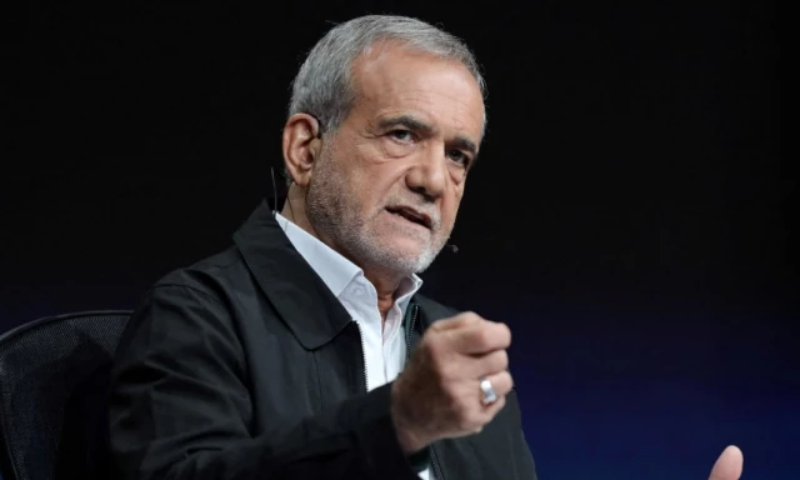
Tehran, August 19, 2026: Iranian President Masoud Pezeshkian on Wednesday pledged full government support for the country’s armed forces as tensions with the United States continued to escalate, while reports that Tehran was considering possible strikes on US military assets in Europe prompted NATO to warn that it was prepared to respond to any threat.
Speaking at a cabinet meeting, Pezeshkian said the government would support the armed forces “with all our might” and spare no effort to meet their needs despite existing limitations and challenges.
The remarks came amid growing uncertainty over the future of the conflict and stalled diplomatic efforts between Tehran and Washington.
An Iranian parliamentary security and foreign policy commission member, Fada Hossein Maleki, separately warned that Iran would respond to any US nuclear attack with a response proportionate to the weapon used.
Maleki said he did not rule out an “ill-considered” move by US President Donald Trump but argued that a nuclear strike would risk triggering a much wider war. He did not explicitly claim that Iran possesses nuclear weapons.
He also warned that Tehran had “multiple options” in response to further US military action and said some of Iran’s military capabilities had yet to be revealed.
The Financial Times reported on Wednesday, citing two people close to the Iranian government, that Iranian forces had examined potential strikes against US military assets in southeastern Europe if Washington escalates the conflict.
The reported options included US-linked facilities in Bulgaria and Cyprus. Iran was also said to have examined possible attacks on subsea fibre-optic cables in the Strait of Hormuz.
The claims have not been independently confirmed and do not indicate that Iran has decided to carry out such attacks.
NATO nevertheless said it was prepared to address any threat and would take whatever action was necessary to defend its members. The alliance also pointed to earlier interceptions of Iranian ballistic missiles heading towards Türkiye as evidence of its deterrence and defence capabilities.
Iranian armed forces chief of staff Ali Abdollahi meanwhile warned Gulf countries against providing assistance or facilities to the US military, saying such support would amount to participation in American military operations.
The tensions have also sharply affected Iran’s relations with the United Arab Emirates.
The UAE announced the suspension of commercial activities, trade exchanges and financial transactions with Iran until further notice after its defence ministry reported detecting two ballistic missiles launched from Iran towards maritime areas. Iran denied responsibility for the alleged missile launches.
The decision represents a significant economic development given the importance of the UAE as a trading and re-export hub for Iran. Reuters reported that the UAE had been particularly affected by Iranian attacks earlier in the conflict, although the latest reported incident was the first such attack on the Emirates in several weeks.
UAE presidential diplomatic adviser Anwar Gargash also rejected reports that Abu Dhabi was providing financial facilities to Iran, describing such claims as false information.
Meanwhile, commercial shipping through the Strait of Hormuz remained sharply reduced as shipowners continued to avoid the strategic waterway amid uncertainty over its security and future reopening.
Kpler data showed only six commodity vessels crossed the strait on Tuesday, compared with nine the previous day and a 10-day average of 11. Before the conflict, the waterway carried around one-fifth of global crude oil and liquefied natural gas shipments.
US President Donald Trump has maintained that the strait is open, while Iran says it remains closed to shipping, leaving international shipping companies facing continued uncertainty.
Amid the escalating rhetoric, former Iranian president Mohammad Khatami called for a more measured approach, warning against allowing emotions to determine national policy.
Khatami questioned arguments that Iran should expand the conflict to US territory and said governing a country could not be based solely on emotion. He urged decision-makers to consider what best serves Iran’s long-term national interests.
The contrasting statements underscore the widening debate inside Iran over how Tehran should respond to continued US pressure and the risk of a broader conflict.
Iranian Parliament Speaker Mohammad Bagher Ghalibaf also travelled to Baghdad on Wednesday for talks with senior Iraqi officials on political, economic, cultural and security cooperation.
At the same time, US Secretary of State Marco Rubio spoke with UAE National Security Adviser Sheikh Tahnoon bin Zayed Al Nahyan about regional security and freedom of navigation through the Strait of Hormuz.
With diplomatic efforts stalled, shipping disrupted and tensions extending beyond the Middle East, the latest developments have raised concerns that the conflict could broaden geographically if Washington and Tehran fail to restore a viable channel for negotiations.