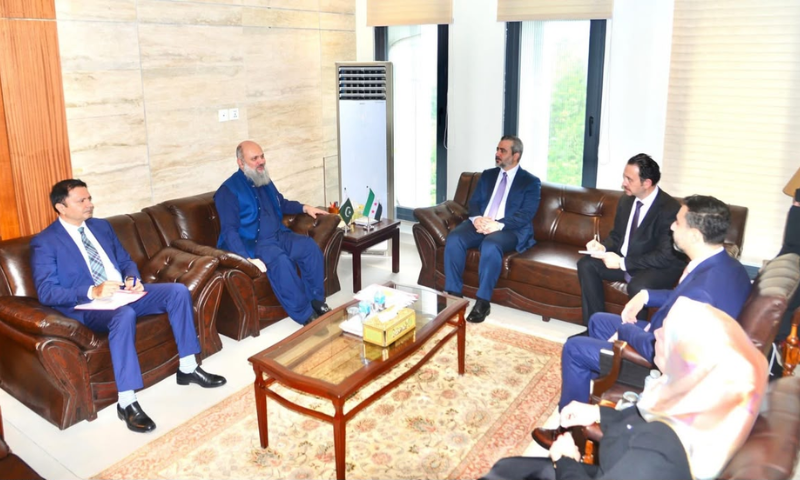
Islamabad, August 20, 2026: Syrian Foreign Minister Asaad Hassan al-Shaibani, accompanied by a high-level delegation, on Thursday visited the Ministry of Commerce and held talks with Federal Minister for Commerce Jam Kamal Khan on expanding bilateral trade, investment and economic cooperation.
Welcoming the Syrian foreign minister and his delegation on their first visit to Pakistan, Jam Kamal Khan said Pakistan highly valued its longstanding brotherly relations with Syria, rooted in shared history, culture and mutual respect.
The commerce minister expressed solidarity with the Syrian people and conveyed condolences over the loss of lives and hardships endured during the prolonged conflict. He also expressed Pakistan’s best wishes for Syria’s peace, stability, reconstruction and long-term prosperity.
Briefing the Syrian delegation on Pakistan’s economic and export potential, Jam Kamal Khan highlighted opportunities in textiles and apparel, pharmaceuticals, leather, sports goods, food processing, rice and other agricultural products, light engineering, information technology, cosmetics and other value-added sectors.
He said the complementary strengths of the two economies offered considerable scope for mutually beneficial cooperation and emphasized the need for greater interaction between the private sectors of Pakistan and Syria to identify trade, investment and joint-venture opportunities.
The Syrian foreign minister briefed Jam Kamal Khan on Syria’s reconstruction and development priorities, highlighting the resilience of the Syrian people and progress in restoring essential infrastructure and public services.
He identified housing, real estate, energy, transportation, seaports, agriculture, industry and human-resource development as promising areas for bilateral cooperation. Al-Shaibani noted that the current volume of Pakistan-Syria trade did not reflect the actual potential of the two countries and stressed the importance of sustained institutional and business engagement.
The Syrian foreign minister proposed the establishment of a Pakistan-Syria Joint Business Council to facilitate direct interaction between the two countries’ business communities. He also proposed holding a joint investment forum in Damascus, bringing together representatives from Pakistan’s and Syria’s public and private sectors.
Al-Shaibani further informed the commerce minister that a delegation from Syria’s Ministry of Economy, which also oversees trade and industry, would visit Pakistan to explore avenues for expanding bilateral economic cooperation.
Jam Kamal Khan proposed close coordination between the relevant trade authorities to identify priority sectors and develop a practical roadmap for cooperation. He suggested arranging virtual meetings between Pakistani and Syrian businesses ahead of physical engagements to facilitate focused business matchmaking.
The commerce minister also proposed reviving the Pakistan-Syria Joint Ministerial Commission and its relevant Joint Working Groups to provide a structured institutional mechanism for advancing cooperation across multiple sectors.
He emphasized the importance of activating the existing framework between the chambers of commerce of the two countries through regular exchanges, business delegations and business-to-business engagements.
Jam Kamal Khan expressed Pakistan’s willingness to explore sending a trade and business delegation to Syria and conveyed Pakistan’s interest in strengthening its trade representation and institutional presence in the country in the future.
Highlighting the historical and cultural connections between Pakistan and Syria, particularly Balochistan, the commerce minister noted that historical accounts and traditions point to ancestral links between the Baloch people and Syria. He said these shared bonds further enriched the longstanding brotherly relations between the peoples of the two countries.
The two ministers reaffirmed their commitment to deepening Pakistan-Syria relations and agreed to maintain close coordination to translate longstanding goodwill into concrete progress in trade, investment, reconstruction and broader economic cooperation.