Istanbul, August 30, 2026: Senior officials from Pakistan, Saudi Arabia and Türkiye will meet in Istanbul on Monday for the first committee meeting under the landmark Makkah Joint Defence Agreement signed earlier this month, a Turkish Foreign Ministry source said.
The meeting will bring together the foreign and defence ministers as well as chiefs of staff of the three countries to discuss regional and international security developments and ways to strengthen trilateral defence cooperation.
Pakistan, Saudi Arabia and Türkiye signed the Makkah Joint Defence Agreement on August 7 in the presence of Prime Minister Muhammad Shehbaz Sharif, Saudi Crown Prince and Prime Minister Mohammed bin Salman and Turkish President Recep Tayyip Erdogan.
The agreement seeks to strengthen collective deterrence and stipulates that an armed attack against any one of the three countries would be regarded as an attack against all three, broadly reflecting the principle of collective defence enshrined in Article 5 of the NATO treaty.
According to the Turkish Foreign Ministry source, international security issues will be high on the agenda of Monday’s meeting. The discussions are expected to focus on enhancing defence capabilities, improving interoperability among the three armed forces and expanding cooperation in the defence industry, including joint production and development.
The trilateral initiative comes amid heightened security tensions in the region following the ongoing US-Israel war with Iran, which has affected the wider Middle East and disrupted maritime traffic through the strategically important Strait of Hormuz.
Iran has launched attacks on regional countries hosting US military facilities and has warned neighbouring states against allowing their territory or infrastructure to be used for US military operations against Tehran.
Pakistan has remained closely engaged in diplomatic efforts since the conflict began and has played a prominent role in attempts to mediate between the United States and Iran.
The latest meeting also comes as negotiations aimed at resolving the conflict remain stalled, while the administration of US President Donald Trump has intensified economic pressure and sanctions against Iran.
Türkiye has said the defence agreement is not directed against any particular country and remains open to expansion. President Erdogan has previously indicated that other “brotherly countries”, including Egypt, could potentially join the framework.
The Turkish president said the agreement was designed to strengthen collective deterrence, advance security and defence cooperation, promote joint defence-industry projects and enhance efforts against terrorism.
He also stressed that the pact reaffirmed the right of self-defence under Article 51 of the United Nations Charter and was aimed at promoting peace, prosperity and stability in the region.
The trilateral defence arrangement is also being discussed against the backdrop of closer coordination among Türkiye, Pakistan, Saudi Arabia and Egypt through the R4 grouping, which has emerged as a mechanism for consultations on major regional developments, particularly the conflict involving Iran.
Türkiye has said the R4 aims to translate growing political coordination among the four countries into concrete mechanisms for regional cooperation.
The first committee meeting under the Makkah agreement is expected to provide an institutional framework for advancing the commitments made by the three countries and identifying practical areas for closer military and defence-industrial cooperation.
Meanwhile, Chief of Defence Forces and Chief of Army Staff Field Marshal Syed Asim Munir has arrived in Türkiye for the high-level engagements, according to the Inter-Services Public Relations.
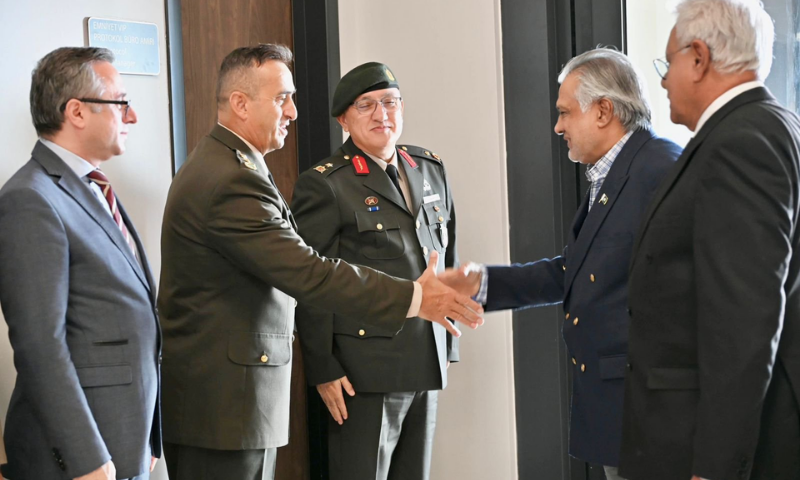
Deputy Prime Minister and Foreign Minister Senator Mohammad Ishaq Dar also arrived in Istanbul on Sunday for official engagements, the Foreign Office said.
Dar was received by Deputy Chief of Staff for Administration Brigadier General Senol Varol, Pakistan’s Ambassador to Türkiye Dr Yousaf Junaid, Turkish Foreign Ministry Ambassador Cihad Erginay and other senior Turkish government officials.