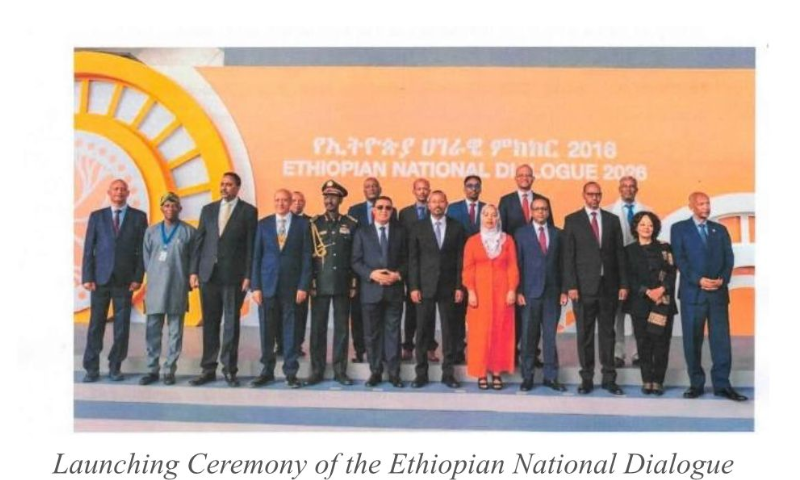
Addis Ababa, September 2, 2026: Ethiopia has concluded a landmark four-year National Dialogue process aimed at addressing longstanding political divisions, historical grievances and structural challenges, marking a major step in the country’s efforts to build lasting peace, reconciliation and national consensus.
The five-week National Dialogue Conference, formally opened in Addis Ababa on July 15, brought together around 4,000 delegates representing Ethiopia’s regional states, political parties, civil society organisations, religious institutions, professional associations, traditional leaders, youth and women’s groups, as well as members of the Ethiopian diaspora.
The conference concluded on August 22 following extensive deliberations on issues considered central to Ethiopia’s future governance, national identity, political system and social cohesion.
The National Dialogue was established as a mechanism to help move Ethiopia away from zero-sum political confrontation towards peaceful engagement, compromise and consensus-building. The process sought to address deep-rooted disagreements over historical narratives, the Constitution, the federal system, power-sharing, governance and other issues of national importance.
The Ethiopian National Dialogue Commission (ENDC) was established as an independent public body on December 29, 2021, under Proclamation No. 1265/2021. It was mandated to facilitate an inclusive and participatory process designed to promote national consensus, sustainable peace and reconciliation.
Officials have described the initiative as a home-grown process drawing on Ethiopia’s indigenous knowledge, traditional institutions and diverse cultural traditions.
The agenda for the dialogue was developed through a bottom-up approach, beginning with consultations at local and woreda levels before expanding to regional and diaspora consultations and eventually culminating in the federal-level agenda and national conference.
Farmers, elders, women, young people and community groups participated in the initial consultations, while Ethiopians living abroad contributed through consultations held in countries including the United States, Canada, the United Kingdom, Sweden and the United Arab Emirates.
The final conference was organised around eight thematic assemblies, each comprising about 500 delegates. Smaller discussion groups within the assemblies enabled participants to undertake detailed deliberations before their recommendations were consolidated and presented for broader consideration.
The agenda covered a wide range of issues, including nation-building and national identity, the structure and form of government, the federal system and power-sharing, and the status and administration of Addis Ababa and Dire Dawa.
Other areas included religious affairs and interfaith harmony, institution-building, the rule of law and human rights, transitional justice and socio-economic issues.
The Ethiopian government has pledged to review and implement recommendations emerging from the dialogue, describing the initiative as a high-priority mechanism for achieving long-term peace and national consensus.
Prime Minister Dr. Abiy Ahmed, who presided over the opening of the conference, urged Ethiopians to replace political confrontation with dialogue and compromise. He also expressed the government’s commitment to translating the recommendations into legislative and policy measures.
Parallel efforts encouraging political parties and armed groups to pursue their objectives through negotiations rather than armed conflict have also reportedly contributed to several groups entering peaceful negotiations.
At the closing ceremony, former Nigerian President Olusegun Obasanjo congratulated the Ethiopian government and people for advancing dialogue, mutual understanding and national consensus.
The National Dialogue also received diplomatic support from international partners, including the European Union and Norway.
EU High Representative for Foreign Affairs and Security Policy and Vice-President Kaja Kallas visited Addis Ababa on July 15, the opening day of the conference. During her visit, she met Prime Minister Abiy Ahmed and Foreign Affairs Minister Gedion Timothewos and also visited the dialogue proceedings.
Kallas welcomed the grassroots character of the initiative and expressed hope that the process would deliver concrete results capable of strengthening peace, reconciliation and national unity.
The European Union has viewed the National Dialogue as part of its broader engagement with Ethiopia’s democratic development, including efforts to strengthen good governance and institutional capacity.
The conclusion of the National Dialogue represents a significant milestone in Ethiopia’s efforts to address political and social divisions through an inclusive and nationally owned process. The next and potentially more difficult phase will be translating the recommendations reached through the dialogue into practical policies, institutional reforms and governance measures capable of delivering sustainable peace, stability and national cohesion.