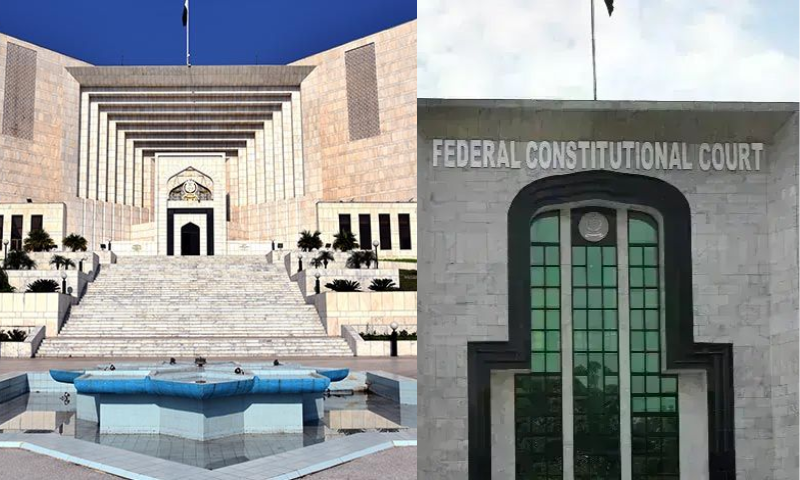
Islamabad, September 16, 2026: The Supreme Court on Wednesday deferred proceedings on petitions concerning the hospital transfer of Pakistan Tehreek-e-Insaf (PTI) founder Imran Khan for a date after three weeks, expressing reservations over a Federal Constitutional Court (FCC) directive to requisition the relevant cases from the SC and fix them before itself.
A three-member bench comprising Justice Shahid Waheed, Justice Naeem Akhtar Afghan and Justice Ishtiaq Ibrahim heard the matter.
The bench said its concern centred on paragraph six of the FCC’s September 15 order, which directed the SC office to requisition the relevant case records and fix the cases before the FCC under Article 175-E of the Constitution.
The FCC had issued the directive on Tuesday on a petition filed by three inmates of Adiala Jail seeking relief similar to that granted to Imran Khan by the Supreme Court in an interim order issued on August 18.
Justice Waheed observed that fixing cases before the FCC after requisitioning them from the SC did not appear to fall within clause 5 of Article 175-E.
Article 175-E, inserted through the 27th Constitutional Amendment, empowers the FCC to call for the record of a case and decide matters involving major questions of constitutional law.
Attorney General for Pakistan (AGP) Mansoor Usman Awan told the bench that the matter required detailed analysis and deliberation.
The bench acknowledged that the situation was unprecedented, noting that this was the first instance in which the FCC had requisitioned case records from the Supreme Court, whereas such requisitions traditionally involved records from high courts.
Justice Waheed also read out four questions framed by the FCC in its September 15 order concerning prisoners’ fundamental rights:
- Which courts have jurisdiction and competence to enforce fundamental rights under the Constitution?
- What rights must be afforded to prisoners under the Constitution and the Pakistan Prison Rules, 1978?
- What is the scope and extent of the state’s obligations regarding prisoners’ fundamental rights?
- What consequences arise if a state functionary violates prisoners’ fundamental rights?
Justice Waheed observed that if fundamental rights were the central issue, such rights were involved in virtually every category of case, including civil, criminal and service matters.
He further noted that the constitutional guarantee of a fair trial under Article 10-A applied to every case.
The judge also said the Supreme Court could extend relief to prisoners under the guiding principles of the Holy Quran and Sunnah, a jurisdiction he said was not available to the FCC.
AGP Awan responded that the SC’s Shariat Appellate Bench possessed jurisdiction to interpret questions relating to the Holy Quran and Sunnah.
Justice Naeem Akhtar Afghan said the bench’s principal concern was the scope of action available to the Supreme Court in light of paragraph six of the FCC order.
“Both institutions have to co-exist, and both have jurisdiction of their own,” Justice Afghan observed.
The court questioned the implications of the FCC requisitioning cases already pending before the Supreme Court and expressed reservations over the direction to fix those cases before the FCC.
Senior counsel Barrister Syed Ali Zafar, who was present during the proceedings, argued that the transfer of the cases had nothing to do with jurisdiction and that Article 175-E(5) did not involve taking away or conferring jurisdiction.
The Supreme Court also clarified that its August 18 direction concerning Imran Khan’s transfer to Shifa International Hospital, a private facility in Islamabad, had been issued without prejudice to the intentions of the parties.
When asked about the status of the August 18 order, the AGP conceded that it remained in force but did not give an assurance when counsel for the petitioner pressed for its interpretation.
Justice Waheed told the petitioners that implementation of the August 18 directions was being left to the AGP.
The AGP was not present when the hearing initially began. No other law officer was present in Courtroom No. 5, which was packed with lawyers and observers.
The court subsequently called for AGP Awan. Additional Attorney General Rana Asadullah Khan initially appeared and read out the FCC’s September 15 directions concerning requisition of the case record.
The bench then briefly retired and directed that the AGP himself appear.
When Awan arrived around 35 minutes later, the bench asked whether the FCC’s September 15 order was binding on the Supreme Court.
The AGP explained that the FCC had issued its directions by invoking Article 175-E(5), adding that the respective jurisdictions of the two apex judicial institutions had been outlined through the 27th Constitutional Amendment.
Advocate Uzair Karamat Bhandari, representing Dr Uzma Khan in a petition concerning the alleged violation of the Supreme Court’s August 18 directive, requested the bench to at least issue directions allowing Imran Khan to meet his family members and lawyers.
The court, however, focused on determining the appropriate procedural course in light of the FCC order.
According to the order issued by the Supreme Court, the bench sought the AGP’s “assistance” on the proper course of proceedings, particularly regarding the extent to which the FCC directive was binding on the SC.
The court said this approach was necessary to avoid any situation inconsistent with the proper functioning of the country’s two apex judicial institutions while preserving the principle of judicial comity.
The AGP requested three weeks to examine the constitutional questions and prepare his submissions.
The Supreme Court subsequently adjourned the proceedings for a date after three weeks, observing that “propriety demanded” deferment of the matter.
The bench noted that, in the spirit of the Constitution, the Supreme Court could not simply disregard a judicial order, particularly in circumstances involving the respective jurisdictions and functioning of the two apex courts.