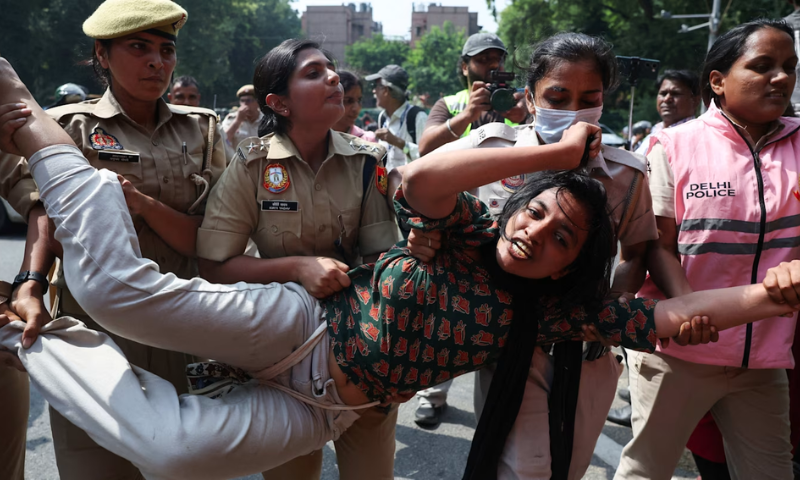
New Delhi, October 10,2026: Indian police detained scores of protesters, including the founder of the Cockroach Janta Party (CJP), Abhijeet Dipke, on Saturday as authorities imposed sweeping security restrictions in the capital to prevent a youth-led demonstration demanding the resignation of Chief Election Commissioner Gyanesh Kumar.
CJP leaders Saurav Das and Ashutosh Ranka were also detained after landing at Delhi airport, the movement said in a statement. Television channels reported that police had met Dipke at the airport after he arrived from Mumbai and asked him to call off the protest, which authorities had not authorized.
Police detained around 200 protesters in central New Delhi, a police source told Reuters. A police spokesperson said that protest supporter Dhruv Rathee, a popular YouTube personality, was among those detained outside the capital.
Television footage showed police chasing groups of young demonstrators in the city’s central business district before taking them away in vehicles.
Authorities shut metro stations and markets, suspended mobile internet services and deployed thousands of security personnel. Police also checked buses, cars and other vehicles at entry points into the city, while barricades and concrete blocks restricted traffic. Anti-riot vehicles equipped with tear gas launchers were stationed along key routes, according to Reuters witnesses.
“Why is the prime minister so scared of the country’s youth, the country’s people?” Dipke asked before leaving Mumbai for Delhi, according to the ANI news agency. He criticized the closure of transport services and suspension of internet access, describing the restrictions as a sign of fear.
The protesters had planned to assemble at Jantar Mantar, a designated protest site in central New Delhi, at 10am.
The demonstration, promoted by the CJP under the slogan “Save Democracy,” is part of a series of protests that began last week following a report by The Indian Express that officials working under Kumar had questioned and disagreed with him over revisions to voter lists.
The reported changes involved approximately 130 million voter entries, a figure larger than Japan’s population. Opposition parties have accused the ruling Bharatiya Janata Party (BJP) of attempting to manipulate electoral rolls to its advantage, allegations that have gained renewed attention following the newspaper’s report.
Kumar has not commented on the report. The Election Commission and the BJP have denied allegations of wrongdoing.
The BJP has attributed its electoral success to Prime Minister Narendra Modi’s popularity and India’s economic growth, while accusing opposition parties of misleading the public because they have been unable to win elections.
The demonstrations present a fresh political challenge for Modi’s government, following protests earlier this year that led to the resignation of his education minister over allegations involving examination paper leaks.
The protests also come ahead of a series of important state elections scheduled to begin in early 2027, including a contest in Uttar Pradesh, India’s most populous state, which is governed by the BJP.
Delhi police said on Friday that permission had not been granted for the demonstration and warned that anyone violating the restrictions would face legal action.
In a statement, police described the temporary measures as precautionary steps intended to regulate movement, prevent overcrowding, maintain public order and protect protesters and other members of the public.
CJP leaders rejected the decision, maintaining that holding the demonstration was their fundamental right.
Opposition parties allege that the voter list revision was used to influence election outcomes in the BJP’s favor, with the alleged involvement of officials appointed to the Election Commission, including Kumar.
They have also claimed that voter deletions affected the results of some recent state elections won by the BJP, raising concerns about the electoral process in the world’s largest democracy.
Election Commission data, also cited by the BJP, shows that approximately 130 million names were flagged during the verification exercise. These included around 63 million entries involving people who had relocated, 30 million people who could not be traced and 28 million entries relating to deceased individuals.
The commission has said the figures relate to entries flagged during the draft revision stage and that the exercise is not yet complete. It has also stated that voters whose names are wrongly removed can register again.