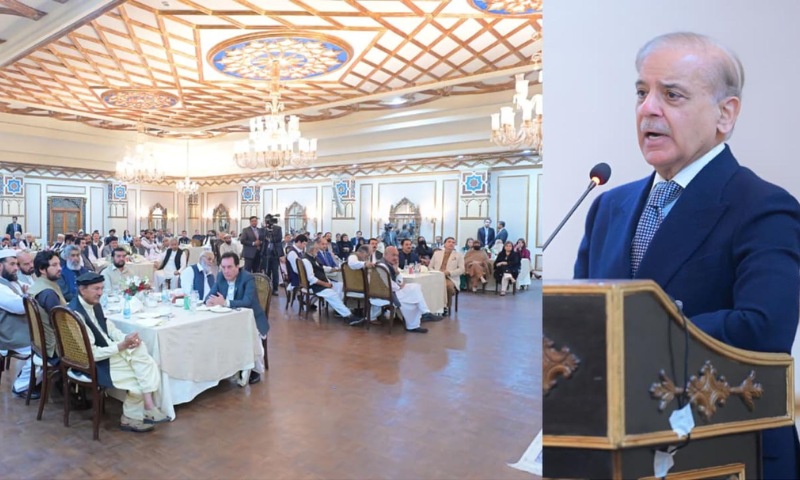
Islamabad, October 31,2026: Prime Minister Shehbaz Sharif has criticised the Pakistan Tehreek-e-Insaf’s (PTI) 13-year governance record in Khyber Pakhtunkhwa, questioning whether public funds allocated to the province had been transparently utilised for the welfare of its people.
Addressing a meeting of the Pakistan Muslim League-Nawaz’s (PML-N) parliamentary party from KP in Islamabad on Saturday, the prime minister questioned the fulfilment of PTI’s promises to build dams, generate solar power and establish hospitals, universities and schools across the province.
He asked how many universities and hospitals had been established, how much the healthcare system had improved and what facilities had been provided to the people during the party’s tenure.
Shehbaz also questioned the transparency of public spending and the extent of corruption, saying that residents across Peshawar, Kohistan, Hazara and southern KP would testify that the PTI government had done little to address their basic needs.
The prime minister said terrorist activities in the province had been brought to an end to a considerable extent by 2017-18, adding that KP had made some of the greatest sacrifices in the fight against terrorism.
He said around 80,000 people had lost their lives in terrorism-related violence, while the country’s economy had suffered estimated losses of Rs15,000 billion.
The premier praised former prime minister and PML-N supremo Nawaz Sharif for his counterterrorism policies following the 2014 Army Public School tragedy, in which more than 140 students and teachers were killed.
He also criticised the PTI for its prolonged protests and sit-ins, recalling that a 2014 demonstration in Islamabad had led to the postponement of Chinese President Xi Jinping’s planned visit to Pakistan.
Shehbaz further accused the PTI-led provincial government of allowing militants from Afghanistan to settle in Swat, saying the development had contributed to the resurgence of terrorism.
He said thousands of civilians and security personnel had been martyred over the past two and a half years, adding that the PTI had been offered an opportunity to join hands with the federal government to combat terrorism.
The prime minister questioned the utilisation of funds allocated to KP under a special National Finance Commission (NFC) arrangement for counterterrorism efforts.
He asked how many Safe City projects had been initiated and how much had been spent on strengthening the Counter-Terrorism Department (CTD).
He said that even if the provincial government had spent Rs80 billion on strengthening the police and other law enforcement agencies, they would have been better equipped to address security challenges.
Shehbaz said the federal government had managed to stabilise the national economy, although the recovery process would remain a long journey.
Recalling previous negotiations with the PTI, he said a committee comprising members of the PPP and PML-N had held talks with the party, and a draft agreement had been finalised.
However, he said the agreement could not be signed after approval from then-chief minister Sohail Afridi failed to materialise.
The prime minister said the federal government had been compelled to impose emergency and governor’s rule in KP, describing the decision as timely and warning that delaying it could have had severe consequences.
He urged PML-N lawmakers from the province to prioritise basic public needs and focus on short-term welfare initiatives rather than long-term projects for the time being.
“Focus on short-term welfare projects so that you can help turn people’s fortunes around within the next six months to a year,” he stressed.
PTI rejects criticism
The PTI rejected the prime minister’s criticism, challenging the federal government to account for its own performance instead of blaming the party for security and governance problems in KP.
PTI Central Information Secretary Sheikh Waqas Akram said the prime minister had no moral authority to lecture the party on democracy and governance, alleging that the present political setup had come to power through electoral manipulation and political arrangements.
Waqas accused the federal government of shifting responsibility for the province’s worsening security situation onto the PTI-led provincial government.
He alleged that the Centre had failed to provide the province with the necessary resources and equipment for counterterrorism operations.
He also accused the federal government of prioritising political opposition over security and governance, alleging that PTI leaders and workers had faced raids, arrests and intimidation.
The PTI leader challenged the prime minister to present a comprehensive account of his government’s four-year performance.
Less than a week after emergency and governor’s rule were imposed in KP, a joint sitting of Parliament approved the federal government’s move amid strong opposition protests.
The developments followed weeks of political tensions between the Centre and the PTI, including negotiations to bridge their differences, after the party announced a long march to Islamabad demanding the release of its jailed founder, Imran Khan.
Federal ministers alleged that the PTI-led provincial government had a “nexus” with terrorist groups, arguing that the security situation necessitated the imposition of emergency.
The Centre and the PTI have remained at odds over counterterrorism policy, one of the main reasons behind the breakdown of their October 3 talks.
The PTI said it was being excluded from security decisions concerning KP, a claim denied by the federal government. The party also called for a review of the counterterrorism policy, while the Centre criticised the provincial government’s efforts to combat terrorism and objected to its stance on dialogue with the Afghan Taliban.