
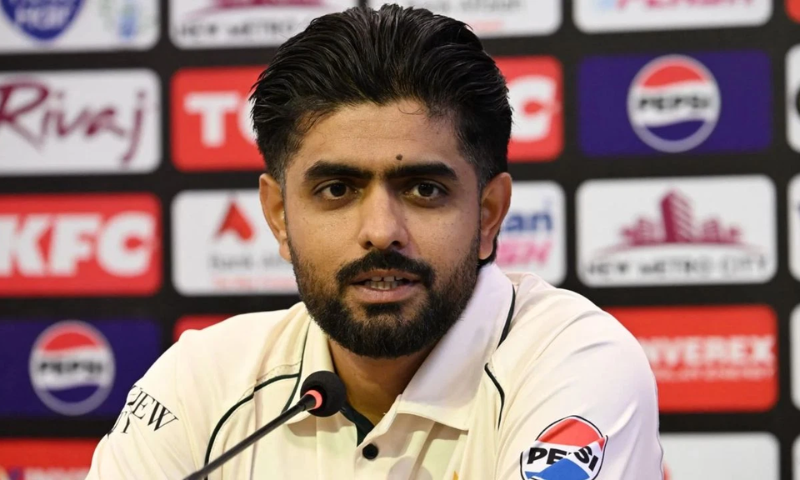
Rawalpindi, November 13,2026: Pakistan captain Babar Azam on Friday expressed openness to playing pink-ball Tests in future home assignments after the first Test of the two-match series against Sri Lanka ended in a draw due to rain and bad light.
Around 141 overs were lost during the recently concluded fixture, with players forced to leave the field before the scheduled close of play on each evening because of poor light. The fourth day was also called off in the afternoon due to rain.
Notably, the umpires had suspended play even before the rain began on the fourth afternoon as the light had deteriorated considerably, making it risky to continue with the red ball under fading conditions.
Weather interruptions throughout the five days had made a draw almost inevitable. When Pakistan resumed their second innings on the final day, they batted through the day, with only 63.3 overs possible, and finished at 248/8, setting Sri Lanka a target of 273 runs.
The International Cricket Council (ICC), following its quarterly meeting earlier this year, has already approved the use of the pink ball in day Tests to help address weather-related interruptions, including rain and bad light.
Speaking at the post-match presentation, Babar welcomed the possibility of using the pink ball as an alternative but said the team would need sufficient time to prepare for the change.
Pakistan’s next Test against Sri Lanka is scheduled to begin on November 17 at the same venue. However, Babar ruled out switching to the pink ball for the upcoming fixture, saying the team had insufficient time to adapt.
“You will have to prepare differently for the pink ball, and two-three days are not enough because we play with the red ball throughout,” Babar said.
“If we get a chance to prepare with the pink ball for longer, then it is certainly something we would be open for [to play a day Test with the pink ball],” he added.
Besides the weather interruptions, the match witnessed several shifts in momentum after Sri Lanka captain Kusal Mendis won the toss and elected to field.
Pakistan batted until the afternoon session of the second day before declaring their first innings at 434/9, with half-centuries from Mohammad Taha, Tayyab Arif, Babar, Saud Shakeel and Arafat Minhas.
Sri Lanka lost early wickets in reply but recovered through centuries from Dhananjaya de Silva and captain Mendis. Their efforts helped the visitors secure a narrow 12-run lead, despite debutant Saqib Khan’s impressive seven-wicket haul on the penultimate day.
Reflecting on his team’s performance, Babar credited the openers for providing a solid start on a pitch Pakistan had expected to be challenging.
He also praised de Silva and Mendis for their 249-run partnership, which helped Sri Lanka recover from their early setbacks and build a first-innings lead.
“Everyone was expecting the pitch to be difficult, and I give credit to my openers for the way they assessed the pitch and gave us a start on the first day,” Babar said.
“We should also give credit to Dhananjaya de Silva and Mendis for the way they built the partnership, which helped Sri Lanka bat for longer after they lost early wickets,” he added.
The Pakistan captain also praised debutant pacer Saqib, whose seven-wicket haul triggered a remarkable collapse as Sri Lanka went from 404/4 to 446 all out in response to Pakistan’s 434/9 declared.
“It is very good to see how Saqib Khan played. He had a lot of confidence because of the first-class cricket he has played. He had hunger to get wickets and was outstanding,” Babar said.
Pakistan, however, faced difficulties in their second innings after slipping to 125/5 in 43 overs. Saud Shakeel once again steadied the innings with a half-century, helping the hosts regain control.
Shakeel, who had top-scored for Pakistan with 93 in the first innings, narrowly missed another century in the match. The left-handed batter had also been dismissed in the nineties during Pakistan’s second Test against England at Lord’s in August, leaving him short of a hundred for the third time in as many matches.
Babar said the team was trying to understand why Shakeel had been unable to convert his starts into centuries but backed the batter’s ability to deliver lengthy innings in crucial situations.
“We are trying to figure out why Saud is getting out in the nineties. Saud knows very well how to churn longer innings in crunch moments, and he is the backbone of our team,” he said.